

At a glance
- Era
- The Crusades, Ayyubids and Mamluks · The Gunpowder Empires
- Region
- Arabia · Egypt & Nile · Anatolia
Coffee, sugar and the foods that travelledCitiesHospitalityGames, play and leisure
Quick facts
- Domain
- Institutions and systems
- Kind
- Institution
- First attested
- c. 1500 CE · c. 906 AH
- Era
- Middle period
- Where
- Mecca
- Attribution
- Original
Who made it
- Abd al-Qadir ibn Muhammad al-Jaziri Describer
The claim and its basis
The coffeehouse was a genuinely new social institution made by coffee's spread — neither tavern, mosque nor market but a fourth place for public gathering and news — documented first in Mecca, then Cairo and Istanbul.
Ukers calls the Meccan kaveh kanes 'the first coffee houses' and dates the Schemsi/Hekem houses of Istanbul to 1554; EI2 KAHWA documents the Yemeni beverage, its arrival in Cairo at the start of the tenth/sixteenth century and the prohibition episodes in Mecca and Cairo.
Sources: Ukers, All About Coffee (1922) · Encyclopaedia of Islam, 2nd edition (Leiden: Brill, 1954–2008), 13 volumes · Hattox, Coffee and Coffeehouses (1985)
Before it
- Dervish gatherings and the older wine-houses
- Coffee in Yemen: the Sufis' drink and the birth of the Mokha trade
Built on it
- Istanbul's coffeehouses and the 'schools of the wise'
- The European coffee-house and the world café
How it works
Summary
When coffee spread out of Yemen's Sufi circles in the fifteenth century, it created something no city had possessed before: the coffeehouse — a public room that sold nothing but a drink and a place to sit, where strangers met, played chess, heard music and traded news. Documented first in Mecca, it reached its Ottoman summit at Istanbul in 1554 and became the ancestor of the world's café {cite:ukers-all-about-coffee-1922; encyclopaedia-of-islam-2}.
What it is
A social institution in a single rented room: benches or couches, coffee served by the dish, admission priced in the cup. Meccans called theirs kaveh kanes; Turks called it the kahveh kane — 'that great institution of early eastern democracy', as Ukers puts it 2.
The world before it
The Islamic city had mosques for worship, markets for trade, bathhouses for the body and private majlis rooms for guests — but no dedicated public place whose only product was sociability. Wine-houses existed at the margins, disreputable; the coffeehouse was the first such space built on a lawful drink {cite:ukers-all-about-coffee-1922; hattox-coffee-coffeehouses-1985}.
The story
Coffee drinking came down from Yemen through the dervishes, who valued the wakefulness it gave for night devotions. Reaching Mecca toward the close of the fifteenth century, it broke out of the zawiya into public houses — the kaveh kanes — where the idle gathered for coffee, chess, singing and news 2. Religious scandal followed: in 1511 the governor of Mecca closed the coffeehouses in the first of many 'coffee persecutions' — Cairo 1532, Istanbul's imam-led outcry of about 1570 — each reversed as the houses proved unstoppable {cite:ukers-all-about-coffee-1922; encyclopaedia-of-islam-2}. In 1554 two Syrians, Schemsi of Damascus and Hekem of Aleppo, opened the first two coffeehouses of Istanbul in the Tahtakale quarter, and the institution came of age 2.
The maker(s)
Anonymous drinkers and keepers — no founder is recorded. The named witnesses are the writers: al-Jaziri, whose treatise is the earliest surviving book on coffee and on whom EI2's entry leans, and the Ottoman chroniclers who record Schemsi and Hekem {cite:encyclopaedia-of-islam-2; ukers-all-about-coffee-1922}.
How it works
Pay for a dish of coffee — about a cent in Ukers' translation — and the room is yours: conversation, games of chess and backgammon, singers and storytellers, the news of caravans and courts. In Istanbul the houses grew luxurious: carpeted lounges, 'schools of the wise' where young men seeking office, judges, professors, pashas and travellers from everywhere sat together 2.
The spread
Mecca and Medina, then Cairo — where Yemeni dervishes had introduced the cup about 1510 — then Aleppo and Damascus, then the imperial capital in 1554; within a generation the kahveh kane was an Ottoman fixture, and by the seventeenth century the model had passed through Venice and Vienna into the coffee-houses of London {cite:ukers-all-about-coffee-1922; encyclopaedia-of-islam-2}.
What it was built on
The Sufi night-gathering that first drank coffee communally; the older majlis habit of the honoured guest; and the street-market habit of sitting in public over a drink. What was new was fusing these into a commercial, all-day, all-comers institution {cite:ukers-all-about-coffee-1922; hattox-coffee-coffeehouses-1985}.
What was built on it
The Ottoman coffeehouse and the Iranian qahveh khaneh; the Arabic maqha; the European coffee-house — Venice, Vienna, then the London houses of 1652 onward that became newspapers' offices, insurance exchanges and clubs. The modern café in every country descends from this line 2.
Impact on daily life
It changed where ordinary people could meet. It made conversation a commodity anyone could buy for the price of a cup, gave news a public circulation outside palace and mosque, and created the first mass leisure venue of the Islamic city — which is exactly why authorities kept trying to close it 2.
How it changed history
The coffeehouse is the first global civic institution built around a beverage. From its rooms grew the reading public, the talking public and eventually the political public that historians credit with a real role in Ottoman, Safavid and European civic life {cite:hattox-coffee-coffeehouses-1985; ukers-all-about-coffee-1922}.
Who invented it?
The city of Mecca, collectively — the drinkers who made a room of their own at the end of the fifteenth century. No single founder exists in the sources; even Istanbul's famous pair, Schemsi and Hekem, were importers of a Meccan idea, not inventors 2.
Today
The descendant is universal: the café, the coffee shop, the qahveh khaneh, the tea-house that inherited the social slot where coffee is not served. 'Meeting for coffee' remains the world's default form of public sociability 2.
Surviving examples
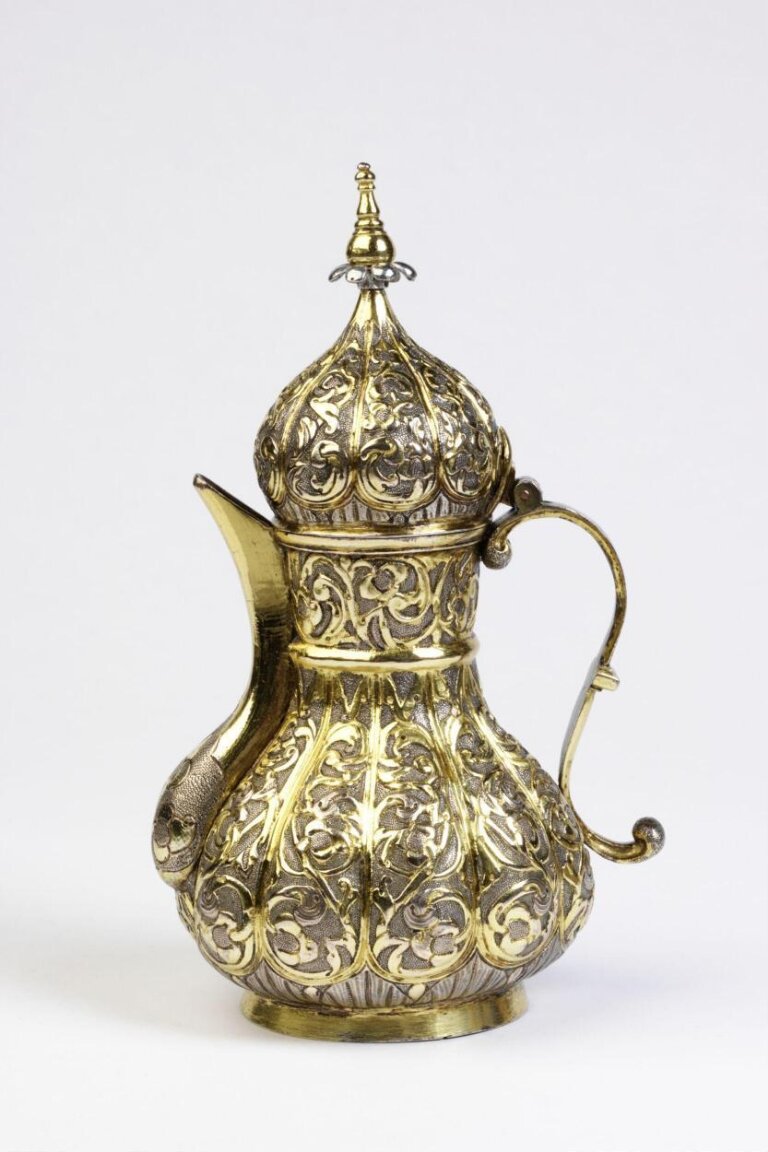
No fifteenth-century house survives; the institution itself is the survival — the Ottoman-era coffee culture of Istanbul's old quarters, the qahveh khaneh tradition of Iran, and the unbroken café line of Cairo's own houses. Objects of the ritual — Ottoman dallah pots and Kütahya finjans, like the ones pictured in this record — are the material witnesses 2.
In culture
The coffeehouse has always been suspect and beloved: attacked by preachers as a rival to the mosque, celebrated by poets as the 'school of the wise', painted by Gérôme and others as the emblem of the eastern city 2.
For young readers
Imagine a room where anyone can sit all day for the price of one cup, play chess, listen to stories and hear the news from travellers — no phones, no newspapers. People invented that room five hundred years ago in Mecca, and every café in the world is its great-great-grandchild.
References
- William H. Ukers, All About Coffee (1922), historical chapters on Mecca's kaveh kanes, the persecutions, and the 1554 Tahtakale houses, pp. 16-20 2.
- Encyclopaedia of Islam, 2nd ed., vol. IV, KAHWA, printed pp. 449-455 3.
- Ralph S. Hattox, Coffee and Coffeehouses: The Origins of a Social Beverage in the Medieval Near East (1985) — bibliographic record 4.
Connections
People and things also explored
Coffee in Yemen: the Sufis' drink and the birth of the Mokha trade· Ali ibn Umar al-Shadhili· Muhammad ibn Sa'id al-Dhabhani· Cairo· Istanbul· Ottoman Empire· Abd al-Qadir ibn Muhammad al-Jaziri· Souq Waqif
Sources
- Ukers, All About Coffee (1922) , pp. 16-20; encyclopaedia-of-islam-2 vol. IV pp. 449-455 KAHWA
- Ukers, All About Coffee (1922)
- Encyclopaedia of Islam, 2nd edition (Leiden: Brill, 1954–2008), 13 volumes
- Hattox, Coffee and Coffeehouses (1985)
Cite this page
islam.museum contributors. “The coffeehouse as a new social institution”. islam.museum, https://islam.museum/en/invention/coffeehouse-yemen/. CC BY-SA 4.0. Last updated 2026-11-15.
Improve this page on GitHub · Report an error · Help complete it · JSON