

At a glance
- Era
- The Buyid, Fatimid and Seljuk Era · The Mongol and Post-Mongol Era
- Region
- Persia & Central Asia · Egypt & Nile
Engineering and technologyTrade and finance
Quick facts
- Domain
- Materials and industry
- Kind
- Material
- First attested
- c. 1100 CE · c. 494 AH
- Era
- Middle period
- Where
- Kashan
- Attribution
- Improvement
Who made it
- Abu al-Qasim al-Kashani Describer
The claim and its basis
A documented Islamic craft composite that re-discovered an older technique — glazed composite pastes of Pharaonic and Roman Egypt — and made the ceramic body that carried the greatest Islamic pottery; the precise origin — Iraq, Egypt or Iran — is contested in the scholarship.
Lane: the 1301-described paste (10 quartz : 1 frit : 1 clay) fused body and glaze inseparably and removed the need for slip, and the technique 'completely revolutionized' twelfth-century fine pottery — in his judgement a re-discovery of an old Egyptian craft dormant since the ninth century.
Sources: Arthur Lane, Early Islamic Pottery: Mesopotamia, Egypt and Persia, London: Faber and Faber, 1947 · Encyclopaedia of Islam, 2nd edition (Leiden: Brill, 1954–2008), 13 volumes
Before it
- The composite pastes of ancient Egypt
- Chinese porcelain as the admired model
- Abbasid polychrome and lustre pottery
Built on it
- Lustre and minai wares
- Later European soft-paste porcelain
How it works
Summary
Islamic potters built a ceramic body that nature does not provide: powdered quartz bound with glass frit and a little white clay. The result — hard, white, fused to its glaze — carried the lustre dishes and minai bowls that are the glory of medieval Islamic pottery. The recipe survives in a potter's treatise of 1301; the date and place of the first invention are honestly debated 1.
What it is
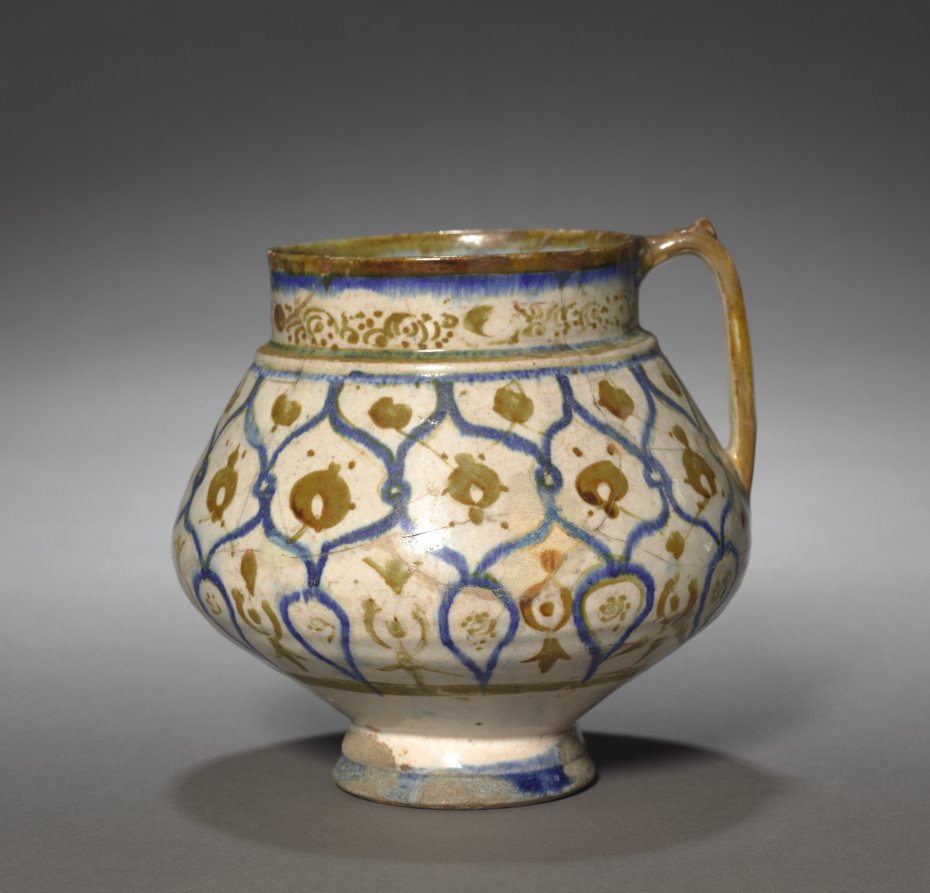
Fritware, or stonepaste: a manufactured paste of about ten parts ground quartz, one part glass frit and one part white clay — the formula Abu'l-Qasim al-Kashani records for the Seljuq potters — fired into a white body the alkaline glaze could not flake off 1.
The world before it
The story
Admiring the thin, ringing translucency of Chinese porcelain, the potters of the Islamic world — Lane gives Persia the probable credit, in the workshops of Rayy and Kashan — rebuilt a white porcelain-like body without kaolin, from local quartz and glass. From Seljuq times the technique spread everywhere and, in Lane's words, completely revolutionised fine Islamic pottery 1.
The maker(s)
The makers are the unnamed potter families — among them Kashan's Abu Tahir line, whose Abu'l-Qasim wrote the craft's surviving recipe in 1301. A craft transmitted through workshops, not a named inventor 1.
How it works
Quartz pebbles are powdered and melted with potash to make a glass frit; the frit is ground and mixed with more quartz and a little white clay into a paste. Body and glaze share the same substances, so in the kiln they fuse into one material — white, hard, sometimes translucent, needing no slip 1.
The spread
What it was built on
Ancient Egyptian composite pastes, dormant since the ninth century; the Abbasid tin-glaze and lustre tradition; and the admired model of Chinese Ting and ying-ching porcelain, which the white body imitated without copying its material 1.
What was built on it
Kashan lustre and tilework, minai polychrome, the pierced 'window' bowls, Iznik and the later glazed traditions of the Islamic world — and, structurally, Europe's eighteenth-century soft-paste porcelains, built of the same three ingredients 1.
Impact on daily life
It put a white, durable, colour-carrying tableware into the houses of the Islamic world and a tile skin onto its architecture — the material of the mihrab revetments still visible at Kashan and elsewhere 2.
How it changed history
It made Islamic pottery a match for porcelain on its own terms — an engineered material rather than a borrowed one — and gave the craft its two greatest schools of painted ware 1.
Who invented it?
Today
Fritware fills the Islamic galleries of the world's museums, and the composite-body idea survives wherever potters build a white vitreous body — the craft's modern descendants are everywhere ceramics are engineered 1.
Surviving examples
In culture
The white body became the canvas of Islamic ceramic art — lustre gold, minai enamel, cobalt and black under clear glaze — and its tilework gave mosques their coloured skin 2.
For young readers
Potters long ago wanted cups as white and fine as Chinese porcelain, but they did not have the special clay. So they made their own white clay from ground-up sand, melted glass and a little real clay — like a recipe. Their pots came out so white and strong that painters could cover them in shiny gold colours, and you can still see those pots in museums today.
References
Connections
- Described by
- Abu al-Qasim al-Kashani
People and things also explored
Lustre-painted pottery under Muslim potters· Kashan· Abu al-Qasim al-Kashani· Glassmaking in the early Islamic world· Islamic Glass in the Making· Al-Madina Souq, Aleppo· Bazaar of Tabriz· Khan el-Khalili
Sources
- Arthur Lane, Early Islamic Pottery: Mesopotamia, Egypt and Persia, London: Faber and Faber, 1947
- Encyclopaedia of Islam, 2nd edition (Leiden: Brill, 1954–2008), 13 volumes
Cite this page
islam.museum contributors. “Fritware (stonepaste): the composite ceramic body of Islamic pottery”. islam.museum, https://islam.museum/en/invention/fritware-stonepaste/. CC BY-SA 4.0. Last updated 2026-11-15.
Improve this page on GitHub · Report an error · Help complete it · JSON