

At a glance
- Region
- al-Andalus & Europe
Images
Quick facts
- Domain
- Medicine and surgery
- Kind
- Technique
- First attested
- c. 1000 CE · 390 AH
- Era
- Abbasid age
- Where
- Cordoba
- Attribution
- Improvement
Who made it
- Abu al-Qasim al-Zahrawi Describer
The claim and its basis
A described suture-material contribution within an older tradition, not invention of suturing from nothing or established worldwide priority.
Page211 names intestinal filaments and experimental status; Majeed credits catgut among al-Zahrawi's technologies without a comprehensive priority study.
Sources: Al-Zahrawi's surgery — Leclerc1861 translation · How Islam changed medicine — Azeem Majeed2005 · ZEHRÂVÎ — TDV İslâm Ansiklopedisi · et-TASRÎF — TDV İslâm Ansiklopedisi · Alzahrawi's stone extraction — Abdel-Halim et al. · Catgut material photograph — Commons
Before it
- Wound-suturing tradition attributed in the chapter to Galen
How it works
Summary
Abu al-Qasim al-Zahrawi describes animal-intestinal filaments in a discussion of intestinal suturing in the surgical book of al-Tasrif. Leclerc's French translation preserves an important qualification: this approach and the neighbouring ant-closure account remain experimental 1. Azeem Majeed includes catgut sutures among his surgical developments; this page concerns that specific material contribution, not invention of all suturing or certification of a modern treatment 2.
What it is
The described material consists of thin filaments from animal intestines, used in the passage as a means of joining an internal wound; it is not a named brand or modern laboratory specification 1. “Animal-intestinal thread” keeps the description close to the passage, while catgut is the name used in modern historical writing; neither name by itself identifies a particular animal species 1 2. Material and instrument are different subjects: this record is not about al-Zahrawi's stone drill.
The world before it
The same chapter presents inherited wound-suturing knowledge and explicitly draws on Galen, discussing tissues and circumstances rather than offering one thread for every injury 3. Bringing wound edges together therefore did not begin with al-Zahrawi: he discusses an existing tradition and adds to its material account 4. This does not establish that Galen used the identical intestinal filament. The documented precursor is suturing practice, not proof of material identity.
The story
The translated pages contain different voices: the author's wound classification and suture categories, an individual injury with his fears and reported outcome, and the translator's footnote invoking a later writer 5. Classification is not a case series; a feared complication is not a confirmed diagnosis, and one patient's return to ordinary life is not a general success rate 6. Separating expectation, outcome and later commentary preserves historical observation without extracting a clinical protocol.
The whole chapter broadens the material's context: Leclerc's translation classifies abdominal wounds as large, small and medium, and reports the author's preference for medium wounds in part of his discussion of protruding intestines 7. This is a historical judgment, not present-day triage guidance; classification precedes the thread passage, and a material name does not replace the chapter's other questions.
The text distinguishes four abdominal suturing patterns, two shared with other wounds and two specific to the abdomen 8. Some knowledge crosses surgical chapters while some concerns a particular location; not every internal-wound discussion proposes intestinal thread 9. This page preserves the distinction between classifying closure methods and choosing material, without teaching their performance.
Page210 distinguishes intestine from omentum, relating the latter's discussion to tissue condition and bleeding risk; it also records the author's pessimistic prognosis for jejunal wounds, explained through his description of vessels and thin walls 10. These are historical anatomy and expectations, not diagnosis of a current patient: the author did not regard all abdominal tissues as repairable in the same way. A later mention of thread consequently cannot guarantee treatment results 11.
A first-person case concerns a man wounded in the abdomen whose wound discharged fecal matter and gas; the author did not expect recovery but reports healing and return to eating, drinking, bathing and normal movement 11. It neither compares suture materials nor explicitly attributes recovery to the displayed thread: it is an individual clinical narrative about a changing expectation, not a controlled experiment or calculated success rate 11. Personal experience and a proposed material are different kinds of evidence.
The passage belongs to chapter 87, following an extended discussion of abdominal wounds and treatment limits, not a separate inventor's card or celebratory discovery anecdote 12. On page 211 the filament description follows an account attributed to physicians of the empirical school involving ants; an experimental qualification then applies to both approaches 1.
That arrangement matters: the text compares alternatives while marking limits to what has been established. Not everything preserved in a medical encyclopaedia is a settled result 1. TDV places completion of al-Tasrif around 390 AH/1000. This approximately dates the book, not a first operation, invention year or photographed specimen 13.
The maker(s)
Al-Zahrawi was an Andalusian physician associated with Cordoba, author of a30-book medical encyclopaedia, not only a surgical manual; his biography distinguishes broad fame from sparse early personal testimony 14 13. Abdel-Halim and colleagues explicitly call him a Muslim surgeon: that is the identity basis, not an inference from name or ancestry 15. Sunni is the museum's declared frame, not proof of personal legal-school allegiance. The recorded contribution here is a describer's, not a modern patent holder's.
How it works
The general idea is that the material joining tissue matters as well as an instrument's shape: the passage places animal-derived filament in an internal-suturing context 1. This explains function, not procedure. The museum does not reproduce preparation, needle use or injury-treatment steps.
The passage is not an experiment measuring absorption time, sterility or tensile strength, and does not specify the behaviour of every modern medical product with a similar name 1. Its explicit experimental qualification belongs to the evidence; it should not disappear to make the achievement sound more triumphant 1.
The spread
TDV records Gerard of Cremona's Latin surgical translation and later editions and translations including Channing1778, Leclerc1861 and Spink/Lewis1973, distinguishing these from transmission of other encyclopaedia sections 13. The French edition is the witness read here, not a claim to have collated every Arabic or Latin copy 16. These are routes of textual circulation, not counts of surgeons using this filament or a map of its manufacturers.
What it was built on
The chapter's explicit inheritance is wound-suturing knowledge and discussion attributed to Galen, followed by an animal-derived material in a particular context 4. The teaching diagram connects that inheritance only to this description. It does not arbitrarily link the urinary drill or another browser invention. Innovation can be read within existing knowledge without erasing predecessors.
What was built on it
Leclerc's footnote on page 211 reports Guy de Chauliac's rejection of the ant method 17. This later surgeon's judgment is known here through the translator, not independent reading of his original; it concerns ants, not testing intestinal thread 17. Adjacent alternatives therefore cannot automatically share one endorsement or rejection.
Several voices coexist: the author classifies, relates experience and cites others; the translator adds a note; modern historians summarize the thread as catgut 18 19. They are not independent examinations of every Arabic witness. Each provides a different kind of evidence without making the French edition an original Andalusian manuscript or a medical summary a material analysis 16.
Majeed's BMJ editorial includes catgut sutures in al-Zahrawi's surgical contributions and discusses the European educational reception of al-Tasrif 2. The summary does not supply an industrial pedigree for every later thread, or make a shared material name prove a particular product's descent. No specific technical dependent is recorded without evidence. Continued historical recognition differs from an established, uninterrupted chain of practice.
Impact on daily life
The surgical discussion connects material choice to an injured person's wound and prospects for healing: the thread is not an ornament detached from suffering 20. But this passage provides no documented patient series comparing outcomes or success rate that the museum can responsibly display as a number 1. Its established contribution is preserving a material idea in treatment literature, not a retrospective calculation of lives saved.
How it changed history
Al-Tasrif preserved the material account in a surgical book with a long translation and teaching history; modern medical writing credits it among the author's developments 13 2. Leclerc's page also preserves the experimental caveat, revealing medical writing as transmission, comparison and acknowledgement of limits rather than a list of completed discoveries 1. This textual contribution is clearer than a slogan assigning him all absorbable sutures.
Who invented it?
The account is documented under al-Zahrawi's name and Majeed credits the contribution; neither requires a claim to the first suture in history, since the chapter explicitly presents inherited practice 4 2. The record uses “improvement” and “describer”. Reading an actual passage differs from establishing worldwide priority through comparisons these sources do not provide. No first-operation place, day or patient is established here.
Today
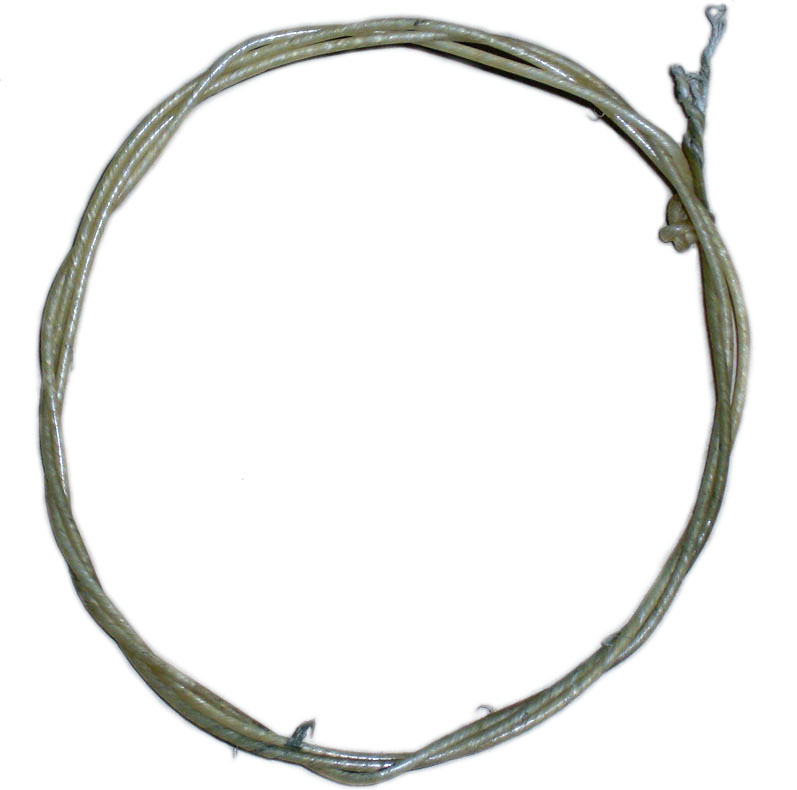
The published translation makes it possible to read the witness alongside a modern medical-history summary 1 2. The photograph shows a loop of modern material on white: its description does not certify a sterile surgical product or medical suitability 21. Visual resemblance is not permission to treat someone. The museum does not recommend thread outside professional medical care.
Surviving examples
The specific witness is a French edition dated June1861 on its title page, containing printed page 211; title and passage were checked against scan images 16. No thread surviving from al-Zahrawi's lifetime or author autograph is presented. Dogmonster published the licensed photograph, and Hohum later removed its background. This explicitly modern material comparison is not an archaeological surgical specimen 22.
In culture
Majeed places al-Zahrawi in a broader reminder of Islamic civilization's contributions to European medicine, a modern act of scientific remembrance 2. Alongside that memory, the translated text's experimental qualification preserves the book's voice and limits 1. Respecting a contribution does not require making every description a universal first or every illustration an original object.
For young readers
A new idea may concern what something is made from, not only its shape. Al-Zahrawi wrote about animal-derived thread in a suturing discussion, with an experimental caveat 1. Ask what the writer described and what he established. We learn through a book and picture, never by trying to sew a person's or animal's body. The photograph helps explain a material, not make a home treatment or reenact an old operation.
References
- Leclerc's1861 French translation, chapter 87, especially 207–211; not an independent collation of Arabic. 23
- Azeem Majeed, BMJ331(7531),2005,1486–1487: historical editorial, not a global-priority study. 2
- Esin Kahya's TDV entries: biography, work structure, chronology and translation history. 14 13
- Abdel-Halim and colleagues 2003,1283: named Muslim classification, not the filament evidence used here. 15
- Commons, Catgut.jpg: description, upload history and public-domain dedication. 24
Connections
- Described by
- Abu al-Qasim al-Zahrawi
People and things also explored
Al-Zahrawi's differentiated dental scrapers· Al-Zahrawi's urethral-stone drill· Cordoba· Abu al-Qasim al-Zahrawi
Sources
- Al-Zahrawi's surgery — Leclerc1861 translation , ch.87 p.211
- How Islam changed medicine — Azeem Majeed2005 , pp.1486–1487
- Al-Zahrawi's surgery — Leclerc1861 translation , ch.87 pp.207–208
- Al-Zahrawi's surgery — Leclerc1861 translation , ch.87 pp.207–211
- Al-Zahrawi's surgery — Leclerc1861 translation , pp.202–211
- Al-Zahrawi's surgery — Leclerc1861 translation , pp.202–210
- Al-Zahrawi's surgery — Leclerc1861 translation , ch.87 pp.202–204
- Al-Zahrawi's surgery — Leclerc1861 translation , ch.87 p.203
- Al-Zahrawi's surgery — Leclerc1861 translation , ch.87 pp.203,211
- Al-Zahrawi's surgery — Leclerc1861 translation , ch.87 p.210
- Al-Zahrawi's surgery — Leclerc1861 translation , ch.87 pp.210–211
- Al-Zahrawi's surgery — Leclerc1861 translation , ch.87 pp.202–203,207–211
- et-TASRÎF — TDV İslâm Ansiklopedisi , pp.132–133
- ZEHRÂVÎ — TDV İslâm Ansiklopedisi , pp.189–191
- Alzahrawi's stone extraction — Abdel-Halim et al. , p.1283
- Al-Zahrawi's surgery — Leclerc1861 translation , title and ch.87 p.211
- Al-Zahrawi's surgery — Leclerc1861 translation , ch.87 p.211 footnote
- Al-Zahrawi's surgery — Leclerc1861 translation , ch.87 pp.202–211
- How Islam changed medicine — Azeem Majeed2005 , medicine discussion
- Al-Zahrawi's surgery — Leclerc1861 translation , ch.87 pp.202–203,211
- Catgut material photograph — Commons , description and image
- Catgut material photograph — Commons , upload history
- Al-Zahrawi's surgery — Leclerc1861 translation , title and ch.87 pp.207–211
- Catgut material photograph — Commons , description and upload history
Cite this page
islam.museum contributors. “Al-Zahrawi's intestinal-filament suturing account”. islam.museum, https://islam.museum/en/invention/zahrawi-intestinal-suture/. CC BY-SA 4.0. Last updated 2026-11-14.
Improve this page on GitHub · Report an error · Help complete it · JSON