

At a glance
- Region
- al-Andalus & Europe
Images
Quick facts
- Domain
- Water, irrigation and agriculture
- Kind
- Method
- First attested
- c. 1000 (approx.) CE
- Era
- Middle period
- Where
- Toledo
- Described in
- Al-Qasd wa-l-bayan
- Attribution
- Improvement
Who made it
- Ibn Bassal Describer
The claim and its basis
Practical organization within older traditions, not invention of farming or all soil classification.
Text relates land type to water, season and crop and stresses surface/subsurface inspection and repeated experience.
Sources: Ibn Bassal — Qasd wa-l-bayan, revised online Arabic · Filaha Texts Project — Ibn Bassal biography and synopsis · Ahmet Ozel — Ibn Bassal, TDV · Commons — USDA soil-profile teaching graphic
Before it
- Earlier farming practice and Ibn Wafid's Toledo milieu
How it works
Summary
Ibn Bassal does not treat garden land as a uniform substance needing the same water and work in every season. In Al-Qasd wa-l-bayan, he distinguishes four water sources and ten practical land types, relating observed properties to season, plants and cultivation. The contribution is this network of relationships, not invention of farming or the first recognition that soils differ. Observations about water, air and changing surfaces coexist with the older language of hot, cold, moist and dry natures 1.
This is a historical way of organizing agricultural decisions. Its ten categories are not a modern laboratory standard, nor are the water names a table of chemical analyses. Its value lies in specifying the question: which land, which water, which season and which plant?
What it is
The method connects classification to practice. Land description leads into discussions of suitable water, season, crops and work. The author does not merely declare land “good” or “bad.” His soil chapter warns that the surface can differ from what lies beneath, and that judgment requires examination and repeated practical experience. This is explicit in the read text, not a modern phrase projected onto it 2.
The categories nevertheless mix criteria: colour, texture, location and a condition arising from previous cultivation. They are not converted here into a taxonomy using uniform modern measurements, or a scheme in which every soil worldwide must occupy one exclusive box.
The world before it
Ibn Bassal worked within established farming traditions, in a Toledo setting that included Ibn Wafid and al-Mamun's garden. Ozel describes his association with Ibn Wafid and work in the garden. The story does not begin with a garden without gardeners or a country unfamiliar with planting until one author appeared 3.
The Filaha Texts Project notes that his book does not cite earlier agronomic writers and reads this as evidence of personal experience's prominence. But failure to name an earlier book does not prove absence of inherited knowledge or the contribution of surrounding workers. A mode of authorship and the source of every practice are different questions. Neither a short reference list nor its absence reconstructs an entire history 4.
The story
The author is Abu Abd Allah Muhammad ibn Ibrahim ibn Bassal, associated with Toledo and then Seville. Ozel connects the larger Diwan al-filaha with al-Mamun's Toledan court and uses the ruler's1075 death to place its composition earlier. This is a bound for the compendium, not a discovery day for each observation or a certain date for the abridgement read today 5.
Both sources distinguish the larger work from Al-Qasd wa-l-bayan. Their relocation chronology differs: Ozel places the move after Toledo's1085 fall, whereas the project says before it. We retain the discrepancy rather than assemble a dated itinerary from accounts disagreeing about the same event 3 4.
In Seville, the accounts connect him with a garden for al-Mutamid and a community of agronomists. This is a setting for work, teaching and exchange, not measured yields for each field or proof that every farm implemented every recommendation 3.
The maker(s)
Ibn Bassal is recorded as describer of an improved practical method within an older tradition. These witnesses do not name everyone tending gardens, transmitting knowledge or copying the book. The role attributes known work; it does not erase unnamed workers from the history 3.
Sunni frame: The individual Muslim basis is a biographical report of pilgrimage to the Hijaz/Mecca, attributed to the Anonymous Botanist of Seville, not his name or the epithet “pilgrim” alone. Sunni is separately the museum's declared frame for the documented Andalusian milieu, with no contrary personal tradition in the biographies read; it is not a certificate of a personal legal school 6.
Academic reading: Ozel says life dates are unknown, while the project offers broad approximations. These are not turned into fixed birth/death years, nor is certainty extracted from employment at a datable court 7 4.
How it works
The water chapter distinguishes rain, rivers, springs and wells, then discusses their relations to plants, surface residues and seasonal effects. These descriptions belong to an older account of nature and suitability, not electrical-conductivity readings or chemical analyses performed on the text 8.
The Arabic does not give all river water a single character. It describes variation in dryness, moisture, roughness and softness. We therefore do not reproduce the English synopsis's simplifying description of river water as universally dry and sour. Direct reading preserves a difference lost in a one-water-fits-all account 8 9.
The ten land descriptions concern soft, heavy, mountain and sandy land; black, manured, burnt-surfaced land; white, yellow and red land; rough/stony land; and reddish mukaddana. The compound black-land description is one category, not three additions to the ten. Names are followed by observations about openings, cracking, water movement and suitable plants 2.
Soft land, for example, is described through open pores admitting air and water; heavy land through changing behaviour in heat and rain. “Heavy” does not simply mean useless. Colour alone is insufficient too: assessment varies with the subsurface, season, work and the land's history 2.
The spread
Ozel describes later agronomists' quotations and reports273 references to Ibn Bassal in Ibn al-Awwam. This is the reference's count, not our own manuscript tally. Some quotations are absent from the available abridgement, a reason to distinguish what a later reader knew of the larger work from what survives in this shorter witness 10.
The biography also reports a thirteenth-century Castilian translation, not automatically a Latin one. A book's travel does not establish implementation of every passage or descent of every later European agricultural classification. A named quotation remains stronger evidence than a general spread story identifying neither text nor reader 4.
What it was built on
The method belongs to observation of gardens with diverse plants and water sources, and the travel and exchange reported in the biography. That account attributes Egyptian, Syrian and Sicilian observations to Ibn Bassal during pilgrimage, but we do not construct a certain itinerary from every place mentioned only as a possibility 6.
The explanation employs natures and temperaments to understand plants and land. These deserve to be seen beside observation, not erased to make the book resemble a modern textbook. Calling soil hot is not automatically a thermometer reading; calling it rich or fatty is not a specific analysis of organic matter or a nutrient 1.
What was built on it
The contents place water and land before planting, grafting, vegetables and flowers. Sixteen chapters let a reader connect a plant discussion with questions about site, water and cultivation. Our reading covers the contents, two complete chapters and the opening of chapter10, not every chapter or fruit description 11.
The project identifies a transmission gap: cereals occur in headings, but the witnesses discussed lack an expected treatment of all principal cereals, and part of the Castilian text is missing. We do not fill omissions from a later book and attribute the result to this abridgement. Later quotations remain evidence needing their own examination 12.
Impact on daily life
This writing addresses a recurring practical question: why does a plant respond differently in different ground? Distinguishing land, water and season organizes the question instead of merely labelling a site bad. That is a value in organizing knowledge visible in the text, not a documented percentage increase in farmers' income 1.
The number of categories cannot measure economic benefit. Four water names do not mean four drinking-safety grades; ten land categories are not quality scores from one to ten. Benefits and problems depend on plants and work. An easy numerical ranking would replace, rather than explain, the author's relationships.
How it changed history
The contribution presents farming as action, description, distinction and teaching together. Later quotations show that garden knowledge could travel in writing as well as by direct demonstration. But one famous book cannot measure a region's output or establish its author as the cause of every agricultural change 10 4.
The change supported here is bounded: arranging related observations so another reader can reason with them. No “father of modern soil science” title is needed, and earlier farming need not disappear to make his presence visible. This record lacks evidence for deriving every modern classification from his work.
Who invented it?
The attribution is Ibn Bassal's practical organization within earlier husbandry. “Describer” does not deny his experience; it fits the available evidence, a text explaining observations and relationships rather than minutes of humanity's first experiment. The project's assessment of originality is attributed to its reading, not independent proof that he learned from nobody 4 1.
Nor is this reduced to invention of drip irrigation or grafting, different claims requiring sources, technical definition and predecessors. The record concerns one linked method. It does not turn each land type or chapter into another invention.
Today
The text helps us read the history of questions connecting land, water and plants, not adopt an old fertilizer prescription or endorse every explanation of natures. It is not a current laboratory standard. Historical observation, its explanatory vocabulary and what today's reader could investigate with other tools remain distinct 1.
We reproduce no waste quantities or handling instructions, and invite no child to taste unknown water or collect hazardous samples. Paper questions suffice: what is given, what is observed, and which conclusion exceeds the available information?
Surviving examples
The direct witness is the Filaha project's Arabic text, revised from Millas Vallicrosa and Muhammad Aziman's Tetuan1955 edition. It is not a manuscript image or our own collation of every witness. The contents show37–38; visible markers in the read chapters include40 and42–48. We cite a chapter where a page number is not itself rendered, rather than infer one from expected sequence 11.
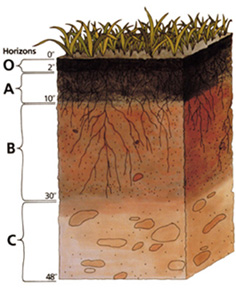
The image is a modern USDA teaching drawing,236×288, showing O/A/B/C vertical horizons and approximate inch depths. It is neither a photograph nor Ibn Bassal's figure, and these horizons are not his ten classes. Commons declares public domain;2004 is upload date, not creation of a drawing whose individual artist is unknown 13.
In culture
Water and land reveal scientific history beyond the spectacular machine. This book's knowledge appears in differences between soils, seasons and plants, and the challenge of expressing working experience for another reader. The account stays tied to text and documented reception, not an imagined scene presented as the author's actual garden 1 10.
The abridgement's title recalls that what reaches us is not necessarily everything its author wrote. Abridgement, translation, copying and quotation produce different witnesses. An attractive illustration cannot close a textual gap or establish an unknown life date 4.
For young readers
Put “rain,” “river,” “spring” and “well” on four paper cards. Add another: “What do we know about the land?” Do not test water or handle wastes: this is a paper-question game. Consider why a source name alone cannot determine what suits every plant.
Then draw a surface with an empty space beneath it. Do we know whether the ground below resembles the top? Ibn Bassal points out that difference and the need for repeated examination. Not knowing is not failure; it identifies a question the card has not answered yet 2.
References
- Ibn Bassal, Al-Qasd wa-l-bayan, revised online Arabic: contents, complete chapters1–2 and chapter10 opening only, not a complete manuscript reading 11.
- Filaha Texts Project, biography/read chapter synopses; pilgrimage, abridgement and transmission limits attributed 14.
- Ahmet Ozel, TDV2020 revised EK-1,587–589; actual article/metadata, not all referenced works 15.
- Commons, actual USDA drawing description, rights and upload history 13.
Connections
- Described by
- Ibn Bassal· Al-Qasd wa-l-bayan
People and things also explored
Sources
- Ibn Bassal — Qasd wa-l-bayan, revised online Arabic , chs.1–2
- Ibn Bassal — Qasd wa-l-bayan, revised online Arabic , ch.2
- Ahmet Ozel — Ibn Bassal, TDV , biography
- Filaha Texts Project — Ibn Bassal biography and synopsis , biography
- Ahmet Ozel — Ibn Bassal, TDV , work
- Filaha Texts Project — Ibn Bassal biography and synopsis , biography-and-ch.10-synopsis
- Ahmet Ozel — Ibn Bassal, TDV , opening
- Ibn Bassal — Qasd wa-l-bayan, revised online Arabic , ch.1
- Filaha Texts Project — Ibn Bassal biography and synopsis , ch.1-synopsis
- Ahmet Ozel — Ibn Bassal, TDV , reception
- Ibn Bassal — Qasd wa-l-bayan, revised online Arabic , contents-chs.1–2
- Filaha Texts Project — Ibn Bassal biography and synopsis , biography-and-chs.10–12-synopsis
- Commons — USDA soil-profile teaching graphic , description-and-history
- Filaha Texts Project — Ibn Bassal biography and synopsis , biography-and-synopsis
- Ahmet Ozel — Ibn Bassal, TDV , biography-and-work
Cite this page
islam.museum contributors. “Ibn Bassal's linked soil, water and crop assessment”. islam.museum, https://islam.museum/en/invention/ibn-bassal-soil-water-matching/. CC BY-SA 4.0. Last updated 2026-11-06.
Improve this page on GitHub · Report an error · Help complete it · JSON