

At a glance
- Era
- The Crusades, Ayyubids and Mamluks
- Region
- al-Andalus & Europe · Egypt & Nile
Quick facts
- Domain
- Pharmacy, chemistry and distillation
- Kind
- Method
- First attested
- c. 1200 (approx.) CE
- Era
- Middle period
- Where
- Misr (Egypt)
- Described in
- al-Mufradat fi'l-Adwiya wal-Aghdhiya
- Attribution
- Improvement
Who made it
- Ibn al-Baytar Improver
The claim and its basis
Critical improvement in assembling, naming and comparing simples, not origin of every drug.
Kaya describes source/name criticism and a verification policy; Iranica details synonym counts and Persian-name limitations.
Sources: Ibn al-Baytar — Mahmut Kaya · al-Mufradat — Mahmut Kaya · Ibn al-Baytar and Persian elements — Iranica · Kohler rosemary plate metadata
Before it
- Dioscorides, Galen, al-Razi, Ibn Sina, al-Ghafiqi and local knowledge
How it works
Summary
One plant can have several names; one name can denote different things. In his Compendium of Simples, Ibn al-Baytar assembled earlier authors' descriptions, circulating names and his experience in an alphabetical reference, criticizing what he considered mistaken identification or transmission. This was a comparative improvement within older traditions, not invention of botany or pharmacy from nothing 2.
Our record concerns organizing and criticizing knowledge, not discovering every substance or establishing its medical suitability today. The book includes animal and mineral materials as well as plants, and its total includes synonym entries. Fame must not turn into thousands of personally discovered species or historical remedies into recommendations from the museum 3.
What it is
A “simple” is a single medicinal material in this tradition, rather than a compound remedy; it is not necessarily a chemically pure substance in the modern sense. Kaya describes an alphabetical book comparing materials' names and medical and natural-historical accounts. Iranica distinguishes about 1,422 substantive simples from 931 short synonym entries: not 2,353 independent plant species 4 5.
A reader could approach through a familiar name and reach a material bearing another name without treating these as two discoveries. One substantive entry might contain several attributed voices. Quoting an earlier scholar does not transfer authorship of that scholar's observation to Ibn al-Baytar, nor does gathering statements make them mutually consistent or equally reliable 6.
The world before it
Dioscorides, Galen, al-Razi and Ibn Sina belonged to a large pre-existing literature. Kaya emphasizes the first two among the compendium's sources. Iranica also traces Persian authors and scholars associated with the medical tradition of Gondeshapur. The inherited material was not exclusively Muslim; non-Muslim authors and translators cannot disappear from its history 7 8.
Local names and habitats also mattered. Kaya describes Ibn al-Baytar learning Andalusian plants, their properties, locations and names with Abu al-Abbas al-Nabati. The contribution was not merely importing Greek names into Arabic: written and local knowledge were brought into a space where accounts could be compared and corrected while their different origins remained visible 9.
The story
He grew up in Malaga, worked in Seville's scholarly environment and read earlier books of simples. Kaya lists several proposed birth years; we do not choose one because it became popular. He describes departure in 617 AH and arrival in Anatolia in 620 AH after North African travels. These are source-reported dates, not newly calculated calendar conversions 10.
He later served in the Ayyubid environment of Egypt and Syria, becoming chief herbalist under al-Kamil and retaining his position under al-Salih. Kaya dates the Jami's composition to 1242–1248; our record uses the thirteenth century, not a supposed exact invention day. Some extended itineraries were Leclerc's inference from plant names, not an independently read travel diary 11 12.
The maker(s)
His role here is improver and comparative author. The Muslim identity basis is not his name or birthplace: Kaya documents his individual religious and transmitted-science education before botany. The Sunni frame is recorded separately as the museum's default in the documented Ayyubid milieu, not a personal legal-school certificate or an inference from a ruler's religion 13.
The existing person record retains its earlier Shadharat al-Dhahab attribution and authorial history. Another longer-named biography already has a possible-identity connection. We have neither deleted it nor silently consolidated identifiers. This contribution uses the existing work-linked person; leaving consolidation outside this batch does not establish that these were two different scholars.
How it works
Ask what a material is before asking what benefits are attributed to it. A transmitted name may change language, pronunciation or spelling. Kaya describes names in several languages and vocalization intended to reduce confusion. Iranica describes Persian words becoming Arabicized and sometimes suffering further distortion by copyists 14 15.
Description and attribution accompany the name. The Jami often begins substantive accounts with suitable passages from Dioscorides and Galen when available. Distinguishing another author's statement from the compiler's addition lets a reader follow layers of knowledge rather than an anonymous collective voice. This arrangement alone does not prove each conclusion correct 16.
Comparison and correction follow. Kaya reports the preface's declared policy of naming sources, rejecting unreliable material and verifying through observation and experience. This is Kaya's report of the author's aims: we have not read the original preface or repeated historical tests. It does not show that every entry received an independent test, still less a modern controlled clinical trial 17.
For teaching only, imagine two paper cards for a fictional object. One says “narrow leaf”; the other says “narrow leaf with a different edge.” Do not merge them because the ink is the same colour. Keep name, description and source separate and mark the disagreement. This is our modern example, not a translated Jami entry or a procedure for identifying something safe to eat.
Error remains possible. Iranica challenges an earlier overestimate of Ibn al-Baytar's Persian proficiency: some compounds received plausible explanations, while other names' origins or meanings were misunderstood. A verification ideal and actual linguistic limitations coexist. Explaining the method need not hide those limits, and recognizing them need not erase the entire book 18.
The spread
Kaya describes copies, abridgements and translations into Turkish and European languages, including Sontheimer's German translation and Leclerc's three-volume French translation published in 1877–1883. Translation and abridgement are not necessarily transparent transfer: selection, order and wording can change 19.
Some early translation attributions are tentative in the source. We retain that qualification rather than making a certain, dated diffusion chain. Nor do we put every named library on a map as if we had tracked a manuscript's complete journey. Its present repository need not be its place of production or historical readership 20.
What it was built on
Comparison rested on accumulated description, language and knowledge of place. Iranica describes over 150 sources alongside the compiler's observations, detailing al-Razi, Ibn Sina, al-Dinawari and others. A source count is not an experiment count or a plant count. Repeated quotations from one author cannot be added to substantive entries to inflate discoveries 21.
Teaching mattered too. Kaya describes Ibn Abi Usaybia studying Ibn al-Baytar's work and predecessors' books with him in Damascus. This was neither a library reader isolated from fields and teachers nor a collector isolated from books. That connection does not establish identical verification for every account, specimen or journey 22.
What was built on it
The read sources document copying, abridgement, translation and study. Kaya presents the Jami as an important reference for Muslim physicians and pharmacists, followed by selections and adaptations. These are relationships in a particular book's reception, not proof that every later pharmaceutical school descended from it or retained every substance unchanged 23.
Other works by the same author are distinct. The Mughni has twenty organ-arranged chapters; the Dioscorides commentary has another structure; the Ibana criticizes Ibn Jazla's book. They are not automatically additional inventions here. Sharing an author does not let us transfer one work's structure, entry count or manuscript date to another 24.
Impact on daily life
Where names and provenances differed, a comparative reference offered a place to consult accounts together. Kaya emphasizes multilingual, vocalized naming, while Iranica explains the synonym entries. This organizes access to knowledge; it does not automatically demonstrate therapeutic success or material safety 14 25.
The read articles provide no patient-level dataset for calculating cure rates or reductions in dispensing mistakes. We invent no such figures. The museum explains a historical reference without asking readers to use any plant, animal or mineral mentioned in it. A botanical picture is not a collecting guide, diagnosis or authorization to make a remedy. Understanding an old reference differs from applying its medicine.
How it changed history
The Jami makes geographically and linguistically varied traditions visible together under named materials and attributed sources. Iranica details the considerable presence of al-Razi, Ibn Sina and al-Dinawari. This network cannot fairly become a single arrow from Greece through al-Andalus to Europe, with everyone in between reduced to passive carriers 8.
Kaya reports criticism of thirteen scholars and particular botanical additions and classifications drawn from earlier research. These are reported counts, not a new census we performed on the original book. Their definitions cannot simply match everything unfamiliar to a modern reader. The contribution is breadth, organization and criticism within a tradition, not an unlimited “father of modern science” title 26.
Who invented it?
We do not manufacture a winner in a competition whose terms the sources never defined. Ibn al-Baytar authored this compendium and its comparisons; predecessors retain the accounts attributed to them. We record an improvement, not the first observation of a plant or first comparison of two sources. Historical praise remains its authors' assessment, not a scientific verdict from the museum 27.
The units matter: 2,353 entries are not 2,353 new drugs; 1,422 materials are not 1,422 plants; 931 name references are not extra species. Kaya reports ten additional plants and seventeen classifications from a cited study. We do not force these into harmony with popular hundreds-of-discoveries totals without establishing what “new” and the counting population mean 5 26.
Today
The book can be studied in histories of naming, translation, documentation and criticism. Comparing the reported preface with reported Persian-name errors illustrates the difference between authorial ambition and outcome. This reading neither assigns equal confidence to every statement nor makes a linguistic mistake disprove every unrelated description 17 28.
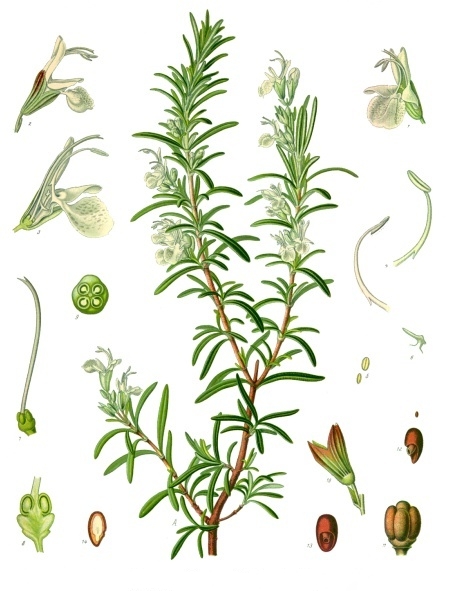
The accompanying rosemary plate is much later: Commons attributes it to Kohler's publication and dates it 1897. It is not from the Jami. It helps distinguish visual description from naming, not identify a particular medieval entry with a modern species. Its detailed flower anatomy cannot be credited to Ibn al-Baytar centuries earlier, and it supplies no directions for using the plant 29.
Surviving examples
Kaya describes manuscripts, translations and editions, including the four-part Bulaq printing, a reprint and a later edited adaptation changing some detail and arrangement. “Reading the book” therefore needs a specified witness or edition. We have not read or collated those originals: this account uses the specialist encyclopedia entries and attributes edition history to them 30.
The biography lists manuscripts of the Mughni, Dioscorides commentary and other works too. They do not become surviving Jami examples, nor do their copy dates date this particular contribution. Our record contains neither a page in the author's hand nor his preserved specimen collection. The identified later contextual image is no substitute for manuscript evidence 31.
In culture
The biography presents a traveller, student, teacher and author. Kaya reports Ibn Abi Usaybia's testimony to his knowledge and standing. The older source retained in the museum record likewise conveys substantial praise. Such literary reputation must remain separate from priority: esteem does not transform every account a scholar reports into a personal discovery 32.
The multilingual names reveal knowledge moving among people and places, not belonging to one language alone. Yet listing languages does not prove fluency in each. Iranica's discussion of Persian limits makes this a history of human scholarly work rather than a flawless hero. The method is more intelligible when its strengths and imperfections are both present 33.
For young readers
Make two paper cards for an imaginary object, each with a name, description and named reporter. Is a similar name enough to make them the same thing? What if descriptions agree in one detail and differ in another? No real plant is needed. This is a museum-designed activity, not an experiment attributed to Ibn al-Baytar.
Add a third card saying “I do not know yet.” Keep it when evidence is missing. Never taste plants, handle them to test a theory, collect materials from a garden using the picture or make a remedy. The goal is to distinguish name, description, source and conclusion. An old book can teach us about knowledge without requiring us to act on all its contents.
References
Connections
- Improved by
- Ibn al-Baytar
- Described by
- al-Mufradat fi'l-Adwiya wal-Aghdhiya
People and things also explored
Sources
- al-Mufradat — Mahmut Kaya , structure and preface
- al-Mufradat — Mahmut Kaya , structure and method
- Ibn al-Baytar and Persian elements — Iranica , opening and entry counts
- al-Mufradat — Mahmut Kaya , structure
- Ibn al-Baytar and Persian elements — Iranica , entry counts
- Ibn al-Baytar and Persian elements — Iranica , nomenclature and sources
- al-Mufradat — Mahmut Kaya , sources
- Ibn al-Baytar and Persian elements — Iranica , quoted authors
- Ibn al-Baytar — Mahmut Kaya , education
- Ibn al-Baytar — Mahmut Kaya , biography
- Ibn al-Baytar — Mahmut Kaya , travel and service
- al-Mufradat — Mahmut Kaya , composition
- Ibn al-Baytar — Mahmut Kaya , education and service
- Ibn al-Baytar — Mahmut Kaya , nomenclature
- Ibn al-Baytar and Persian elements — Iranica , Persian names
- Ibn al-Baytar and Persian elements — Iranica , Greek sources and quotation practice
- al-Mufradat — Mahmut Kaya , preface
- Ibn al-Baytar and Persian elements — Iranica , Persian proficiency and examples
- al-Mufradat — Mahmut Kaya , translations
- al-Mufradat — Mahmut Kaya , Turkish translations and manuscripts
- Ibn al-Baytar and Persian elements — Iranica , sources and Persian authors
- Ibn al-Baytar — Mahmut Kaya , teaching
- al-Mufradat — Mahmut Kaya , reception
- Ibn al-Baytar — Mahmut Kaya , works2–4
- Ibn al-Baytar and Persian elements — Iranica , synonymic entries
- al-Mufradat — Mahmut Kaya , contributions
- al-Mufradat — Mahmut Kaya , sources and criticism
- Ibn al-Baytar and Persian elements — Iranica , Persian nomenclature
- Kohler rosemary plate metadata , Description and history
- al-Mufradat — Mahmut Kaya , editions
- Ibn al-Baytar — Mahmut Kaya , works
- Ibn al-Baytar — Mahmut Kaya , reputation
- Ibn al-Baytar and Persian elements — Iranica , Persian proficiency
- Ibn al-Baytar — Mahmut Kaya , complete biography and works
- al-Mufradat — Mahmut Kaya , complete entry
- Ibn al-Baytar and Persian elements — Iranica , complete article body
- Kohler rosemary plate metadata , Description licence and history
Cite this page
islam.museum contributors. “Ibn al-Baytar's comparative materia-medica method”. islam.museum, https://islam.museum/en/invention/ibn-baytar-comparative-materia-medica/. CC BY-SA 4.0. Last updated 2026-11-14.
Improve this page on GitHub · Report an error · Help complete it · JSON