

At a glance
- Era
- The Early Abbasid Caliphate
- Region
- Levant & Iraq
Quick facts
- Domain
- Pharmacy, chemistry and distillation
- Kind
- Method
- First attested
- c. 800 (approx.) CE (derived)
- Era
- Abbasid age
- Where
- Baghdad
- Attribution
- Improvement
Who made it
- al-Kindi Improver
The claim and its basis
A proportional, numerical interpretation of Galenic degrees, not invention of drugs or pharmacy.
Prioreschi distinguishes the four degrees from al-Kindi's ratios and discusses combining different ingredients; his first-serious-quantification assessment remains attributed to him.
Sources: Al-Kindi's drug degrees — Plinio Prioreschi · Al-Kindi — Mahmut Kaya, TDV · Czartoryski medicinal-jar image metadata
Before it
- Galen's degrees of drug qualities
Built on it
- Latin translation and Roger Bacon's reception
How it works
Summary
How could the strength of a simple drug be compared with a mixture of different ingredients? Al-Kindi tried to give this question a mathematical basis within Galen's framework of warmth, coldness, moisture and dryness, as medical historian Plinio Prioreschi explains 1. Al-Kindi worked in Abbasid Baghdad in the ninth century, but the source supplies no specific composition year for the treatise known in Latin as De gradibus 2. This record concerns a historical calculation, not invention of pharmacy or proof that a treatment works.
What it is
The table's1:1 balance is equality between its assumed qualities, not absence of both;2:1 expresses a difference 3. Balance cannot therefore simply become zero quantity, nor a higher degree a new substance name without measurement.
The model connects a degree's name with a numerical ratio between opposing qualities, then addresses a compound containing ingredients with different qualities 1. Its “warmth” is not a physical thermometer reading: it belongs to the medical framework explained by the source 1. The essential distinction is between the degree's label, such as first or second, and the magnitude of the increase that al-Kindi assumed lay behind that label 1.
The world before it
Prioreschi describes a Galenic tradition classifying the intensity of qualities in four degrees: a drug might be warm in one degree and dry in another 1. Degrees allowed comparisons, but his account identifies uncertainty over their exact magnitude and relationship to sensation 1. Combining ingredients made the problem harder: knowing each ingredient's quality did not automatically establish the degree of the entire mixture 1. Calculation started from this problem, not from an absence of earlier drug knowledge.
The story
The article places al-Kindi in Baghdad under al-Mamun and al-Mutasim and describes writings across mathematics, philosophy, medicine and other subjects 4. It does not record a princely commission for this treatise or patient experiments validating its equations; the general setting should not become an invented laboratory or hospital story. It calls the work De gradibus and also mentions Quia primos, a name taken from the Latin text's opening 5. These identify the text; neither supplies its original composition year.
The maker(s)
Al-Kindi's role here is mathematical development of an inherited model, not creation of every earlier drug theory; Prioreschi says there is no evidence that he practised medicine despite his many medical writings 6. His person record retains the Muslim basis documented through Mahmut Kaya's account of his defence of Islam and makes the disagreement about theological classification visible 7. The Sunni frame is the museum's explicit frame with the disagreement shown, not an invented personal declaration of a particular school.
How it works
The theory's number ranks a quality, not drug mass 8.
Prioreschi's table lists theoretical values, not drug names: balance is 1:1, first degree2:1, second4:1, third8:1 and fourth 16:1for warmth versus coldness 3. This is a sequence within an old theory of qualities, not measured chemical concentrations or a scale for evaluating present-day medicines. The table is the historian's presentation, not a directly inspected Arabic page from al-Kindi's treatise 3.
Its arithmetic can be explained with paper marks only: one color represents one side of the ratio and another the comparison side; counts move from 1 to 2,4,8 and 16 while the comparison remains fixed. This explicitly modern teaching representation has increases1,2,4 and 8 rather than a constant increment, although degree names advance one step at a time 3. The illustration derives the reported sequence without attributing paper cards to al-Kindi, mixing substances or recommending treatment quantities. Writing1,2,3 and 4 records degree ranks, whereas2,4,8 and 16 records the model's doubling ratios 3.
Prioreschi cites a different experiment from al-Kindi's work on the cause of ebb and flow, involving a closed glass vessel containing snow and weighing, as an example of clear experimental presentation 9. It is not the drug-degrees treatise and does not establish that the ratio table came from that experiment; separating the examples preserves the difference between observation and mathematical organization 10. This historical description is neither a home experiment nor medical validation.
The study attributes more than 270 titles to al-Kindi, about thirty medical, and mentions two critiques of alchemists' claims to manufacture gold and silver 9. It also uses his separate work on diseases attributed to phlegm to illustrate continuing Galenic explanations in some of his medicine 9. Criticizing a metallurgical claim does not mean rejecting every inherited medical theory, nor does using numbers make every work modern experimental science.
Prioreschi consequently asks why no school sustained this direction, comparing it with historical beginnings that did not develop like the European scientific revolution 11. This is the historian's question, not a student census or proof that all al-Kindi's works lacked readers 11. Mathematical model, Latin transmission and historical interpretation remain distinct layers, none establishing drug efficacy or a present-day prescription.
The model begins with a temperate condition in which opposing qualities balance, then links regular increases in degree with a geometric increase in their ratio 1. First, second, third and fourth progress by equal steps, while the corresponding parts double in Prioreschi's mathematical account 1. This distinguishes an ordering scale from a sequence of magnitudes; it is not simply addition of degree names.
Different ingredient quantities then enter the compound problem: assigning two materials the same or different degrees does not replace accounting for their contributions 1. The historian says the reasoning becomes complicated and reports Bacon's complaint about its difficulty 12. The museum therefore does not present the historical table as a simple prescription or a tool for treatment decisions.
The spread
Prioreschi attributes the twelfth-century translation of De gradibus to Gerard of Cremona and reports Roger Bacon's discussion of its mathematical difficulty 12. This documents textual transmission and reading, not a count of practising users or a map of adoption in every city. The source does not supply workshop-to-workshop stages, so none are invented here. Bacon's assessment as reported in the article combines an appreciation of the calculation's importance with the assertion that few Latin physicians knew it: translation did not mean universal practical adoption 1.
What it was built on
The immediate foundation was Galen's framework of four qualities and their degrees of intensity, explained before al-Kindi's modification 1. In this account al-Kindi did not discard the framework: he tried to make relationships within it calculable 1. That is why the museum calls his contribution a bounded improvement—a reinterpretation of degree and the passage from simple to compound—not a complete break with ancient medicine or invention of drug knowledge from nothing.
What was built on it
The continuation documented here is Latin reception: translation, then Bacon's discussion as Prioreschi reports it through Michael McVaugh's edition, not from an independent reading of Bacon 12. The article's references point to publication of the Latin text in an appendix to the relevant 1975 edition 13. This is useful bibliographic guidance; it does not by itself establish direct descent from al-Kindi's equations to modern dosing models.
Impact on daily life
The mixture problem concerns a concrete aspect of preparing medicines: comparing multiple ingredients of different quantities and qualities rather than naming each one's quality separately 1. The source nevertheless supplies no register of prescriptions dispensed using the method, patient counts or comparative outcomes. We can describe what the calculation tried to clarify without claiming it improved an individual's treatment. This treatise must also be distinguished from al-Kindi's formulary, described as a separate work containing preparations whose ingredients were predominantly botanical 1.
How it changed history
Prioreschi assigns the attempt a substantial place in the history of quantification and describes al-Kindi as a precursor of the later scientific revolution 14. That is the historian's interpretation, not a mathematical result proved by the treatise or a museum verdict that one person caused everything that followed. Latin reception lets us trace the text's presence in a particular medical and mathematical discussion; the article does not measure practical adoption or continuous influence 12.
Who invented it?
The study clearly attributes this attempt to al-Kindi and also identifies the earlier Galenic model it reinterpreted 1. Calling it the first serious attempt at quantification in medicine is Prioreschi's assessment, attributed to him rather than presented as a worldwide survey conducted by the museum 1. A fair account distinguishes an existing scale of qualities, a mathematical innovation within that scale, and demonstrated clinical success. This record documents the second through the historical study; it does not claim the third.
Today
The 2002 article revisits the work as a subject in the history of medical method and mathematics 14. That is its use here: understanding how an earlier author thought about magnitudes and qualities. This record supplies no contemporary standard for estimating drug strength and does not invite testing the model on a person. A precise mathematical relationship chosen by an author does not, by itself, validate its medical assumptions; explaining a model and verifying its outcomes are deliberately distinguished.
Surviving examples
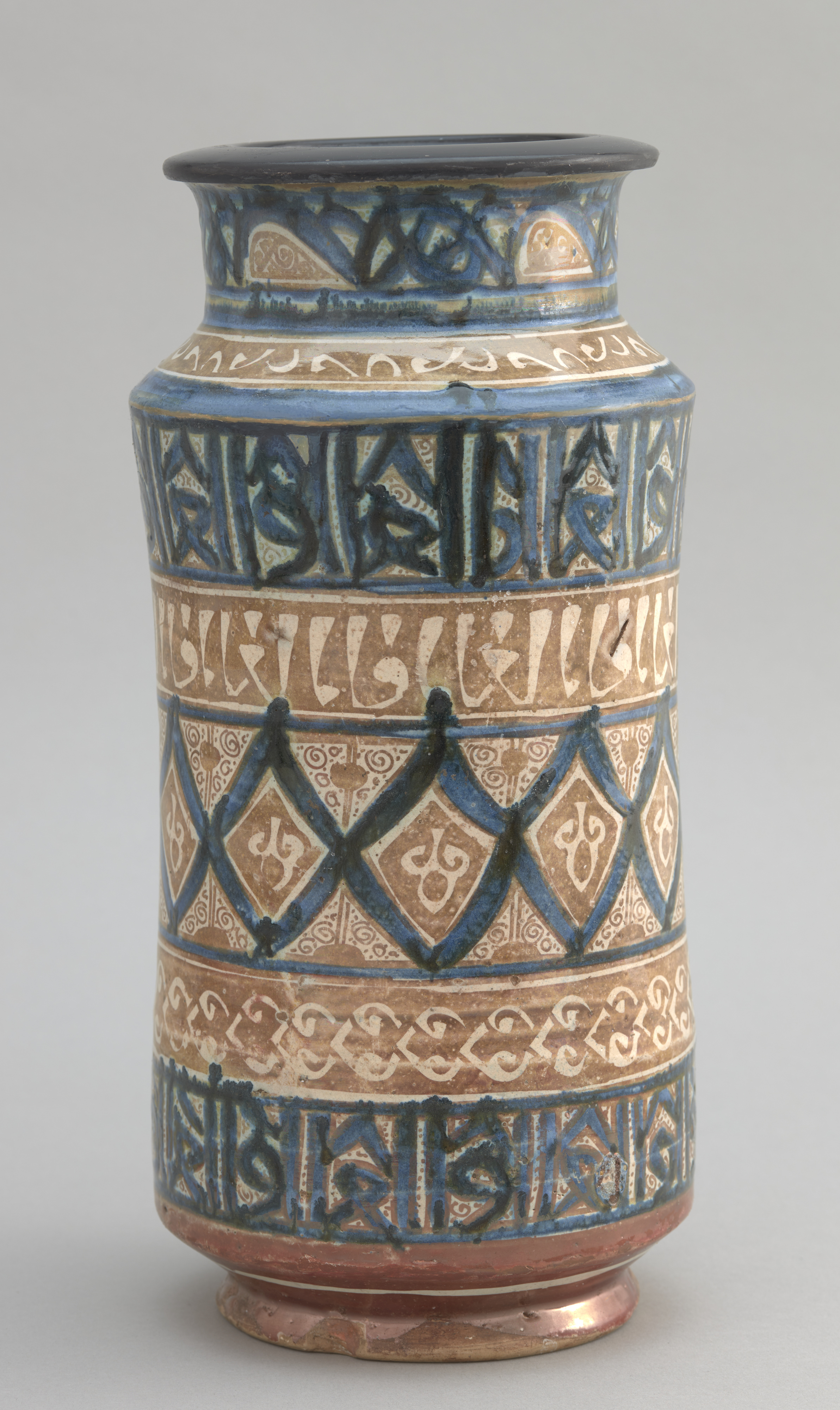
Prioreschi points to Quia primos in the appendix to McVaugh's 1975 edition; we do not claim to have examined that appendix or its manuscripts here 13. The accompanying image is a different kind of witness: a Valencia medicinal jar dated 1400–1425, MNK XIII-1776 in the Czartoryski collection, according to its image metadata 15. It is later visual context, not al-Kindi's jar or evidence that his calculation was used. The relationship diagram connects ideas; it is not a preparation recipe.
In culture
Prioreschi's title, “A Precursor Of The Scientific Revolution”, itself exemplifies al-Kindi's place in modern historical writing 2. The article also reports Cardano's appreciation of his intellectual standing through Sarton, not as specific testimony to successful drug calculation 16. The sources used for this record do not identify a documented film, stamp or literary work about the method itself. That limit remains visible instead of being filled with an invented example.
For young readers
Imagine a number ladder: the degree rises one step while the number of pieces in the model doubles. Al-Kindi used this distinction to turn a description of drug strength into a mathematical question, according to Prioreschi's account 1. Think with coloured paper counters, not mixed medicines: an old model is not treatment advice. The general idea to notice is that ordering and naming things do not, on their own, tell us how large the differences between them are.
References
- Plinio Prioreschi on al-Kindi and medical quantification, pp. 17–20; especially p. 18 for the calculation and pp. 19–20 for reception and references.
- Mahmut Kaya's TDV entry on al-Kindi, Mu'tezile section; identity and disagreement as explained in the person record.
- Medicinal-jar image metadata, object description and CC0 status; not evidence of al-Kindi's ownership.
Connections
- Improved by
- al-Kindi
People and things also explored
Al-Kindi's letter-frequency cryptanalysis· Abu Zayd Ahmad ibn Sahl al-Balkhi· Farghana· al-Kindi
Sources
- Al-Kindi's drug degrees — Plinio Prioreschi , p. 18
- Al-Kindi's drug degrees — Plinio Prioreschi , pp. 17–19
- Al-Kindi's drug degrees — Plinio Prioreschi , p.18
- Al-Kindi's drug degrees — Plinio Prioreschi , p. 17
- Al-Kindi's drug degrees — Plinio Prioreschi , p. 19
- Al-Kindi's drug degrees — Plinio Prioreschi , pp. 17–18
- Al-Kindi — Mahmut Kaya, TDV , Mu'tezile section
- Al-Kindi's drug degrees — Plinio Prioreschi , pp.17–19
- Al-Kindi's drug degrees — Plinio Prioreschi , p.17
- Al-Kindi's drug degrees — Plinio Prioreschi , pp.17–18
- Al-Kindi's drug degrees — Plinio Prioreschi , p.19
- Al-Kindi's drug degrees — Plinio Prioreschi , pp. 18–20
- Al-Kindi's drug degrees — Plinio Prioreschi , p. 20
- Al-Kindi's drug degrees — Plinio Prioreschi , pp. 18–19
- Czartoryski medicinal-jar image metadata , metadata
- Al-Kindi's drug degrees — Plinio Prioreschi , pp. 19–20
Cite this page
islam.museum contributors. “Al-Kindi's calculation of compound-drug degrees”. islam.museum, https://islam.museum/en/invention/kindi-drug-degrees/. CC BY-SA 4.0. Last updated 2026-11-14.
Improve this page on GitHub · Report an error · Help complete it · JSON