

At a glance
- Era
- The Buyid, Fatimid and Seljuk Era
- Region
- al-Andalus & Europe
Images
Quick facts
- Domain
- Astronomy and its instruments
- Kind
- Method
- First attested
- 1050 CE · 441 AH (derived)
- Era
- Middle period
- Where
- Toledo
- Attribution
- Improvement
Who made it
- Al-Zarqali Improver
The claim and its basis
Improvement of earlier astronomical tables through new observation at Toledo, not the invention of tabular astronomy or of organised solar observation.
The biography reports him making instruments at Toledo from about 1048–49 and observing the sun for some quarter century from 1050, and that the tables attributed to him and his school were carried into Latin and became the basis of the Alfonsine Tables; no Arabic copy survives to settle each scholar's share.
Sources: Al-Zarqali — MacTutor · Wikipedia (English), "Al-Zarqali" · A page of the Alfonsine Tables, Wikimedia Commons
Before it
- Earlier zij and astronomical tables in Islam and al-Andalus
- Al-Battani's Zij (the Sabian Zij)
Built on it
- The Alfonsine Tables built on the Toledan Tables
How it works
Summary
The Toledan Tables are not a single authored book but a tradition of astronomical tables assembled at Toledo from observation and collective contribution around the mid-eleventh century, carried into Latin in the twelfth century and becoming the basis of the Alfonsine Tables that served Europe for generations 1 2. No Arabic copy of the tables themselves survives to settle each scholar's share, but what remains of their Latin versions and the testimony of the biographies is enough to establish that al-Zarqali's observation and school at Toledo changed the course of European astronomical computation 1.
What it is
The Toledan Tables are books of astronomical computation built on observation: they gathered calculated data on the positions of the Sun, Moon and planets over many years, with tables of parallax, eclipses, the settings of the planets, the positions of the stars and trigonometric tables 1. Earlier astronomical data — from the tables of al-Khwarizmi, al-Battani and others — was adapted in them to fix the coordinates of Toledo itself, as the biographies report 2. In this sense they belong to the genre of the zij: a book that gathers the tables needed for astronomical computation without beginning from the rudiments of spherical astronomy, in the tradition of the Arabic tables 1.
And the tables were not a single form in their history: two or more versions of their Latin translations survive today, made by Gerard of Cremona in the twelfth century, and no Arabic copy of the tables survives to settle each part's attribution to its author 1.
The world before it
Before Toledo, astronomical tables were an established craft: among the earliest models are the tables the Greeks transmitted from Ptolemy, then the tables of al-Khwarizmi and the tables of al-Battani, which were the heaviest Arabic-Andalusian reference before the eleventh century 1. These tables were not merely a scientific luxury but a practical necessity: Islamic law obliges prayer five times a day, fixing the prayer times depends on the Sun's altitude above the horizon in each locality, determining the qibla needs the calculation of Mecca's direction, the lunar calendar for festivals and feasts needs knowledge of each month's beginning, and sighting the crescent at sunset is a delicate matter — all of this drove precise computation and instruments 1.
The political and scholarly background of this work was mixed: the Caliphate of Córdoba — which reached its peak between 929 and 1031 CE — had ended, unity had broken apart and independent Muslim principalities were fighting one another, while pressure on Muslim lands was growing from the Christian kingdoms of the north; in this atmosphere every state needed its own scholars and calculations, and Toledo became one of the centres of this production 1 3.
In al-Andalus specifically, Toledo — after becoming an independent Muslim principality in the fifth century AH — was a magnet for scholars, and there the qadi ibn Sa'id gathered a body of astronomers — Muslims and Jews — working under his patronage on calculations built on observation 3 1.
The story
Al-Zarqali is Abu Ishaq Ibrahim ibn Yahya al-Naqqash al-Zarqali, nicknamed al-Naqqash "the engraver of metals", born around 1029 CE in a village near the outskirts of Toledo, and trained in the family craft of making instruments, the greatest craftsmen being in Córdoba 3 1. When he moved to Toledo, the qadi ibn Sa'id employed him to make astronomical instruments for the group working there under his patronage, and he became known for making astrolabes and water clocks 1.
It is related that when al-Zarqali was asked about his education he answered that he had never studied any science nor read a book, but thanks to his patron he was given books which he mastered in two years, and in 1062 CE he joined the qadi ibn Sa'id's Toledo group of astronomers, remaining in it for more than twenty years making instruments and observing the Sun, Moon, planets and stars, until he became head of its school 1. It is said that much of his solar observation rested on long years: he claims to have observed the Sun for twenty-five years and the Moon for thirty 1.
Then came the year 1085 CE, when Toledo fell to Alfonso VI, king of Castile, and al-Zarqali and his colleagues were forced to flee the city; he is said to have moved to Córdoba and died there in 1100 CE, though the place of his death is not settled with certainty — some accounts say he fled to Córdoba, others that he died in a refugee camp 3 1.
And the tables were not his only work in this programme: al-Zarqali also worked under two other patrons, for according to Wikipedia he began work after 1048 under the qadi ibn Sa'id for al-Ma'mun, emir of Toledo, and also under al-Mu'tamid ibn Abbad, lord of Seville 3. He perfected the safiha — the universal astrolabe that bore his name and remained a navigator's instrument into the sixteenth century — and was the first to demonstrate the motion of the solar apogee at 12.04 arc-seconds a year, close to the modern value of 11.77, and set out a model of the apogee's motion later used by European scholars down to Copernicus 4 1. The Toledan Tables were part of a wider programme of observation and instruments that did not stop at the tables themselves.
The maker(s)
The tables are not the work of a single author but the collective heritage of Toledo's school: al-Zarqali and the qadi ibn Sa'id's group, which included Muslims and Jews, worked together on long observations, instrument-making and table computation 1. Al-Zarqali is the name the tradition puts first: the tables are ascribed to him and to his school, and he observed the Sun for roughly a quarter century at Toledo 1 2. His Islam is documented in the MacTutor and Wikipedia biographies, and the museum claims no particular school of law for him 1 3.
How it works
The system works in three steps: first, organised observation — measuring the positions of the bodies over many years, not in a single night, which requires precise instruments; second, converting observation into tables — values precomputed for positions, eclipses, parallax, the positions of the stars and trigonometric tables, so that the reader need not recompute each time 1. Third, revision of the earlier heritage — for the tables "contained much copied from earlier tables such as those of al-Khwarizmi, al-Battani and Ptolemy, but they also contained the observations of al-Zarqali and the other members of the qadi ibn Sa'id's large group", as MacTutor describes 1.
This is the difference between astronomical tables and theoretical astronomy: the tables turn theory into usable numbers, and every improvement in them — a corrected coordinate, an added table, a settled observation — is reflected directly in the accuracy of the computation that follows them 2 1.
The spread
No Arabic copy of the tables survives, but their Latin versions carried them into Europe: Gerard of Cremona translated them into Latin in the twelfth century, and two or more versions of the translation exist 1. The tables were used in Europe until the production of the Alfonsine Tables around 1270 CE, then were incorporated into the Alfonsine Tables in the thirteenth century 1 2.
Within al-Andalus itself the school's trace remained: al-Zarqali's works influenced a generation of Andalusian scholars — such as Ibn Bajjah, Ibn Tufayl and Ibn Rushd — as the biographies record 3. His name also remained in European memory: the lunar crater Arzachel was named for him, and Chaucer mentions him in his works as "Arsechieles" 5.
What it was built on
The Toledan Tables were built on a clear earlier heritage: they "contained much copied from earlier tables such as those of al-Khwarizmi, al-Battani and Ptolemy" as MacTutor describes, and were then adapted to fix the coordinates of Toledo 1 2. The heaviest Arabic reference before them was al-Battani's zij (the Sabian Zij), a composite tabular heritage from Ptolemy and his successors, and the museum holds a work record for it under the name al-Zij al-Sabi 1.
And the Toledan Tables were not separate from the founder's own work: alongside them ran al-Zarqali's other zijs and almanacs, including his almanac which "contained tables that allowed one to find the days on which the Coptic, Roman, lunar and Persian months begin" and tables giving the positions of the planets at any time and easing the prediction of solar and lunar eclipses 1.
What was built on it
What was built on the Toledan Tables is the Alfonsine Tables: the scholars of Alfonso X's court at Toledo used the Toledan tables as their basis and rebuilt them, and the Alfonsine Tables became the European astronomical reference for decades 2 1. This means the Toledan Tables were not an end but a bridge: they carried Andalusian observation into Latin versions, then were used to build what came after them 1.
In the learning of astronomy generally, the Alfonsine Tables — built on the Toledan — were what Europe's scholars read in the thirteenth and fourteenth centuries, forming the bridge across which Islamic-Andalusian astronomy passed into European science 2.
Impact on daily life
The tables were not an everyday instrument for ordinary people, but they were an instrument for astronomers, navigators and timekeepers: whoever needed to know the date of an eclipse or the beginning of a month or the qibla's direction in a distant place found a ready reference in the tables instead of recomputing from scratch 1. The almanac al-Zarqali himself compiled — on the pattern of earlier calendars — "contained tables that allowed one to find the days on which the Coptic, Roman, lunar and Persian months begin", and gave the Sun's true positions for the four Julian years 1088 to 1092, and the positions of the five planets every five or ten days over eight years for Venus and seventy-nine for Mars, and so on 1.
How it changed history
The Toledan Tables changed the course of European astronomy: they built on corrected Andalusian observation, then the Latin translation carried them into Europe, where they became the basis of the Alfonsine Tables that served Europe's scholars for generations 1 2. In this sense they witness that Toledo in the fifth century AH was a centre of Andalusian scientific production that reached Europe not by random transmission but by a methodological structure 1.
But the bound must remain clear: the Toledan Tables were not the first astronomical tables in history, and al-Zarqali and his school did not invent "the art of tables" or "organised solar observation"; what they did was improve an existing tradition with new observation at Toledo 1 2.
Who invented it?
The tables are not an "invention" in the literal sense — neither al-Zarqali nor his school invented the art of tables or organised solar observation from nothing; they improved an existing tradition of Ptolemaic, Khwarazmian and Battani tables with new observation at Toledo 1 2. The attribution here is sound but bounded: the name put forward is al-Zarqali's and his school's, but no Arabic copy of the tables themselves survives to settle each scholar's share, so the ascription to "al-Zarqali" is a probable traditional attribution, not conclusive proof that every part of every table is his alone 1 2. What the record establishes is that his school at Toledo produced tables built on long observation, and that they reached Europe and became the basis of the Alfonsine Tables 1 2.
Today
Surviving examples
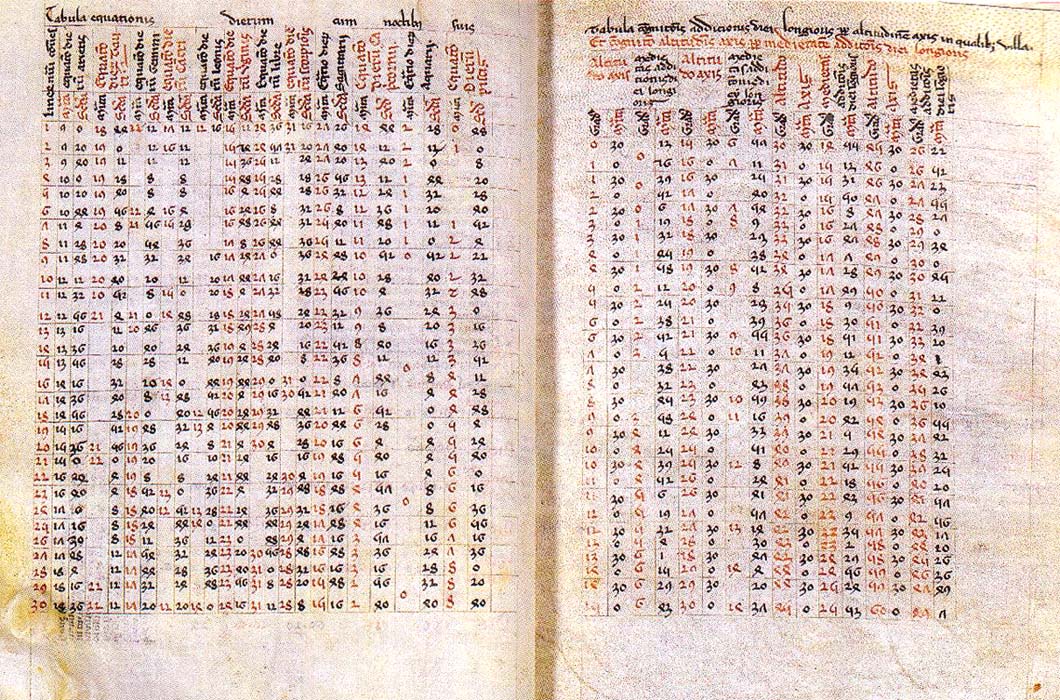
No Arabic copy of the tables survives, but their Latin versions remain: two or more versions of their Latin translations made by Gerard of Cremona in the twelfth century exist today 1. A printed page of the Latin Alfonsine Tables — the tradition built on the Toledan Tables — appears on Wikimedia Commons under the public-domain mark, a witness to what Europe's scholars read in the thirteenth and fourteenth centuries 6.
In culture
The Toledan Tables did not become a "cultural icon" the way illuminated manuscripts did, but they remained in European scientific memory as a bridge between Islamic and Latin astronomy. Al-Zarqali's name also remained in memory: the lunar crater Arzachel was named for him, and Chaucer mentions him in his works as "Arsechieles" 5.
For young readers
About a thousand years ago a Muslim astronomer named al-Zarqali made instruments at Toledo and measured the positions of the Sun, Moon and planets for many years; his calculations were gathered into tables that helped Europe's Alfonsine Tables. No Arabic copy of these tables survives, but their Latin translations remain and did their work in teaching Europe's astronomers 1 2.
References
Connections
- Improved by
- Al-Zarqali
People and things also explored
Baylatan of Toledo — twin water basins that followed the lunar month· Al-Zarqali's independent equatorium· Al-Zarqali's universal astrolabe plate· The Toledo baylatan: twin basins credited to al-Zarqali working on the moon's cycle· Al-Zarqali's moving solar-apogee model· Cordoba· Toledo· Al-Zarqali
Sources
- Al-Zarqali — MacTutor , biography
- Wikipedia (English), "Al-Zarqali" , Toledo tables paragraph
- Wikipedia (English), "Al-Zarqali" , life
- Wikipedia (English), "Al-Zarqali" , science
- Wikipedia (English), "Al-Zarqali" , culture
- A page of the Alfonsine Tables, Wikimedia Commons
Cite this page
islam.museum contributors. “The Toledan Tables”. islam.museum, https://islam.museum/en/invention/toledan-tables/. CC BY-SA 4.0. Last updated 2026-11-15.
Improve this page on GitHub · Report an error · Help complete it · JSON