

At a glance
- Era
- The Early Abbasid Caliphate
- Region
- Levant & Iraq
Quick facts
- Domain
- Mathematics and computation
- Kind
- Method
- First attested
- 762 CE · 145 AH
- Era
- Abbasid age
- Where
- Baghdad
- Attribution
- Improvement
Who made it
- Abu Hanifa al-Nu'man ibn Thabit Improver
The claim and its basis
Shifting brick counting from one-by-one tally to measured estimation of large stacks.
Le Strange reports supervision and measurement-based quantity reckoning in Baghdad works context.
Sources: Baghdad During the Abbasid Caliphate — Le Strange1900 · Bagdat — Abd al-Aziz al-Duri, TDV · Futuh al-Buldan — Hitti translation, volumeI,1916 · Tarikh al-Khulafa — al-Suyuti (Dar al-Minhaj edition)
Before it
- Pre-existing counting,weight and measure practices in trade/craft
How it works
Summary
In large building projects, the question is not only "How many bricks do we need?" but "How do we estimate quickly in a way others can audit?" Measurement-based brick-stack reckoning in Baghdad works captures that issue. In Le Strange's transmitted account, Abu Hanifa appears in supervision where brick quantities were estimated through measurement logic rather than one-by-one tallying 1. This is not invention of arithmetic and not invention of volumetric mathematics itself. It is a practical management improvement in construction provisioning. Its value appears when placed inside a city-making context where policy, markets, security and service operations had to move together.
What it is
This invention is an estimation method. The core idea: when stacks are large, shift from counting each brick individually to deriving quantity from repeated measured units. That saves time and allows review if participants share a unit standard. The record does not claim preserved formulas notebook by notebook, or a complete technical manual. What it does establish is awareness of counting burden in very large works and a reported practical response based on comparative measurement 1. In that sense the invention belongs to work organization and applied quantitative reasoning, not to abstract mathematics detached from a construction economy.
The world before it
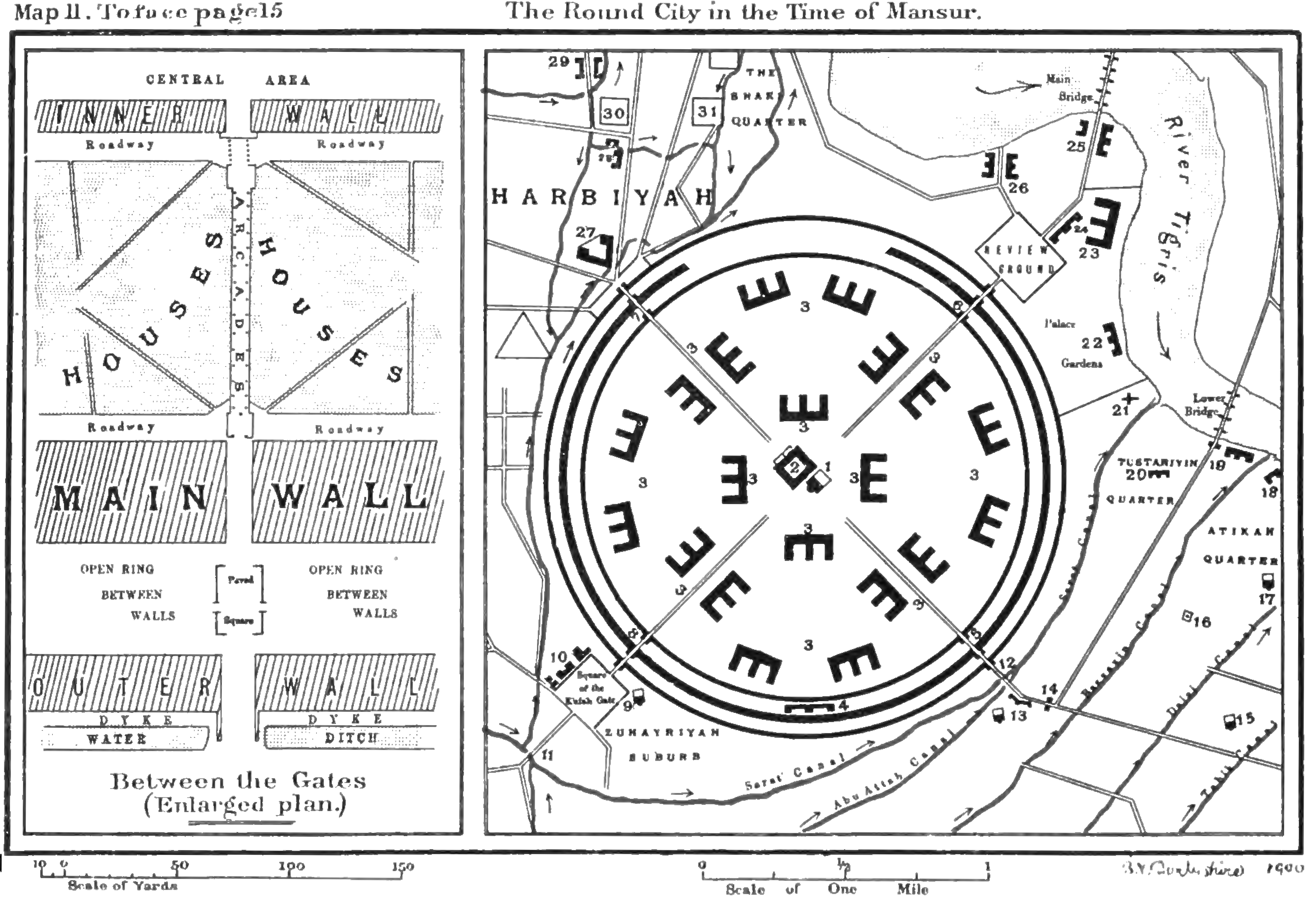
Counting, weight and measure existed long before Abbasid Baghdad. This record does not start those histories. Duri's Baghdad article describes earlier settlements, canals and route layers, and notes older circular-city precedents 2. Hitti's Baladhuri translation also preserves older built context around the site 3. Therefore what is new here is not "discovering numbers"; it is applying known measurement culture to large-scale provisioning under capital construction pressure. Keeping that distinction prevents overclaiming and keeps attribution proportional to evidence.
The story
The report appears inside phased Baghdad-building narratives where foundation, occupation and completion are not one instant. Within that frame, Le Strange lists overseers and includes Abu Hanifa in supervision/brick-reckoning language 1. Historically, the key issue is operational: how to control huge material quantities under time constraints while preserving accountability. We are not given day-by-day tables, but we are given an administrative principle: use measurement to convert overwhelming quantity into reviewable estimates. That principle fits broader readings of Baghdad as a complex governance project, not merely geometric symbolism.
The maker(s)
The method is attributed to a reported role for Abu Hanifa in supervision and reckoning, not to solitary genius erasing collective labour. Construction execution still depends on many actors: brick producers, transporters, store overseers, site coordinators and scribal accounting. A famous name inside that chain does not replace everyone else. Nor is this entry a political endorsement: conflict narratives remain preserved elsewhere, including coercion-related reports around al-Mansur's era 4. Likewise, we do not recast a jurist as a modern certified engineer. The careful statement is narrower: a transmitted practical role in material estimation within a broader urban works system.
How it works
The operational logic is straightforward. Define a repeatable measured unit in a stack, then scale from that unit to the whole instead of counting every item. When stack regularity is acceptable, estimation becomes faster while still permitting verification by sampling. Field value: lower first-pass counting overhead in very large quantities. This explanation is modern pedagogic interpretation of a historical report, not literal reconstruction of every original instrument. Le Strange preserves the idea in narrative form, not in audited technical worksheets 1. So we distinguish between an attested estimation principle and unattested detailed engineering parameters.
The spread
There is no continuous chain proving literal transfer of this exact procedure into every later Islamic workshop. The stronger spread claim is conceptual: movement from one-by-one tally toward measured estimation in high-volume environments. That logic reappears historically across inventory and provisioning domains. In Baghdad itself, it fits a city whose functions shifted while scale grew 5. So influence can be discussed; closed technical lineage cannot be asserted from current evidence. This keeps historical significance meaningful while avoiding unsupported diffusion claims.
What it was built on
The method stood on pre-existing measurement culture, urgent material-control needs, and administrative authority capable of enforcing shared estimation frames. It did not require invention of new matter; it recombined known practices for a large project. Hence it sits between practical mathematics and governance procedure. Source disagreements on city details also remind us this is a multi-text interpretive environment, not one final survey blueprint 6. The strength of the case is therefore in method of handling quantity under constraint, not in perfect certainty of every associated number.
What was built on it
What this enabled was not one specific wall by itself, but faster decision-making in procurement, distribution and work pacing. If quantity can be estimated credibly, planning cycles shorten and stoppage risk can be reduced. In a capital where palatial, market and circulation works interlocked, this mattered operationally. It does not mean no waste or no dispute; it means an additional practical tool inside the system. As urban functions shifted, the deeper legacy was managerial habit: sample, estimate, review. That habit outlives any single stack.
Impact on daily life
Daily effects of such methods are often invisible in political narratives: material readiness, work continuity, shorter waiting time for dependent tasks, and more predictable labour sequencing. In a forming capital, delays in brick accounting can delay housing, arcades and service spaces used by ordinary residents and workers. We still avoid false precision: no preserved daily production ledger here gives hard efficiency percentages. So impact is presented as historically plausible and structurally consistent rather than numerically absolute. This preserves epistemic honesty while still recognizing practical importance.
How it changed history
This method changes the historical picture by adding an applied quantitative layer to capital construction stories. Instead of only rulers, gates and walls, we see how quantity decisions were managed on the ground. That matters for connecting intellectual history and labour history. It also shows that juristic figures can appear in technical-administrative roles in specific contexts without collapsing disciplinary boundaries. The contribution is not a world-first claim; it is a sharper interpretation of how governance becomes material through accounting practices in large works.
Who invented it?
If the question is "Who invented measurement in human history?" this record gives no such firstness to Baghdad. If the question is "Who organized this reported form in Baghdad works?" the answer is contextual: a transmitted supervisory role for Abu Hanifa inside a wider labour network 1. That preserves both attribution and limits. We do not suppress what sources state, and we do not add what they do not state. The invention is therefore best framed as a method-level improvement under evidence constraints.
Today
Today this case is useful in courses on project history, operations history and practical reasoning under scarcity. It can be compared with modern sampling/estimation logic in inventory practice without claiming exact equivalence. Its strongest teaching value is epistemic: when do we count everything, when do we measure a part and estimate a whole, and how do we keep that estimate reviewable? Those are still live questions in economics, engineering and administration. In this repository they remain interpretive questions, not a direct field manual for active construction.
Methodologically, the case is also a training ground for source literacy. Readers must separate three layers: the historical report itself, modern explanatory paraphrase, and contemporary technical application. Confusing these layers creates either exaggeration or dismissal. Keeping them distinct allows the historical insight to remain useful while respecting limits of evidence. That discipline is central to responsible technical history.
Surviving examples
Surviving evidence here is mainly textual: Le Strange's report of supervision/brick reckoning in Baghdad context, with contextual support from Duri and Hitti-Baladhuri framing 7 8 9. This file does not include a preserved original workshop ledger or authenticated physical tool uniquely tied to the exact procedure. Therefore classification stays at "influential transmitted method" rather than complete archaeological reconstruction. Explicit certainty grading is part of method integrity.
The evidentiary value increases when functional motifs recur across administrative narratives of the period: need for control, need for speed, need for shared review language. Even without original numeric tables, this triad helps model decision logic in large works. It does not replace future archival or archaeological discovery; it sharpens what later discovery should try to confirm.
In culture
Culturally, this topic helps break a simplistic binary between jurist and technician. Historical narratives can preserve more layered roles where legal-intellectual figures appear in practical coordination episodes. Whether one accepts every transmission detail or debates it, the case encourages attention to work culture: how quantities were reasoned, how cost-risk was managed, and how authority interacted with measurement practices. That shifts Baghdad's memory from monumental icon alone to operational citymaking.
For contemporary audiences, this also tempers two opposite habits: hero-only storytelling and total-negation skepticism. The file supports a middle picture: broad labour networks with some named actors in bounded roles. That middle picture is often closer to how major cities were actually built and maintained.
For young readers
Draw three stacks of tiny cubes on paper. First, count one stack cube by cube. Second, measure one side of another stack and estimate the total if it looks regular. Third, compare how long each method took. This simple activity helps you understand why people use estimation when numbers are very large. It is only a learning exercise. It is not guidance for real building, safety checks, or material certification.
Try the same activity again with a much larger drawn stack and then with an irregular stack. Ask which case makes estimation easier and which requires more checking. This helps you see that good estimation is not guessing blindly; it depends on pattern, comparison and review.
You can also swap roles with a friend: one person estimates, the other person verifies by recounting a sample area. Then compare both results and discuss why differences happened.
References
Connections
- Improved by
- Abu Hanifa al-Nu'man ibn Thabit
People and things also explored
The Friday sermon in a language other than Arabic: the four Sunni schools· Reciting the Qur'an in translation in prayer: the four Sunni schools· Death, funeral and grave of Abu Hanifa at Baghdad· The Treaty with the Christian Taghlib· The Hanafi school (madhhab)· Ahmad ibn al-Salt al-Himmani· Kufa· Ahl al-Hikma (People of Wisdom) lesson series
Sources
- Baghdad During the Abbasid Caliphate — Le Strange1900 , p.17
- Bagdat — Abd al-Aziz al-Duri, TDV , Foundation and plan
- Futuh al-Buldan — Hitti translation, volumeI,1916 , p.445–446
- Tarikh al-Khulafa — al-Suyuti (Dar al-Minhaj edition) , p.426
- Bagdat — Abd al-Aziz al-Duri, TDV , Development
- Bagdat — Abd al-Aziz al-Duri, TDV , Measurements
- Baghdad During the Abbasid Caliphate — Le Strange1900
- Bagdat — Abd al-Aziz al-Duri, TDV
- Futuh al-Buldan — Hitti translation, volumeI,1916
Cite this page
islam.museum contributors. “Measurement-based brick-stack reckoning in Baghdad works”. islam.museum, https://islam.museum/en/invention/abu-hanifa-brick-stack-reckoning/. CC BY-SA 4.0. Last updated 2026-11-20.
Improve this page on GitHub · Report an error · Help complete it · JSON