

At a glance
- Region
- Levant & Iraq · Persia & Central Asia
Images
Quick facts
- Domain
- Medicine and surgery
- Kind
- Method
- First attested
- 08XX/09XX
- Era
- Abbasid age
- Where
- Baghdad
- Attribution
- Improvement
Who made it
- Abu Bakr al-Razi Improver
The claim and its basis
Organized comparative description in a dedicated monograph, not the first differential diagnosis in all history.
ChapterIII distinguishes relative symptoms/limits while retaining an old humoral explanation.
Sources: Rhazes on smallpox and measles — Greenhill1848 · Al-Razi — Britannica · Razi, Ebu Bekir — Mahmut Kaya, TDV · Abu Bakr al-Razi — Peter Adamson, Stanford · Rhazes1848 catalogue and image — Wellcome · Smallpox — World Health Organization · Measles — World Health Organization · Assabile archive of Tareq al-Suwaidan's lectures (video)
Before it
- Galenic medicine and earlier writing named by al-Razi
How it works
Summary
Abu Bakr al-Razi's treatise on smallpox and measles displays a skill beyond collecting disease names: comparing resemblance and difference. ChapterIII assembles shared symptoms, then distinguishes relatively more nausea and anxiety in measles from more characteristic back pain in smallpox, according to his observations and his period's interpretation 2. Our subject is this organized comparative description, not invention of the diseases, all diagnosis or virology. This is a document in medical history, not a guide to diagnosing or treating illness today.
What it is
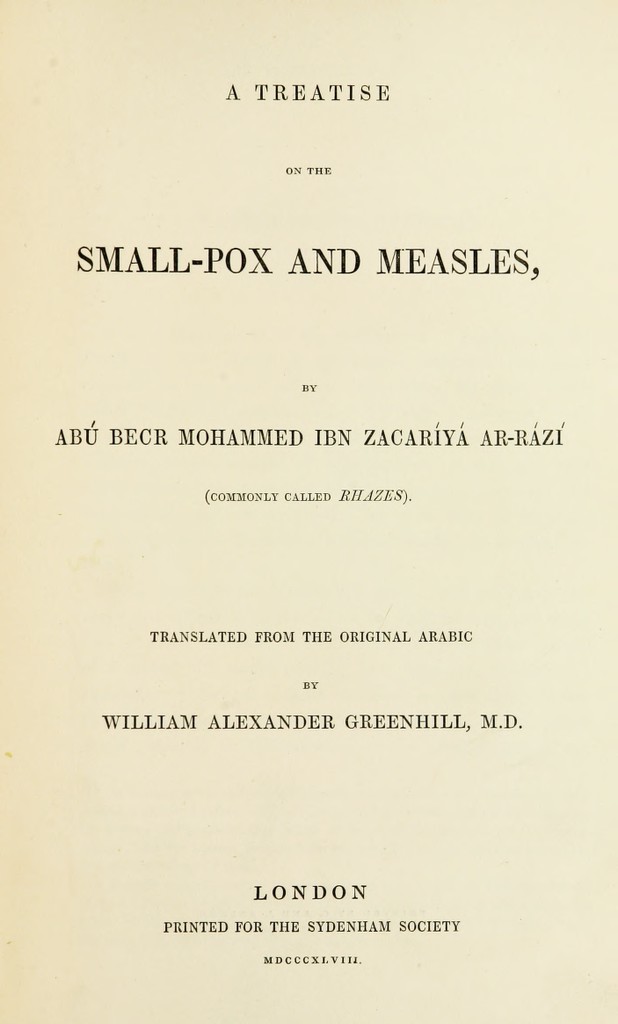
The specialized work Smallpox and Measles circulated in several translations; Britannica mentions Latin, Byzantine Greek and modern languages 3. Here we read selections from William Alexander Greenhill's English translation, printed in London in 1848, not an independently collated Arabic original or all its manuscripts. The displayed English title does not make English al-Razi's language of composition 4.
“Clinical comparison” here means organizing descriptions of patients and disease courses, not a modern laboratory result. The text discusses signs before the eruption and employs relative differences and exceptions rather than one universally decisive sign 2. These limits belong to the contribution: removing them makes the author more categorical than his text.
The world before it
Medicine did not begin with al-Razi. Britannica describes his engagement with Greek predecessors and the Hawi's coverage of Greek, Syrian, Arabic and some Indian medicine, supplemented by his judgment and experience 3. Adamson explains that the Hawi is predominantly a collection of source excerpts; it should not be reduced to a personal casebook resembling a modern hospital record 5.
The treatise's opening discusses what its author considers references in Galen. He reports asking people familiar with Syriac and Greek and criticizes the inadequacy of earlier explanation as it reached him 6. This is testimony about his reading and project, not comprehensive proof that no earlier observer in any language distinguished the diseases. Criticism presupposes predecessors; it does not justify removing them from the story.
The story
The author's preface describes discussion at the home of a man interested in useful learning, followed by a request for a connected, organized treatment of the disease 7. We present this as the text's account of its occasion, not an independent record proving the host's identity or the meeting's date. Its significance is the stated educational purpose: gathering dispersed knowledge into an accessible arrangement.
Greenhill expressly says the composition date is unknown, while an internal reference places the work after the Mansuri 8. The broad ninth/tenth-century data window therefore supplies author-activity context, not a precise invention year. Baghdad and Rayy belong to the physician's biography, but that does not establish where each chapter was composed 3.
The maker(s)
The work is attributed to Abu Bakr al-Razi in the translation and biography. He is not Abu Hatim al-Razi, the interlocutor in the religious debate, or the later Fakhr al-Din al-Razi 8 9. Authorship of a treatise is a different claim from the first human observation of a disease distinction.
Sunni frame: This is the museum's presentation frame, not proof of al-Razi's personal legal school. Britannica explicitly calls the individual a Muslim philosopher: a named basis, not inference from name or country. Disagreement about his religious thought nevertheless remains 3.
Academic reading: Adamson discusses hostile accounts of rejection of prophecy alongside surviving writings and contrary reports, including whether disputes concerned religion itself, deference to authority or the imamate 9.
Kaya's reading: Mahmut Kaya argues a deist interpretation and defends attribution of the critical material, while reporting contrary evidence 10. That interpretation remains its author's. The museum neither issues a religious verdict nor hides disagreement to fit a list.
How it works
The text does not start with one isolated contrast. It first describes the area of resemblance: chapterIII lists fever, bodily heaviness, red eyes and other features before explicitly comparing the diseases 11. A feature thus belongs to a cluster of observations rather than a detached word easily transferred between conditions.
The question then changes from merely “is this symptom present?” to “in which condition is it more frequent or characteristic?” The translation associates nausea and anxiety more with measles and back pain more with smallpox 11. “More” matters. Replacing it with “always” changes the historical claim. These examples explain the author's reasoning; they are not medical rules for visitors.
The passage adds an exception involving a severe form of smallpox, then connects the differences to a humoral explanation involving blood, bile and vessels near the spine 2. Humours are an older explanatory framework, not another name for viruses or immunity. A historian can separate comparative description from causal explanation without assuming that valuing one validates the other.
The previous chapter discusses bodily dispositions and seasons that the author associates with disease occurrence, but also mentions differences between countries, dwellings and conditions and allows disease in other seasons 12. These selections are not modern statistics or a controlled trial: they supply neither a patient count nor diagnostic sensitivity and specificity. We do not fill that gap with invented numbers or an isolation story absent from the read text.
For teaching the reasoning without imitating old medicine, we can arrange three questions: what is shared, what differs relatively, and what exception prevents a universal claim? That is our modern explanatory arrangement, not an original chart discovered in a manuscript. It follows chapterIII's structure while separating the presentation of an idea from attributing contemporary terminology to its author 2.
The translation itself warns about terminology. Greenhill notes that two Arabic terms rendered with words for pustules and vesicles need not carry the precise definitions used by physicians in his own time 13. We therefore cannot automatically turn an English rendering back into a modern skin-lesion classification or assume that a similar name proves an unchanged concept across a millennium.
The spread
The biography records Latin, Byzantine Greek and modern-language translations. Greenhill describes an Arabic-to-Syriac-to-Greek route while acknowledging unknown translators and dates 3 14. Known links remain distinct from unknown ones; no translator or year is invented to complete the chain.
The 1848 edition witnesses much later European reading, not the date when the observation arose. Greenhill distinguishes the 1766 Arabic-text edition from preceding translations; dates of editions and transmission are not all invention dates 15.
What it was built on
The work rests on inherited medicine that its author read and contested, and on a stated project of collecting and arranging knowledge. He asks for fuller and better-organized explanation by his own assessment 16. We therefore classify an improvement in presentation and comparison, not the creation of medicine from nothing.
Nor do we draw a dependency on another museum invention merely because of chronological proximity or similar titles. Specific reading or direct borrowing requires specific evidence. The read sources establish an inherited framework, not every imaginable link.
What was built on it
Multiple translations establish continuing interest, not that every later physician directly borrowed the comparison 3. His name does not become an automatic bridge from ancient medicine to every modern diagnostic method.
In particular, this record does not credit the treatise with vaccines or smallpox eradication. WHO dates eradication to 1980 and describes present-day measles as viral and vaccine-preventable: different historical layers from the humoral explanation read here 17 18. Distinguishing comparison from modern prevention clarifies the contribution rather than diminishing it.
Impact on daily life
The subject concerns patients' suffering, not merely a contest of names. The preface arranges chapters concerning description, care and disease aftermath, but we do not reproduce prescriptions as contemporary instructions 19. Britannica describes work in Rayy and Baghdad hospitals: professional context, not proof that every discussed case occurred in one identified institution 3.
These selections do not establish how many people benefited or how mortality changed after the book. Addressing an important patient problem differs from measuring therapeutic success. A moving story cannot substitute for unavailable outcome data.
How it changed history
The explicit comparison and dedicated monograph provide a clear witness to organizing medical knowledge in Arabic and its later translation 20 3. Its importance is inspectable: readers can open a particular chapter and examine its contrasts rather than rely on “father of medicine” labels or general claims of superiority.
Calling it the beginning of every differential diagnosis goes beyond this reading. Distinguishing two conditions is a bounded achievement. Universal priority requires a wider comparison with earlier texts, terminology and translations. Exaggeration does not do the work of evidence.
Who invented it?
Sunni frame: The contribution is presented with a named basis for Muslim identification and the full religious disagreement, not a personal-school certificate absent from the sources 3 9.
Encyclopedic assessment: TDV calls him the first to diagnose the two diseases correctly. This is Kaya's assessment, not an independent comparison of all earlier writings performed for this record 10.
Limit of the read text: ChapterIII establishes that he did compare them, while the opening shows how he judged predecessors 21. That supports documented improvement rather than absolute priority. The work's value survives both acknowledgment of predecessors and acknowledgment of gaps in present knowledge.
Today
Eradication of smallpox does not mean every rash disease has disappeared. WHO describes measles as a continuing cause of harm and a vaccine-preventable disease 17 18. The medieval comparison must not be used as a home diagnostic test or any historical remedy substituted for current medical care.
The treatise remains useful for knowledge history: observation, comparison and a period-specific explanation can be examined separately. Recognizing that medicine changed does not erase the document's value; it makes responsible reading possible.
Surviving examples
The displayed image is Greenhill's1848 translation title: al-Razi, translator, London and the Sydenham Society, not an autograph manuscript or patient photograph 22. The Wellcome catalogue and manifest explicitly apply Public Domain Mark; the scan binary stays outside the text repository.
Printed34, containing chapterIII, and the author's preface opening 23 were visually checked. Marginal numbers refer to Channing's edition and must not be confused with Greenhill's printed pagination 23. This later printed copy witnesses transmission, not a surviving object from al-Razi's hospital.
In culture
Popular narratives evoke an exceptional physician ahead of his age in every field. The museum's existing biography attributes the popular programme's claims to its speaker rather than treating them as a substitute for reading the treatise 24. Supporting this particular comparison does not authenticate every claim about surgical threads, experiments or other inventions.
Medical celebration cannot settle a philosophical or religious dispute. Keeping Adamson's and Kaya's readings visible lets visitors inspect the evidence rather than receive certainty manufactured by omission 9 10.
For young readers
Al-Razi thought two illnesses could look alike and still deserve careful comparison, and wrote distinctions we can read today 2. You need not experiment with illness to understand that idea: when comparing things, notice resemblance, difference and exceptions. Illness is for qualified professionals to diagnose; this is a history book, not a game for testing anyone's health.
References
Connections
- Improved by
- Abu Bakr al-Razi
People and things also explored
Al-Razi's reported patient-group comparison· Al-Razi's substance classification and structured handbook· Gerard of Cremona· Rayy· Al-Mubdi'un (programme)· Abu Bakr al-Razi
Sources
- Rhazes on smallpox and measles — Greenhill1848 , pp.32–35
- Rhazes on smallpox and measles — Greenhill1848 , pp.34–35
- Al-Razi — Britannica , biography
- Rhazes1848 catalogue and image — Wellcome , catalogue
- Abu Bakr al-Razi — Peter Adamson, Stanford , sec.1
- Rhazes on smallpox and measles — Greenhill1848 , pp.27–28
- Rhazes on smallpox and measles — Greenhill1848 , pp.23–24
- Rhazes on smallpox and measles — Greenhill1848 , p.3
- Abu Bakr al-Razi — Peter Adamson, Stanford , sec.5
- Razi, Ebu Bekir — Mahmut Kaya, TDV , pp.479–485
- Rhazes on smallpox and measles — Greenhill1848 , p.34
- Rhazes on smallpox and measles — Greenhill1848 , pp.32–33
- Rhazes on smallpox and measles — Greenhill1848 , p.32
- Rhazes on smallpox and measles — Greenhill1848 , pp.3–4
- Rhazes on smallpox and measles — Greenhill1848 , p.4
- Rhazes on smallpox and measles — Greenhill1848 , pp.23–28
- Smallpox — World Health Organization , eradication
- Measles — World Health Organization , overview
- Rhazes on smallpox and measles — Greenhill1848 , pp.23–26
- Rhazes on smallpox and measles — Greenhill1848 , pp.23–28,34–35
- Rhazes on smallpox and measles — Greenhill1848 , pp.27–28,34–35
- Rhazes1848 catalogue and image — Wellcome , canvas0007
- Rhazes on smallpox and measles — Greenhill1848 , pp.23,34
- Assabile archive of Tareq al-Suwaidan's lectures (video) , Al Mubdioune, episode 25, at 00:13:30 · Listen at the archive (opens the audio at this time)
- Rhazes on smallpox and measles — Greenhill1848 , pp.3–4,23–28,32–35
- Abu Bakr al-Razi — Peter Adamson, Stanford , secs.1,5
- Rhazes1848 catalogue and image — Wellcome , catalogue,canvas0007
Cite this page
islam.museum contributors. “Al-Razi's clinical comparison of smallpox and measles”. islam.museum, https://islam.museum/en/invention/al-razi-smallpox-measles/. CC BY-SA 4.0. Last updated 2026-11-14.
Improve this page on GitHub · Report an error · Help complete it · JSON