

At a glance
- Era
- Abbasid Fragmentation
- Region
- Levant & Iraq · Persia & Central Asia
Quick facts
- Domain
- Medicine and surgery
- Kind
- Method
- First attested
- c. 900 (approx.) CE
- Era
- Abbasid age
- Where
- Baghdad
- Described in
- Al-Hawi fi al-Tibb
- Attribution
- Improvement
Who made it
- Abu Bakr al-Razi Describer
The claim and its basis
A particular reported comparison within an earlier medical tradition, not invention of every clinical trial.
Tibi's translation reports comparative intent; Pormann identifies a control group while noting no separate theoretical group discussion.
Sources: Pormann — qualifying and quantifying al-Razi's medical uncertainty · Tibi — al-Razi and treatment comparison, James Lind Library · Al-Razi — Britannica · Abu Bakr al-Razi — Peter Adamson, Stanford · Razi, Ebu Bekir — Mahmut Kaya, TDV · Rhazes1848 catalogue and image — Wellcome
Before it
- Hippocratic case recording and Galenic qualified experience
How it works
Summary
A report in the Comprehensive Book of Medicine, or Hawi, describes Abu Bakr al-Razi deliberately comparing a group receiving an intervention with another not receiving it. Its importance here is not that the report establishes the intervention's effectiveness, but that its author connects judgment to comparing groups rather than recounting a single success. Selma Tibi reads it as evidence of the need for comparison, while warning against recommending the old treatment on this evidence alone. Peter Pormann places it alongside case recording, counting contrary outcomes and acknowledging uncertainty 2 1.
This is not the first complete randomized trial, nor an invention of all experimental medicine. It is a bounded window onto a better question: what happened among those receiving an intervention, what happened among those not receiving it, and what remains unknown about their difference?
What it is
The contribution is a reported method of evaluating treatment through group comparison, against a wider background of observations and records. Pormann describes a control group, but the selected passage supplies neither group sizes nor an allocation method or follow-up table that we can reanalyse. A modern analytical label does not certify a complete modern design 3.
This differs from the smallpox/measles comparison. That asks how two diseases can be described and distinguished; this asks how comparison enters judgment about an intervention. We neither bundle these into an invention of all medicine nor treat every small observation as a separate invention.
The world before it
Patient recording did not begin with al-Razi. Pormann connects hospital records with Hippocratic case writing and discusses Galen's conditions for medical experience and the limits of generalizing from it. Consulting predecessors and considering experience belonged to al-Razi's intellectual setting; he did not enter an empty world awaiting its first observer 4.
Tibi describes medical translation in Baghdad and the importance of Greek material there. Respect for an earlier book did not preclude fresh observation; disagreement with one point did not necessarily reject a whole inheritance. This story grows between transmission, investigation and commentary, not a simplistic contest in which one people possesses reason and another does not 5.
The story
Al-Razi worked in the medical world of Rayy and Baghdad. The Hawi assembles reading extracts and observations from practice: a composite collection, not a uniform personal casebook or one trial's results. Tibi distinguishes it from a collection of cases issued by students after his death. Adamson likewise explains the large place of earlier-source excerpts in the Hawi 6 7.
In the translated passage, al-Razi reports intentionally withholding bloodletting from one group while another received it, seeking a judgment about the result. This is a non-procedural historical description: no treatment steps or symptom list for home diagnosis are reproduced. The term sirsam remains a historical designation, not a modern diagnosis independently confirmed for each patient 8.
The context is the tenth century, but the excerpt supplies no exact day, certain location or participant names. Baghdad as biographical setting cannot automatically fill these gaps. An author's period is not a dated trial record 4.
The maker(s)
The report belongs to Abu Bakr Muhammad ibn Zakariyya al-Razi, not the later Fakhr al-Din al-Razi. His role here is describer of the reported comparison. We do not know everyone involved in patient recording or preparing the transmitted text. Students and later collections are part of the evidence's history, not permission to invent named collaborators 7 6.
Sunni frame: The museum's frame is declared, not proof of personal school. Britannica calls al-Razi a Muslim philosopher: a specific individual basis rather than inference from name or city, while the identity dispute remains visible 9.
Academic reading: Adamson examines hostile testimony, surviving writings and conflicting reports. Neither one accusation nor one favourable anecdote exhausts the evidence 10.
Kaya's reading: Kaya defends a deist interpretation. It remains attributed to him, neither adopted as the museum's verdict nor erased to fit the presentation's frame 11.
How it works
We can unpack the reasoning without reenacting the treatment. What claim is being examined? What comparison is reported? What outcomes does the author record? The passage states an intention to reach a judgment, distinguishing it from an isolated recovery story that says nothing about other patients 2.
Intent is insufficient, however. The excerpt does not establish whether the groups had comparable initial conditions, why each patient entered a particular group, or whether observation periods matched. These are questions for the evidence, not proof that such features were absent from every aspect of al-Razi's practice. Pormann's “control group” is a historian's analytical description, not evidence of random allocation or blinding unmentioned by the excerpt 12.
Recording an outcome contrary to expectation also matters. It prevents the account from consisting only of selected successes. Pormann shows al-Razi acknowledging unexpected courses and the unavailability of complete certainty, especially in acute disease 13.
The spread
Tibi reports the Hawi's thirteenth-century Latin translation and its fifteenth- and sixteenth-century printing as Liber Continens. This establishes circulation of a large book, not that every reader noticed the group passage or applied its reasoning in practice 14.
We therefore distinguish a book's circulation from reception of a particular paragraph. A claim that a later experiment borrowed this comparison needs additional evidence, such as a specific citation or textual transfer. A famous title cannot substitute for that evidence. The chain displayed here concerns historical understanding, not a documented genealogy of every modern trial.
What it was built on
The setting combined reading medical authorities, recording cases and comparing expectations with events. Pormann stresses Hippocratic and Galenic precedents; the Hawi mixes extracts with al-Razi's judgments and observations. Isolating this report from that reading culture obscures what made its questions possible 4 6.
Our own reading has layers too: an older Arabic report, a selected translation, historical commentary and this museum explanation. These are not interchangeable. Reading a translated passage does not amount to critically editing its entire manuscript. Identifying the layers is part of defining the evidence, not a weakness to conceal behind an impressive-looking page number.
What was built on it
Pormann draws further examples of numerical reasoning and prediction limits from other writings by al-Razi. He explicitly notes, however, that al-Razi does not supply a theoretical discussion highlighting the group concept. Scattered examples do not license us to reconstruct a lost experimental-design textbook or statistical theory unreported by the historian 12.
From Doubts about Galen, Pormann reports an approximate number: about 300 of 2000 patients developed contrary to expectation. These are not automatically the bloodletting comparison's participants. Nor are they necessarily identical with the “more than 2000” surviving observations discussed elsewhere in the paper. Similar numbers alone do not merge two groups or documentary claims 1.
Impact on daily life
These accounts make the patient more than a convenient example supporting an established rule. A course can agree or disagree with expectation, and disagreement can enter the record. This is an epistemic value in describing practice, not a numerical estimate of improvement in a city's population health caused by the passage 1.
Three hundred divided by two thousand is approximately 15%, because the historical count is itself approximate. It does not establish that 85% recovered, that the remainder died, or that a medicine achieved a particular effectiveness. “Contrary to expectation” describes a course relative to prediction; it cannot replace a definition of recovery, harm or observation time. The example shows both what numbers permit and what they do not.
How it changed history
The report challenges a picture of earlier medicine as nothing but repeating authority without observation: it describes comparative intent, alongside recognition of outcomes that defied prediction. Yet it does not justify the opposite picture, placing every component of a contemporary trial in the tenth century 15 13.
There is an important space between celebration and dismissal. We can value the physician's question without accepting his account as adequate therapeutic evidence today. That distinction lets us discuss a contribution to knowledge without turning patients into scores in a contest between civilizations or requiring sources to answer questions for which they preserve no data.
Who invented it?
The bounded answer is that al-Razi attributes an intentional comparison to himself in the translated passage, and historians examine it within treatment evaluation's development. We have neither a survey of all world medicine proving absolute priority nor a record identifying everyone who proposed or recorded the observation. The attribution is therefore “improvement” and the maker's role “describer,” not inventor of all experimental medicine 8 1.
A commentary and translation reproducing the same passage are not two independent experiments confirming one another. Pormann and Tibi can agree about comparison's importance while differing in cataloguing detail or explanation. Agreement between readers cannot turn one report into two separate clinical records.
Today
This is material for learning evidence criticism, not for diagnosing illness or selecting treatment. Tibi explicitly cautions against recommending the historical intervention on this evidence. We supply no bloodletting instructions, doses, symptom checklist or invitation to try it on a person or animal 15.
Useful questions include: where are the group sizes? How were people selected? Are unsuccessful cases available? Is the modern meaning attached to an old term justified? Readers can identify unanswered questions in a selected passage without inventing answers. The page's value is not to confer excess confidence but to make confidence's boundaries visible.
Surviving examples
Our read witness is Tibi's selected translation and commentary, alongside Pormann's2013 paper,370–372. Tibi's references identify Oxford Marsh156, fol167a, lines 6–12, and Hyderabad volume 15, page 122; Pormann's web introduction instead gives volumeI, page 122. We record this volume discrepancy rather than choose a definitive locator without collating editions. The Arabic image returned 403 and was not inspected; the complete underlying primary works were not read 16 17.
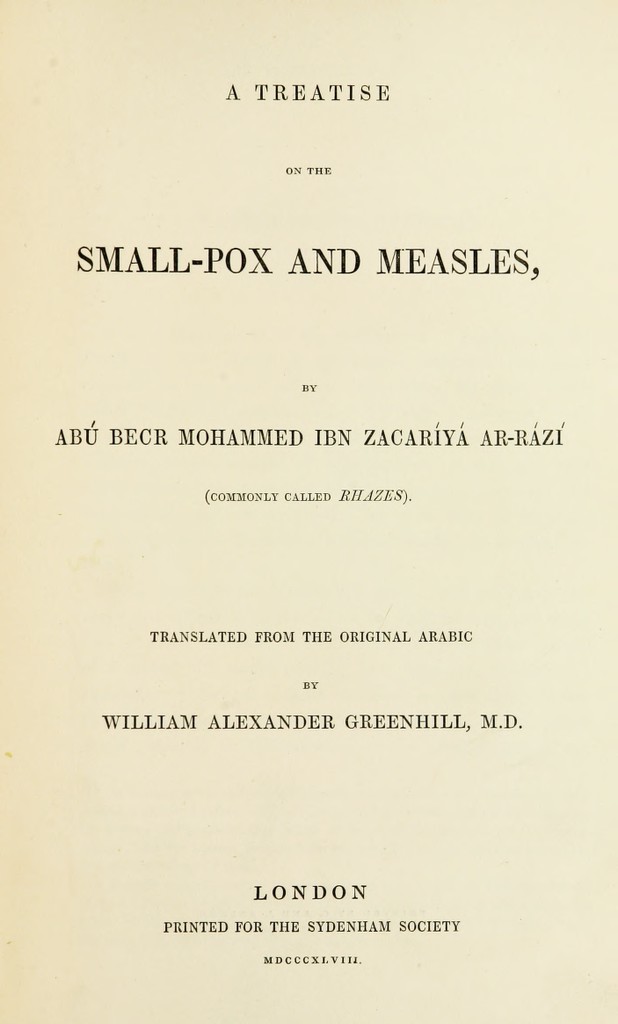
The accompanying image is the title of Greenhill's1848 smallpox/measles translation, not a Hawi page or experiment scene. Wellcome's manifest establishes its book identity and Public Domain Mark. It supplies context for reception of al-Razi's works only 18.
In culture
A catchy “first clinical trial” label removes the questions that make the account interesting: who entered the comparison, what was recorded, and how did the text travel? Tibi foregrounds comparison, while Pormann adds numbers and uncertainty rather than exception-proof praise 15 13.
Even a separate account of three cures and one milder, earlier dropsy outcome requires care. Pormann explains a difficult textual reading and revision of an earlier interpretation. It is not converted here into a verified four-person trial or 75% effectiveness. Scrutinizing wording preserves the story better than an easy promotional statistic 13.
For young readers
Imagine a card saying, “This happened after that, so that caused it.” Ask the card: what happened in the other cases, and do we know how many there were? Learning the difference between one report and a comparison needs no patient or medicine: paper question cards are enough. Never reenact a historical treatment.
A second lesson is that “I do not know” is useful when the notebook supplies no number or date. Al-Razi's reported observation opens questions about outcomes and comparison; the historian distinguishes what the notebook says from what a modern reader adds. More questions do not make its author less important. They make our understanding more precise 1.
References
- Pormann, “Qualifying and quantifying medical uncertainty in 10th-century Baghdad: Abu Bakr al-Razi,” JRSM106(9),2013,370–372; actual commentary and paper read, not all underlying primary works 1.
- Selma Tibi, James Lind Library commentary and selected Hawi translation, including caution and references; no Arabic collation claimed 19.
- Britannica, Adamson and Kaya: an individual identity basis and visible disagreement, not a museum verdict 9 10 11.
- Wellcome's1848 manifest and public-domain conditions; image contextualizes a different book 18.
Connections
- Described by
- Abu Bakr al-Razi· Al-Hawi fi al-Tibb
People and things also explored
Al-Razi's clinical comparison of smallpox and measles· Al-Razi's substance classification and structured handbook· Gerard of Cremona· Rayy· Al-Mubdi'un (programme)· Abu Bakr al-Razi· Al-Hawi fi al-Tibb
Sources
- Pormann — qualifying and quantifying al-Razi's medical uncertainty , pp.370–372
- Tibi — al-Razi and treatment comparison, James Lind Library , comparison-and-conclusion
- Pormann — qualifying and quantifying al-Razi's medical uncertainty , pp.370–371
- Pormann — qualifying and quantifying al-Razi's medical uncertainty , p.370
- Tibi — al-Razi and treatment comparison, James Lind Library , opening-and-Hawi
- Tibi — al-Razi and treatment comparison, James Lind Library , Hawi
- Abu Bakr al-Razi — Peter Adamson, Stanford , sec.1
- Tibi — al-Razi and treatment comparison, James Lind Library , comparison
- Al-Razi — Britannica , biography
- Abu Bakr al-Razi — Peter Adamson, Stanford , sec.5
- Razi, Ebu Bekir — Mahmut Kaya, TDV , pp.479–485
- Pormann — qualifying and quantifying al-Razi's medical uncertainty , p.371
- Pormann — qualifying and quantifying al-Razi's medical uncertainty , pp.371–372
- Tibi — al-Razi and treatment comparison, James Lind Library , Hawi-and-transmission
- Tibi — al-Razi and treatment comparison, James Lind Library , conclusion
- Tibi — al-Razi and treatment comparison, James Lind Library , references
- Pormann — qualifying and quantifying al-Razi's medical uncertainty , introduction
- Rhazes1848 catalogue and image — Wellcome , metadata
- Tibi — al-Razi and treatment comparison, James Lind Library , comparison-conclusion-and-references
Cite this page
islam.museum contributors. “Al-Razi's reported patient-group comparison”. islam.museum, https://islam.museum/en/invention/razi-patient-group-comparison/. CC BY-SA 4.0. Last updated 2026-11-14.
Improve this page on GitHub · Report an error · Help complete it · JSON