

At a glance
- Era
- The Buyid, Fatimid and Seljuk Era
- Region
- Egypt & Nile
Images
Quick facts
- Domain
- Optics and physics
- Kind
- Method
- First attested
- c. 1000 (approx.) CE
- Era
- Abbasid age
- Where
- Cairo
- Described in
- Kitab al-Manazir (The Book of Optics)
- Attribution
- Improvement
Who made it
- Ibn al-Haytham (Alhazen) Improver
The claim and its basis
Geometrical development of an earlier reflection problem, not invention of mirrors or all optics.
Hogendijk separates Ibn al-Haytham's lemmas from al-Mu'taman's simplifications and preserves incomplete cases; MathWorld attributes the earlier question to Ptolemy.
Sources: Hogendijk — simplified lemmas for Alhazen's problem · MathWorld — Alhazen's billiard problem · Commons — HB's Alhazen problem illustration · Kitab al-Manazir, Books 1-3, ed. Abd al-Hamid Sabra (Kuwait 1983) · İBNÜ'l-HEYSEM — TDV İslâm Ansiklopedisi (Hüseyin Gazi Topdemir) · Ibn al-Haytham — Encyclopaedia Britannica
Before it
- Ptolemy's problem and earlier conic geometry
How it works
Summary
Given the position of an object and an eye, where should light reflect on a circular mirror to connect them? This is the question associated with Ibn al-Haytham. His contribution here comprises geometrical lemmas and applications in BookV of the Book of Optics, not invention of mirrors or discovery of reflection's law from nothing 2. Modern research preserves predecessors and distinguishes his work from al-Mu'taman ibn Hud's later simplifications 3 4. A famous name does not imply one reflection point for every configuration or a completely satisfactory treatment of every case.
What it is
The givens are a circle representing the mirror in a plane, its center, and two points representing object and eye. The task is to construct a rim point satisfying equal incidence and reflection angles measured against the local normal 5. A circle's radius to that point is perpendicular to its tangent: the reference is not invariably a fixed horizontal line. This differs from drawing a chord or checking a ray already supplied, because the meeting point itself is unknown 6. It is a mathematical construction, not excavated machinery or an original mirror authenticated as the author's. An illustration posing the question is not itself proof of a solution.
The world before it
MathWorld attributes an earlier formulation to Ptolemy; that attribution is reported through the reference actually read, not independent reading of Ptolemy's text 3. Some auxiliary geometry has a more specific history in the study: inserting a segment of known length between two lines, with its extension passing through a given point, was solved by Pappus using a hyperbola–circle intersection and transmitted into texts by Ahmad ibn Musa and Thabit ibn Qurra 7. Hogendijk relates these proofs to properties in Apollonius' Conics. Using a hyperbola does not mean inventing all hyperbolas, nor does every mirror construction begin without precedents 8.
The story
The lemmas occur within an optical investigation but form linked geometrical problems: one lemma assists another, then the results return to locating reflection points 9. Readers must distinguish a mathematical tool from its intended application; not every circle is a drawing of manufactured apparatus. The historian places the Optics in eleventh-century Egypt. This record uses that broad documentary context, not an invented day or year of invention 10. Egypt is the author's setting, not a workshop address verified here. His Egyptian biography does not establish where each proof was drawn or which actual mirror he used 11.
The maker(s)
Sunni frame: The entry preserves Ibn al-Haytham's individually sourced Muslim identification while distinguishing the museum's explicit Sunni frame from personal testimony naming his school. The sources read do not name a personal legal school 12 11. An Arabic name or residence under a particular government does not establish belief.
His role is development of constructions and some proofs, not invention of everything they contain. Hogendijk finds his proof of one auxiliary construction simpler than those of Pappus, Ahmad and Thabit because it uses a different, better-adapted hyperbola property 7. The historian separately describes al-Mu'taman's alterations and generalizations: these are neither reassigned to Ibn al-Haytham nor reduced to copying without contribution 4. Distinguishing roles is historical fairness, not a slight to either scholar.
How it works
The exposition labels the centerG, the two pointsA/B and the reflection pointX. In the appropriate configuration, the angles on opposite sides of XG must agree, taking account of concave or convex surface and the positions of object and eye 5. Merely making two segments intersect at the rim is insufficient: the intended path must satisfy reflection in that configuration.
Auxiliary constructions turn the general task into intersections, lengths and ratios. In the first two lemmas, for example, Ibn al-Haytham treats a segment cut off between a circle and its diameter, separately handling its location inside or outside 13. Some work uses circle–hyperbola intersections. Drawing both curves does not make the construction a straightedge-and-compass operation 14.
For our modern teaching example only, take the unit circle centered at(0,0), objectA=(2,1) and eyeB=(2,−1). PointX=(1,0) gives two45° angles to the horizontal normal. This checks an easy symmetric case; the coordinates are not Ibn al-Haytham's data or an execution of all his lemmas 15. The ray changes direction atX, while radius and tangent are perpendicular. The example proves neither that asymmetric configurations work by the same shortcut nor that guessing an arc midpoint always suffices.
The spread
A specific reception witness is al-Mu'taman's Istikmal. Hogendijk compares its sequence with that of the Optics and regards the correspondence as evidence of use, although al-Mu'taman does not name his sources 16. Attribution of the simplifications is historical inference, not a signed declaration claiming every alteration 17. The study also mentions the medieval Latin translation and its 1572 printing as textual witnesses; that printing date is not the problem's birth 16. These are bounded traces of reception, not a complete list of everyone who read the book or studied each proof.
What it was built on
The method combines the known equal-angle law with auxiliary constructions. The study identifies Pappus' problems, Apollonius' properties and earlier Arabic traditions, locating a particular proof change rather than assigning all geometry to one individual 18. A circle as a geometrical locus differs from a circle as a reflecting surface: similar drawings can serve different functions. No dependency is invented on the dark-room experiment simply because the same scholar wrote it, or on his fourth-power volume method because it also uses mathematics. Different questions and evidence preserve the independence of these contributions; a shared biography is not a technical lineage.
What was built on it
Hogendijk describes al-Mu'taman combining cases Ibn al-Haytham treated separately, allowing a given chord to be more general than a diameter, and greatly shortening some proof 13. But shorter lemmas do not certify every optical application as repaired: the study expressly finds no evidence of improvement to all the applications it examines 19. Both findings remain. Reception is not mere repetition, but every alteration is not a final victory either. The dependent-inventions list is not populated with modern cameras or software without evidence of a particular transmission. This is a history of reasoning and construction, not a complete industrial family tree.
Impact on daily life
The effect documented in these pages is intellectual: knowing reflection's law becomes a construction question, finding a location that satisfies the condition for particular givens 2. A visitor can distinguish explaining why a ray reflects from finding one connecting object and eye. The study does not count mirrors produced, prices or improved vision in an apparatus built from the method. Those economic or medical outcomes are not guessed. The modern interpretation as a ball rebounding from a circular billiard table is a mathematical analogy, not a report that Ibn al-Haytham built such a table or used a modern game in an experiment 20.
How it changed history
The comparison shows how history can identify a precise change in proof: an alternative property used by Ibn al-Haytham, then combination and generalization by al-Mu'taman, while earlier contributions remain visible 4. Textual comparison opens another question. Hogendijk argues that shared formulations and figures in the Istikmal and Latin translation may indicate a different Western Arabic version 21. That is an argued possibility, not a new manuscript inspected here or a verdict that the Latin translator corrected everything. The witness has bounded historical value without implying that these lemmas alone founded all optics or all imaging geometry.
Who invented it?
The name does not erase the earlier question attributed to Ptolemy or turn inherited conic constructions into separate inventions by Ibn al-Haytham 3 7. The documented development is geometry, proof and optical application in the Optics, followed by alterations with their own contributors 9. Limits matter: Hogendijk finds the discussion of certain concave configurations unsatisfactory, and multiple reflection points are possible. No unique exhaustive answer to every arrangement is attributed to the author 19.
Nor should he be credited with a general algebraic quartic formula. The historian's note states a modern equivalence to a fourth-degree equation and expressly says medieval Arabic mathematicians were unaware of that equivalence 22. A relationship available to a modern reader is not a historical declaration by the author.
Today
The problem remains educational, with modern formulations and equivalents involving triangles and ellipses. MathWorld presents these relationships and references to later solutions, without our implying that every listed reference was read 23. General straightedge-and-compass impossibility permits easy symmetric cases: our45° example is a special case, not a refutation 24. Matching two angles in one drawing does not exhaust the branches or certify manufactured optics. Mathematical construction, experimental accuracy and transmission are different questions. The museum supplies neither a live optical simulator nor a device-building recipe.
Surviving examples
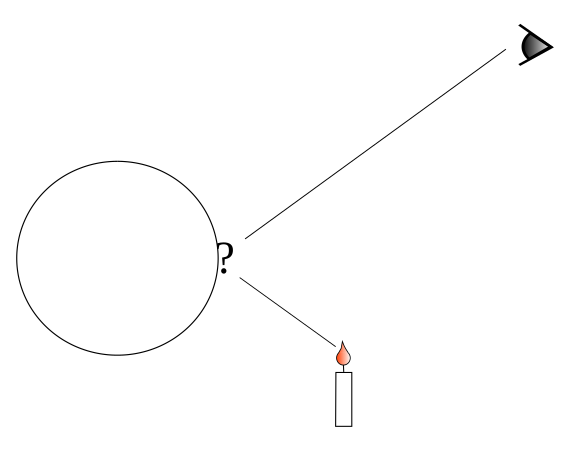
We read pages 59–75 of Hogendijk's1996 study from the author's hosted copy and inspected images 59–65. This was not reading the entire paper, an Optics manuscript or the complete Sabra1982 article 25. The study translates al-Mu'taman's lemmas; his adaptations must not become quotations from Ibn al-Haytham. The museum's previously defined Arabic Optics source covers Books1–3, not BookV: it preserves biographical evidence here, not a claim to have read material absent from that edition 26. HB's modern illustration poses the question through a question mark beside a circle, candle and stylized eye. It is not a solved ray trace or the author's historical drawing 27.
In culture
A famous name helps remember a contributor but can conceal others when treated as absolute ownership. The museum presents the earlier question, Ibn al-Haytham's development and the later alterations identified by research; that sequence needs no erasure of Greek or Arabic predecessors or later workers 3 4. Difficulty itself deserves display: knowing a general rule does not make every application easy. The eye and candle are modern teaching symbols for observer and object, not a historical person's portrait or evidence of the apparatus actually used 28.
For young readers
Draw a circle, mark a rim point and join it to the center to show the local normal. Compare two lines making equal angles with it, distinguishing checking a supplied answer from finding an unknown point 29. In our symmetric example, swapping object and eye across the horizontal axis preserves the angle sizes. This is a drawing activity, not discovery of a new law. Do not use sunlight, lasers, concentrating mirrors or observations on anyone's eyes. Paper is enough to ask: does every rim point work? If one easy point succeeds, have we proved success for every other arrangement?
References
- 25 — Read historical study with explicit limitations, not reading of all its cited originals.
- 30 — Definition, modern formulations and earlier-question attribution.
- 12 11 — Individual identity/biography, not BookV in the Books1–3 edition.
- 31 — HB,14 January2019, CC BY-SA4.0; original image unmodified.
Connections
- Improved by
- Ibn al-Haytham (Alhazen)
- Described by
- Kitab al-Manazir (The Book of Optics)
People and things also explored
Ibn al-Haytham's dark room (the camera obscura experiments)· Ibn al-Haytham's integrated incoming-light theory of vision· Ibn al-Haytham (Alhazen)· Kitab al-Manazir (The Book of Optics)· Ibn al-Haytham summoned to Cairo· Kitāb al-Manāẓir composed· Ibn al-Haytham's factorial remainder construction· Ibn al-Haytham's fourth-power volume method
Sources
- Hogendijk — simplified lemmas for Alhazen's problem , pp.59–70
- Hogendijk — simplified lemmas for Alhazen's problem , pp.59,64–65
- MathWorld — Alhazen's billiard problem , history
- Hogendijk — simplified lemmas for Alhazen's problem , pp.60–63
- Hogendijk — simplified lemmas for Alhazen's problem , pp.64–65
- MathWorld — Alhazen's billiard problem , problem statement
- Hogendijk — simplified lemmas for Alhazen's problem , p.62
- Hogendijk — simplified lemmas for Alhazen's problem , pp.62,73–75
- Hogendijk — simplified lemmas for Alhazen's problem , pp.59–65
- Hogendijk — simplified lemmas for Alhazen's problem , p.60
- İBNÜ'l-HEYSEM — TDV İslâm Ansiklopedisi (Hüseyin Gazi Topdemir) , pp.82–87
- Kitab al-Manazir, Books 1-3, ed. Abd al-Hamid Sabra (Kuwait 1983) , scan p.60
- Hogendijk — simplified lemmas for Alhazen's problem , pp.62–63
- Hogendijk — simplified lemmas for Alhazen's problem , pp.59,62–63
- Hogendijk — simplified lemmas for Alhazen's problem , pp.64–65 reconstructed special case
- Hogendijk — simplified lemmas for Alhazen's problem , pp.59–61
- Hogendijk — simplified lemmas for Alhazen's problem , pp.60–61
- Hogendijk — simplified lemmas for Alhazen's problem , pp.62–65,73–75
- Hogendijk — simplified lemmas for Alhazen's problem , p.70
- MathWorld — Alhazen's billiard problem , billiard interpretation
- Hogendijk — simplified lemmas for Alhazen's problem , pp.70–73
- Hogendijk — simplified lemmas for Alhazen's problem , p.70 note7
- MathWorld — Alhazen's billiard problem , problem and references
- Hogendijk — simplified lemmas for Alhazen's problem , p.59; pp.64–65 reconstructed special case
- Hogendijk — simplified lemmas for Alhazen's problem , pp.59–75
- Kitab al-Manazir, Books 1-3, ed. Abd al-Hamid Sabra (Kuwait 1983) , reliability note
- Commons — HB's Alhazen problem illustration , description,image,licence
- Commons — HB's Alhazen problem illustration , description and image
- Hogendijk — simplified lemmas for Alhazen's problem , pp.64–65 reconstructed paper activity
- MathWorld — Alhazen's billiard problem , problem,history,references
- Commons — HB's Alhazen problem illustration , description,history,licence
- Ibn al-Haytham — Encyclopaedia Britannica
Cite this page
islam.museum contributors. “Ibn al-Haytham's circular-mirror reflection method”. islam.museum, https://islam.museum/en/invention/ibn-al-haytham-circular-reflection/. CC BY-SA 4.0. Last updated 2026-11-13.
Improve this page on GitHub · Report an error · Help complete it · JSON