

At a glance
- Region
- Persia & Central Asia
Quick facts
- Domain
- Pharmacy, chemistry and distillation
- Kind
- Method
- First attested
- c. 1000 (approx.) CE
- Era
- Middle period
- Where
- Hamadan
- Described in
- The Canon of Medicine
- Attribution
- Improvement
Who made it
- Ibn Sina (Avicenna) Describer
The claim and its basis
Systematized assessment conditions within an older medical tradition.
Second maqalah actually read in Arabic and modern translation, without an absolute-priority claim.
Sources: The Canon of Medicine, vol. 1 (Dar al-Kutub al-Ilmiyya, Beirut, 1999) · Nasser, Tibi and Savage-Smith — assessing drugs · Alper — Ibn Sina: life and affiliation · Britannica — Avicenna · Czartoryski medicinal-jar image metadata
Before it
- Humoral pharmacology and earlier medical compendia
How it works
Summary
Seeing improvement after a substance is used does not, by itself, reveal what that substance actually did: Ibn Sina confronts this problem in a chapter of The Canon of Medicine setting out seven conditions for learning drug powers through experience 1. The contribution presented here is that organization of interpretive conditions within humoral medicine, not the invention of all experimentation or the birth of a modern clinical trial 2. This is a text asking what must be known before accepting an inference, not a patient-results table or evidence that every condition was implemented in a documented series 1.
What it is
The passage is the second maqalah in the first general division of Book 2, on simple drugs; we read its Arabic pages 318–319 in the 1999 Dar al-Kutub al-Ilmiyya edition and compared them with the scholarly translation 1 2. “Power” here is not a modern laboratory measurement: it concerns a substance's capacity to act, explained through qualities such as hot and cold and through the distinction between an intrinsic property and an incidental effect 1. Whenever the language sounds familiar, the question is whether the similarity concerns the problem, or also the theory and means of proof; this distinction avoids both simplistic celebration and dismissal 2.
The world before it
The Canon did not emerge into an empty medical world: Nasser, Tibi and Savage-Smith discuss al-Majusi's earlier compendium and explain classification of substances by heat, cold, moisture and dryness 3. Investigation of drugs belonged to this accumulated tradition, so this record does not credit Ibn Sina with every previous remedy, observation or test 4. What the inspected witness lets us identify is a known author's ordering of conditions into a connected argument, with examples of what makes an inference ambiguous 1. The chapter's opening names analogy alongside experience rather than presenting observation as the sole route to all medical knowledge 5.
The story
The study places the beginning of the Canon in Jorjan, its continuation in Rayy and its completion in Hamadan, without independently dating or locating the writing of these particular conditions 6. This record therefore uses an eleventh-century horizon, not an imagined invention day extracted from an approximate book date 3. In 2009 the three researchers published their translation and commentary in the Journal of the Royal Society of Medicine, identifying their illustrated Arabic witness as the Rome 1593 edition 4. Our inspected Arabic pages belong to the 1999 edition: the presence of the passage in both witnesses neither equates their pagination nor turns a later printing into the author's manuscript 1 7.
The maker(s)
Declared Sunni frame: Britannica explicitly calls Ibn Sina a Muslim physician; Alper argues against Shia affiliation using the reported rejection of his father and brother's Ismailism and differences in philosophical concepts, an attributed interpretation rather than conclusive personal testimony of sect 8 9. Reported contrary interpretation: Alper also describes Corbin's and Türker-Küyel's readings connecting his thought with Shiism or Ismailism and challenges them; these arguments are presented through the source actually read, not claimed as independently examined originals 9. The museum does not infer a son's belief from his father or his school from a patron or teacher, and retains earlier attributed positions in the maker record 9.
Attributing the chapter to Ibn Sina is different from attributing its modern translation: the Arabic belongs to the Canon, while the study credits Aida Tibi with translating its quoted passages 1 7. Distinguishing author, translator and commentator tells readers who supplied each interpretation 2.
How it works
First: the substance's condition. Ibn Sina separates a drug's power from qualities acquired through temporary heating or cooling, changes in its substance or contact with another material; the observation may reflect a temporary condition rather than the property being investigated 5. The question is not simply whether something happened, but which aspect of the described material produced it, a distinction developed through the chapter's examples of intrinsic and acquired qualities 5.
Second: a simple condition. With several conditions present, a symptom may disappear because one component changes, and the result may wrongly be attributed to direct action on another component; the text therefore distinguishes direct from incidental benefit 5. This is not a description of random allocation between two groups, but an attempt to reduce ambiguity within its account of disease causation 7.
Third: contrary conditions. Benefit in two conditions classified as opposites does not alone identify the substance's temperament, since action might be direct in one and secondary in the other 5. The comparison is not between treatment and placebo, but between possible explanations of benefit within a hot-and-cold framework 5.
Fourth: relative strength. A power might fail to show an effect against a stronger condition while acting in a weaker one, so absence of an effect in the first context is not conclusive about the substance's quality 5. The English translation inserts “[dosage]” when explaining progression, whereas the Arabic discusses power, disease strength and the weaker case; this difference is not turned into dosing instructions, and the bracketed word is not passed off as the Arabic author's own 5 10.
Fifth: timing. The text asks whether action appeared initially or later and whether a different or hidden action preceded it, relating these questions to intrinsic and incidental effects 1. The Arabic continues by explaining that an acquired quality can act before a natural power, changing the apparent effect over time; that qualification prevents reducing the condition to a slogan that every fast effect must be direct 11. This is not, by itself, a modern criterion valid for every substance and onset time 10.
Sixth: consistency or usual occurrence. Ibn Sina associates natural action with what happens always or in most cases rather than a rare incidental event, without specifying an observation count or a modern calculation of error probability 11. The wording is therefore not replaced by a standardized success percentage or statistical significance that he did not state 11.
Seventh: different bodies. An effect in another animal does not guarantee its counterpart in humans; the author explains differences through relative temperaments and properties specific to one body rather than another 11. This is a historical position on the limits of cross-species inference, not permission for self-experimentation, a modern ethics programme or an invitation to reenact the examples 10.
The spread
Sources discuss the Canon's circulation and place in medical education, but a book's circulation does not establish that every reader implemented all seven conditions or recorded comparable results 12 6. The specific evidence here is a passage surviving in an Arabic printing and becoming the subject of modern translation and commentary, not a complete map of drug-assessment practice across the centuries 1 2. The record consequently does not fill gaps in reception with an invented chain of institutions or pupils 4.
What it was built on
The argument draws on distinctions between an inherent property and an acquired quality, between a direct cause and a secondary effect, and on relative temperaments of substances and bodies 1. The opening and the next chapter's heading show experience and analogy as neighbouring routes in the book's structure, not interchangeable names for one activity 1. Their proximity matters: extracting the conditions from a broader theoretical structure does not make the entire Canon a purely modern experimental handbook 1.
What was built on it
The modern study uses the conditions to discuss confounding and animal-to-human inference, comparisons that illuminate the historical questions 2. Similar questions do not prove direct descent of every later drug test or establish randomization, masking and placebo comparison in the passage 1. Britannica itself warns against assuming that his contribution meant medieval physicians possessed modern research protocols 13.
Impact on daily life
The conditions address a practical difficulty: how to avoid assigning a substance a power on inadequate grounds or confusing removal of a cause with change in a secondary symptom 5. Such questions can make interpretation more cautious, but are not themselves proof of measured health improvement in a particular population; the chapter supplies no mortality or recovery figures attributable to adopting the conditions 1. The everyday contribution described is an organized questioning of judgement, not a treatment guarantee or promise about every patient 2.
How it changed history
The chapter demonstrates that reflection on evidence belongs to written medical history: its author did not simply list substances, but discussed conditions for identifying their actions 1. That textual and methodological importance can be shown from the pages themselves without turning medical history into a contest for the title “first modern scientist” 2. Accurate appreciation retains the humoral inheritance he used and the distance between a plausible historical argument and verification tools he did not describe 13.
Who invented it?
What is established is that Ibn Sina presented these conditions in the Canon, not that a survey of every earlier text proves him the first human to formulate any experimental safeguard 1 4. The record therefore treats the contribution as systematization and improvement within an earlier tradition, not the sole origin of all experimental science 4. Nor is this Ibn Zuhr's animal report or another author's comparison of patient groups: the document offers interpretive conditions, not a dated experimental report with detailed outcomes 1.
Today
Visitors can read the conditions as historical practice in separating observation from interpretation, remembering that hot and cold here do not mean readings on a modern thermometer 1. Comparison with current research calls for its own standards, not using an old text as instructions for testing on oneself or others 2. The safe museum example below concerns reasoning and paper cards only; this page supplies no recipe, substance to ingest or therapeutic testing procedure.
Surviving examples
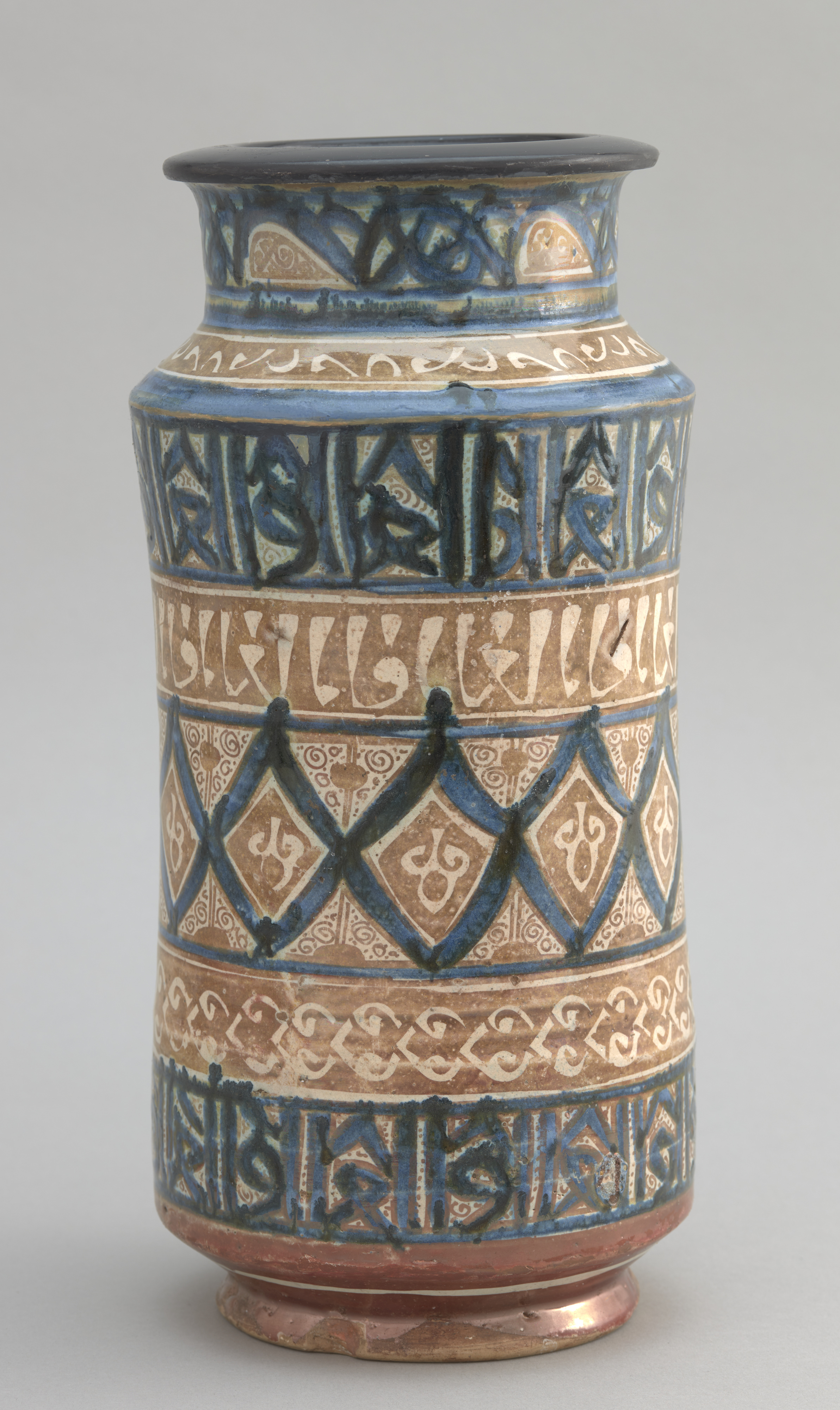
The directly examined witness consists of printed pages 318–319, where the conditions begin and end before the third chapter on analogy; this establishes their location in the inspected edition, not survival of the author's personal experimental records 1. The study identifies a different witness, the Rome 1593 printing in the Sibbald Library, with Tibi translating the text it presents 3. The reused illustration is a Valencia medicinal jar dated 1400–1425 in the Czartoryski collection, neither Ibn Sina's vessel nor evidence that its users followed this chapter 14.
In culture
A numbered list can tempt readers to imagine a direct ancestor of a present-day checklist, while explanation of each condition reveals historical meanings broader than, or different from, that analogy 2. It is possible to value the questions about cause and different bodies without concealing the humoral framework in which they were formulated 1. History here is an encounter with a document, not a modern image projected onto its author 13.
For young readers
A modern museum example, not an experiment from the Canon: imagine one paper card saying a lamp was switched on, and another saying the room became warmer. The lamp might explain it, or a window might have closed at the same time; the order of the cards alone does not choose between those stories. Add a card about the window and ask what information is still missing before deciding. This explores the difference between what we observe and what we infer, not the use of medicines. Its connection with the old text is the question of direct and secondary action, not a claim that Ibn Sina used this example 5.
References
- Ibn Sina, Canon, Dar al-Kutub al-Ilmiyya 1999, vol. 1, 318–319: text read and both page images inspected 1.
- Mona Nasser, Aida Tibi and Emilie Savage-Smith, 2009, 102:78–80: translation and commentary, not independent reading of every cited reference 4.
- Alper, first section of the Ibn Sina entry, life and affiliation; Britannica, individual Muslim description and limits of comparison with modern protocols 9 15.
- Later jar image metadata, CC0; pharmaceutical context only 16.
Connections
- Described by
- Ibn Sina (Avicenna)· The Canon of Medicine
People and things also explored
Ibn Sina (Avicenna)· The Canon of Medicine· Ibn Sina travels west to Gorgan· Ibn Sina enters Buyid service at Rayy· Ibn Sina withdraws to Khuzistan· Ibn Sina becomes vizier to Shams al-Dawla at Hamadan· Al-Tha'alibi at the Khwarazmshah's court, Jurjaniyya, c. 403/1012· Abu Abdallah al-Natili
Sources
- The Canon of Medicine, vol. 1 (Dar al-Kutub al-Ilmiyya, Beirut, 1999) , pp.318–319
- Nasser, Tibi and Savage-Smith — assessing drugs , pp.79–80
- Nasser, Tibi and Savage-Smith — assessing drugs , pp.78–79
- Nasser, Tibi and Savage-Smith — assessing drugs , pp.78–80
- The Canon of Medicine, vol. 1 (Dar al-Kutub al-Ilmiyya, Beirut, 1999) , p.318
- Nasser, Tibi and Savage-Smith — assessing drugs , p.78
- Nasser, Tibi and Savage-Smith — assessing drugs , p.79
- Britannica — Avicenna , opening
- Alper — Ibn Sina: life and affiliation , affiliation-discussion
- Nasser, Tibi and Savage-Smith — assessing drugs , p.80
- The Canon of Medicine, vol. 1 (Dar al-Kutub al-Ilmiyya, Beirut, 1999) , p.319
- Britannica — Avicenna , Canon-discussion
- Britannica — Avicenna , final-evidence-discussion
- Czartoryski medicinal-jar image metadata , description
- Britannica — Avicenna
- Czartoryski medicinal-jar image metadata
Cite this page
islam.museum contributors. “Ibn Sina's seven conditions for assessing drug effects”. islam.museum, https://islam.museum/en/invention/ibn-sina-seven-drug-assessment-conditions/. CC BY-SA 4.0. Last updated 2026-11-06.
Improve this page on GitHub · Report an error · Help complete it · JSON