

At a glance
- Era
- The Crusades, Ayyubids and Mamluks
- Region
- Anatolia
Quick facts
- Domain
- Water, irrigation and agriculture
- Kind
- Device
- First attested
- between 1204 and 1206 CE
- Era
- Middle period
- Where
- Amid (Diyarbakir)
- Attribution
- Improvement
Who made it
- Al-Jazari, Ismail ibn al-Razzaz Describer
The claim and its basis
A specific arrangement for slower alternation between two displays, not the first automatic fountain.
IV.1 description, author's predecessor criticism and explicit original-versus-copy uncertainty, plus Hill's drawing commentary.
Sources: Al-Jazari — Donald Hill translation1974 · CEZERÎ, İsmâil b. Rezzâz — TDV (Sadettin Ökten) · Al-Jazari water-device image metadata and rights — Commons
Before it
- Earlier fountain devices as reported by al-Jazari
Built on it
- Illustrated copies and Hill's interpretive reconstruction
How it works
Summary
Water rises in a single column, then the view changes to six curving jets without somebody redirecting the nozzle at each change. This is the fountain al-Jazari describes in CategoryIV, chapter 1, assigning one constant hour to each display while water continues to arrive 2. Behind the spectacle are two buckets, a tilting pipe and two tanks: filling a bucket switches the supply. This is a particular assembly within an older fountain tradition, not the invention of flowing water, the first automatic fountain, or a machine supplying its own energy 1.
What it is
One fountain in a pool changes its appearance through two separate delivery routes. A narrow pipe serves the central opening; a wider passage feeds a sphere with six holes around its upper part. The former gives a vertical jet, the latter arcs directed over the pool 3. The metal does not transform from a stick into six curves: water reaches different outlets.
The two-bucket title does not cover every fountain in the book. Chapter2 describes another arrangement with two fountains, and later chapters introduce different mechanisms and shapes; their features are not silently combined here 4. Nor is each nozzle a separate invention. Automatic means the change repeats under the stated supply conditions, not that the installation needs no resource, preparation or attention.
The world before it
Al-Jazari opens the category by discussing arrangements he attributes to the Banu Musa: vanes turned by wind or water, then a balance-like pipe and a small accumulating vessel 3. His discussion places the fountain within an earlier technical tradition. The contribution presented here is a particular choice of switching timer and its integration with two water displays, not the first appearance of every component.
His criticism is not a complete trial of earlier engineers. One account seems to him to restore the pipe before its water has finished emptying, but he explicitly does not know whether the confusion belongs to the original or a copy 3. We retain that qualification rather than declare all Banu Musa devices failures or treat a later drawing as transparent evidence of their actual hardware.
The story
The problem is not simply to produce motion but to let viewers see its effect. Al-Jazari considers a change at every vane revolution too rapid for the display to appear fully 3. His arrangement keeps display water flowing while a small branch accumulates timing water. The functions meet when the bucket tips, rather than tying every change directly to rapid rotation.
TDV places the author in Artuqid service at Amid, writing his book at Nasir al-Din Mahmud's request 5. This is the author's setting, not a surviving fountain site examined here. Hill's introduction derives 1204 or 1206 from manuscript differences, against TDV's1205; the book-date disagreement remains, without inventing this fountain's inauguration year or a Hijri date 6 5.
The maker(s)
The browser records al-Jazari as describer of this assembly: the text names parts and explains their sequence, while the biography identifies an engineer and mechanical author 2 5. That role does not make every pipe or bucket his first invention, or identify unnamed craftspeople. A later manuscript illustrator is distinct from the original author, as Hill's translation and interpretation are distinct modern contributions.
Sunni frame: TDV calls the named al-Jazari an Islamic scholar, the individual identity basis here, not inference from name, court or birthplace 5. His biography's explicit Sunni default is the museum's frame for this context, not a newly discovered personal school. The fountain extends his recorded work without replacing the earlier clocks, pump, washer or boat.
How it works
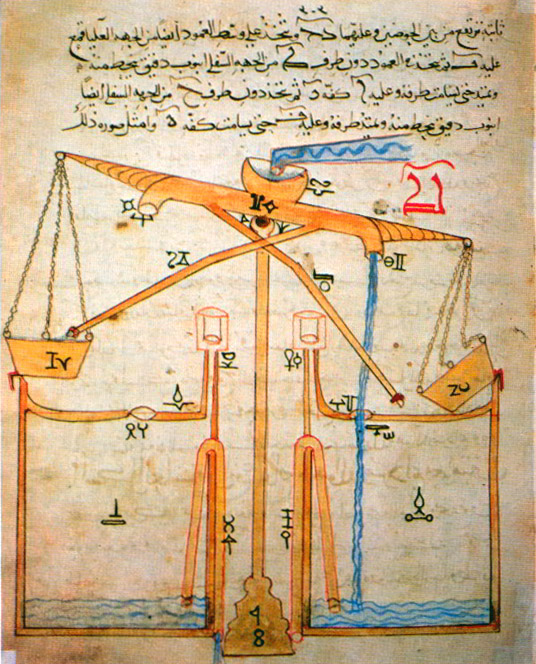
Above the two tanks a pipe pivots about its centre, receiving supply water through a funnel. When tilted to one side it delivers most water to that tank; a small branch with a calibrated outlet directs a smaller amount into the associated bucket 3. The larger flow serves the spectacle, the smaller accumulates toward the switching event. Distinguishing those functions makes the drawing intelligible.
When full, the bucket tips and empties into its tank. Its rear end raises the pipe through a connected rod, lowering the opposite end so supply now enters the other tank and starts filling its timing bucket. That bucket's eventual movement returns the assembly to the first state 7. The account needs no person to perform each switch, but repetition depends on continuing external supply, not water raising itself back to the inlet.
Separate delivery paths distinguish the vertical column from the six arcs. The narrower pipe runs inside the wider and projects above the sphere, while the other route serves the holes around it 1. Understanding this relationship does not require copied historical diameters or soldering instructions. We do not convert Baghdadi ratls and old length units into unsupported modern fabrication dimensions.
Hill explains that the machinery house needs access to a suitable water source and sufficient elevation above the display pool; dimensions depend on flow, supply and delivery head, and the intended jet height 8. Consequently “one hour” is a stated design interval, not measured precision certified for every site. Calibration, bucket capacity and supply conditions matter. No model was built here and no timing error was experimentally recorded.
The spread
The evidence followed here is transmission of a book and drawings, not a map of installations. TDV records manuscript copies, Arabic editing and English translation; Hill examines differences between wording and drawn details 5 8. These witnesses permit study of the design without establishing how many gardens used it or for how long.
Commons describes its illustration as held in the Süleymaniye Library, Istanbul, and dates it1315. Those are attributed metadata claims: no shelfmark, folio or exact chapter was independently verified here 9. A picture's present holding is not the fountain's manufacturing location, and the spread list is not populated with cities lacking evidence for this particular device.
What it was built on
The assembly uses accumulating water, a central pivot, a vessel tipping when filled, and separate passages to fixed outlets. The author himself refers back to earlier descriptions of bucket form and motion 2. Its interest lies in arranging relations and timing events, not claiming each simple element as a new discovery.
Comparison with the musical boat highlights a supply difference: the boat carries finite water and collects it internally; this fountain requires continued external inflow 10. This is a teaching comparison, not a new ancestry edge. Likewise Hill's emphasis on surveying the site's levels does not establish direct dependence on a particular book by al-Karaji 8.
What was built on it
Hill interprets the mechanism in a modern diagram, using later chapters to supply bucket projections missing from figure 121. He also identifies axle bearings drawn in the wrong plane 8. These are declared interpretive interventions, not parts discovered in archaeological hardware or details all visible in the original illustration.
He stresses that his diagram is not proportional and that dimensions depend on the site 8. It is therefore not a ready-made plan for any scale. Similar switching displays in modern fountains do not alone demonstrate an industrial transmission chain from this chapter to electric valves or contemporary software.
Impact on daily life
The direct effect described is visual: water holds one form for a time, then another, rather than presenting an unchanging view 3. Delaying alternation can be read as attention to the viewer's time, since the author criticizes intervals too brief for the effect to appear. This is a bounded interpretation of display purpose, not evidence for the comfort or water consumption of an entire city.
Beauty must also be distinguished from drinking-water or irrigation service. The chapter describes a pool fountain and its feed; it establishes neither water sterilization nor agricultural savings 2. Inclusion in the water domain does not transfer the benefits of every water project to it, or show equal access to its spectacle across society.
How it changed history
The witness brings visible mechanism, temporal sequence and criticism of predecessors into an inspectable account. The text explains what switches the route; modern commentary separates wording from the interpreter's repairs to the drawing 1. It is material for the history of hydraulic control and technical representation, not the sole cause of all later automation.
Distinguishing criticism of an original from criticism of its copy matters to knowledge history too. Turning the author's unresolved explanation of confusion into a firm verdict loses part of his reasoning 3. The comparison remains useful when its limits are shown, rather than made into a claim of comprehensive triumph or a ranking of whole civilizations.
Who invented it?
Author's account within the declared Sunni frame: Al-Jazari explains his two-bucket arrangement and discusses earlier descriptions, expressly allowing copying error; we credit this specific account without judging all Banu Musa work from his remarks 2. A maker-author explaining his approach is not a worldwide survey of every older fountain.
Academic interpretation: Hill explains operation but identifies bearing orientation, omitted projections and details requiring site planning 8. These are not competing claims for a different inventor, but different levels of evidence. Attribution here is a described improvement and integration, not global priority or proof of precise performance from a drawing alone.
Today
Readers can follow supply, timing and switching before attempting any reconstruction. A modern model is not an exact replica merely because it changes water patterns: its copied, inferred and newly added features must be distinguished 8. This entry has not examined an original surviving fountain or a modern experiment measuring its hourly precision.
The analytical lesson is simpler than building hardware: fixed outlets can produce a changing view when their feed changes. This summarizes the pipe-and-sphere relationship for teaching, not a new physical discovery or a pressure-system construction guide 2.
Surviving examples
We read selected Hill translation passages in the category opening and chapter 1,157–158, and the specific commentary 263; the chapter opening and 158 with figure 121 were visually inspected in the shared reader 1. This is limited reading, not collation of every manuscript or a claim to have read every edition and language.
The displayed picture is a separate public-domain reproduction, not Hill's modern page. A feed arm, two buckets and tanks, and central outlet are visible 11. Commons supplies 1315 and Süleymaniye, but we supply no independently verified shelfmark or claim that this is the identical witness to figure 121. The historical artist is unnamed; the image is neither an author portrait nor surviving metalwork measurable from paper.
In culture
The text calls the vertical jet a qadib and the curved jet a sawlajan, explained by Hill through stick and polo-stick imagery 12. These words help readers imagine shapes. They are not verified plant names, and shapes from other fountain chapters are not imported into this account.
Writing and drawing together show a water machine as something to see and explain. Yet an attractive painting alone does not establish successful construction: Hill's drawing criticism demonstrates why wording, pivot and tank should be read together 8. The story needs no promotional “first smart fountain” label to remain engaging.
For young readers
Try a museum-made paper activity, not a historical experiment. Draw two cards: one column and six arcs. Imagine a timing bucket holding6 units, receiving2 per step. After 3 steps change the card and reset the counter. Repeat for the second state: a complete cycle takes 6 steps. These are invented teaching quantities, not Baghdadi ratls or measurements of al-Jazari's machine.
Now give the second side only 1 unit per step: it needs6 steps, making a9-step cycle. Equal capacities do not ensure equal times when inflow differs. The paper lesson relates to the calibrated outlets in the account, not to measured historical performance 2. No water, pressure, glass, weights or machine-building is involved.
References
- Donald Hill's1974 translation, CategoryIV opening/chapter 1,157–158, figures 120–121, and specific commentary 263; selected actual reading, not page reproduction.
- Sadettin Ökten, CEZERÎ, TDV, vol.7,1993,505–506; biography, individual identity basis and book context.
- Commons water-device image, description, file history and PD-Art rights; picture inspected, exact chapter/shelfmark not independently verified.
Connections
- Described by
- Al-Jazari, Ismail ibn al-Razzaz
People and things also explored
Al-Jazari's elephant clock· Al-Jazari's animal-powered scoop water-lifter· Al-Jazari's castle water clock· Al-Jazari's waterwheel-driven double-piston pump· Al-Jazari's hidden-drive water lifter· Al-Jazari's musical boat automaton· Al-Jazari's peacock hand-washing design· Al-Jazari's swordsman candle clock
Sources
- Al-Jazari — Donald Hill translation1974 , pp.157–158,263
- Al-Jazari — Donald Hill translation1974 , pp.157–158
- Al-Jazari — Donald Hill translation1974 , p.157
- Al-Jazari — Donald Hill translation1974 , pp.158–159,263
- CEZERÎ, İsmâil b. Rezzâz — TDV (Sadettin Ökten) , pp.505–506
- Al-Jazari — Donald Hill translation1974 , introduction-life
- Al-Jazari — Donald Hill translation1974 , p.158
- Al-Jazari — Donald Hill translation1974 , p.263
- Al-Jazari water-device image metadata and rights — Commons , metadata
- Al-Jazari — Donald Hill translation1974 , pp.107–109,157–158
- Al-Jazari water-device image metadata and rights — Commons , image,rights
- Al-Jazari — Donald Hill translation1974 , p.157-note
Cite this page
islam.museum contributors. “Al-Jazari's two-bucket alternating fountain”. islam.museum, https://islam.museum/en/invention/jazari-alternating-fountain/. CC BY-SA 4.0. Last updated 2026-11-13.
Improve this page on GitHub · Report an error · Help complete it · JSON