

At a glance
- Era
- The Buyid, Fatimid and Seljuk Era
- Region
- Levant & Iraq
Images
Quick facts
- Domain
- Mathematics and computation
- Kind
- Method
- First attested
- c. 1000 (approx.) CE (derived)
- Era
- Middle period
- Where
- Baghdad
- Attribution
- Improvement
Who made it
- Al-Karaji Improver
The claim and its basis
Extended arithmetic tools to unknowns, powers and composite expressions within earlier algebra, not creation of all algebra or its complete modern theory.
MacTutor describes addition, subtraction and multiplication of composite expressions, narrower division and restricted root extraction; TDV confirms retained geometrical demonstration.
Sources: Al-Karaji — MacTutor mathematical biography · Kereci — TDV encyclopaedia · Karaji and The Extraction of Hidden Waters — Ataie-Ashtiani and Simmons · Extrait du Fakhrî — Woepcke1853 · Polynomial expansion image metadata — Wikimedia Commons
Before it
- Algebra (al-jabr wal-muqabala as a discipline in al-Khwarizmi's work)
- Diophantine arithmetic
Built on it
- Al-Samawal's reception and development
How it works
Summary
We know how to add and multiply numbers, but how do we calculate when some quantities remain unknown? Abu Bakr al-Karaji made powers and composite expressions objects of organized, number-like operations in his mathematical work at Baghdad in the early eleventh century 1 2. This developed earlier algebra: it was neither algebra created from nothing nor invention of the letters and exponents used in our examples 1. Understanding the achievement also means distinguishing a useful historical procedure from a complete modern theory 1.
What it is
The subject includes single terms representing an unknown quantity, its square, cube and reciprocal powers, followed by quantities composed of sums of terms 1. MacTutor calls these “composite quantities” and describes addition, subtraction and multiplication, while distinguishing more restricted division 1. “Polynomial arithmetic” is our modern explanatory name for part of this work, not a claim that the author used today's definitions or notation 1. His treatment also included reciprocals, so our title does not literally reproduce the boundaries of his historical classification 1.
The world before it
Al-Khwarizmi and later algebraists had already developed a tradition of equation solving, while Diophantus's arithmetic problems supplied another resource that al-Karaji studied and developed 1. MacTutor explains the new direction through the encounter between Diophantine arithmetic and Arabic algebraic concepts, not the disappearance of either inheritance 1. The names of roots, squares and cubes were not created from nothing; the development emphasized here is organized calculation on the unknown quantity's successive powers 1. Earlier equation solving and a broader arithmetic of the expressions entering equations are related but distinct achievements.
The story
The biography locates his principal mathematical books in Baghdad, and TDV connects al-Fakhri with Fakhr al-Mulk's patronage in the Buyid setting 1 2. This describes political patronage within the Abbasid world, not the author's personal religious school 2. Woepcke's historical introduction discusses identifying the author and patron as well as difficulties with his manuscript, also documenting nineteenth-century scholarship 3. We retain century-level dating: neither the1853 publication date nor a proposed lifespan supplies an exact day when the method was composed.
The maker(s)
Sources discuss both al-Karaji and al-Karkhi: the former points toward Karaj, the latter toward Baghdad's Karkh district; MacTutor does not treat the family's origin or exact birthplace as certain 1. The Muslim basis is more specific than a name: Ataie-Ashtiani and Simmons explicitly identify the named mathematician and engineer as Muslim 4. Sunni is separately the museum's labelled default for the Abbasid/Baghdad milieu, not personal testimony or an inference from a Buyid patron; the read biographies name no contrary personal affiliation 2 1. His technical role here is improver, preserving earlier contributors 1.
How it works
The starting point is distinguishing successive powers of one quantity: the unknown, its square, its cube and further powers; the biography also includes their reciprocals 1. Multiplication needs a rule identifying the resulting power, rather than a new geometrical diagram for each operation 1. In modern teaching notation, x² multiplied by x³ gives x⁵; this is our illustration, not a manuscript transcription 1. MacTutor stresses that he approached the exponent-product law without defining x⁰=1, so the complete modern formulation is not credited to him 1.
Next come composite expressions: addition and subtraction distinguish kinds of term, while multiplication combines terms before collecting matching results 1. Our modern example (x+2)(x+3) gives x²+3x+2x+6, then x²+5x+6. Setting x=2 provides a numerical check: four times five is twenty, as is four plus ten plus six. These are our explanatory numbers and symbols, not an example claimed to have been copied from the historical book 1.
Substitution can uncover an arithmetic mistake, but agreement at one value does not prove a rule for every value. We distinguish performing an operation, checking an example and justifying a general rule. MacTutor's account of historians' disagreement over al-Karaji's demonstrations is not resolved by one successful numerical example 1. Readers can practise with another value without converting their exercise into historical evidence about the author's text or a claim that the museum has independently checked every problem in his book.
The procedures were not equally general. MacTutor describes division of a composite quantity by a single term, not an algorithm dividing any polynomial by any other polynomial 1. Its account of extracting a composite expression's square root requires positive coefficients, not a solution of all modern root-extraction problems 1. Equation solving also had limits: the biography reports Crossley's distinction between quadratic problems, higher-degree cases reducible to them, and a general solution of higher-degree equations 1.
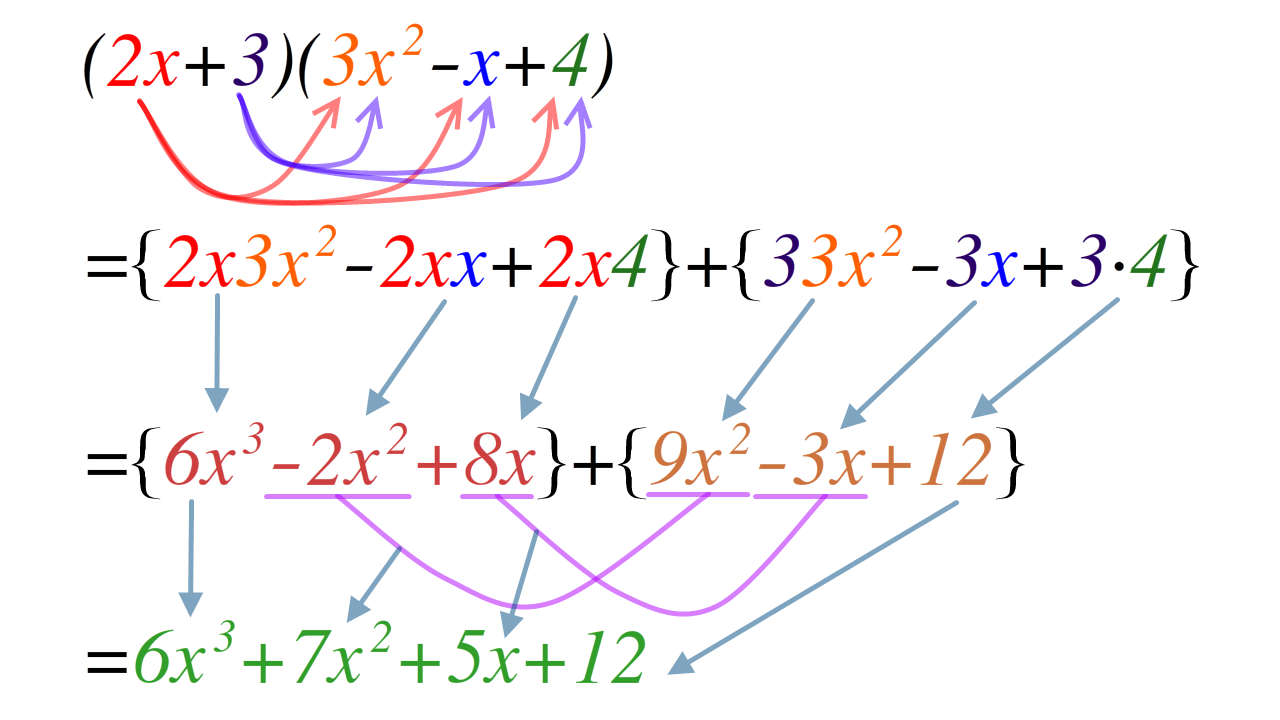
Powers also explain expanding a sum. The biography describes a cube in al-Fakhri, cubic and fourth-power expansions in al-Badi, and a construction of expansion coefficients transmitted through al-Samawal 1. Later testimony matters, but it does not mean every passage has been read here in al-Karaji's own text 1. Our coloured image uses negative terms and modern symbols solely to explain distributive multiplication: it is not evidence that he used that notation or every modern convention for coefficients 5.
The spread
Al-Samawal supplies a named instance of reading and continuing al-Karaji's work, not a complete map of its passage through every school and country 1. TDV lists works, editions and studies, showing that the mathematical heritage also reached readers through later textual scholarship 2. The sources read here provide no census of readers or measured speed of transmission between cities. A published text available today does not establish uninterrupted teaching since its composition; one documented later reader does not establish a direct route to every modern curriculum.
What it was built on
Al-Khwarizmi's algebra and Diophantine arithmetic represent different intellectual resources meeting in this development, according to MacTutor's historical account 1. That account does not present al-Karaji as merely copying Diophantus: it emphasizes generalization and attempts to find more widely applicable methods 1. Conversely, al-Fakhri retained geometrical demonstrations, as TDV confirms, rather than rendering earlier mathematical practice invalid or extinct 2. The relationship diagram summarizes these resources; it does not reconstruct a classroom or claim personal meetings between scholars of different centuries.
What was built on it
The biography connects this work with al-Samawal's later development and uses his testimony to describe constructing expansion coefficients step by step 1. It also describes al-Karaji moving from one case to the next and stating that the procedure can continue, explicitly distinguishing this from rigorously formulated modern induction 1. One example concerns the sum of consecutive cubes and the square of the corresponding sum, demonstrated through a repeated argument in a numerical case 1. These belong to the arithmetic story, not a separate claim of worldwide priority for every coefficient triangle or binomial theorem.
Impact on daily life
The closest source-supported effect concerns mathematical practice: unknown expressions become objects of successive calculation rather than requiring their numerical value before operations begin 1. Alongside algebraic works, TDV discusses al-Kafi and water-related writing; MacTutor also describes geometrical measurement and weighing topics 2 1. Multiple interests do not establish that a particular merchant or well-digger used this multiplication procedure. We distinguish an accessible everyday analogy from a historical record proving that application.
How it changed history
As reported by MacTutor, Woepcke's and Rashed's interpretations emphasize algebraic operations becoming less dependent on geometrical representation, an important direction toward autonomous algebraic arithmetic 1. The account it reports from Crossley stresses numerical examples, limits of demonstration and retained Euclidean theorems in equation solving 1. TDV likewise notes geometrical proof in al-Fakhri 2. We present these interpretations without resolving them through “geometry was abolished”: new operational organization and older forms of justification can coexist in one body of work.
Who invented it?
The bounded claim concerns al-Karaji's development of arithmetic on powers and composite expressions within earlier algebra, not the first human multiplication of an unknown or authorship of every modern algebraic tool 1. The precursors explain the improvement classification, while the structured perspectives preserve historians' differing assessments of independence from geometry 1 2. Appearance in a surviving work is not automatically absolute priority across all traditions. Nor does the historical expression “algebraic calculus” mean invention of differential and integral calculus, which modern readers might associate with that word 1.
Today
A present-day lesson in expanding products illustrates the principle, but resemblance does not establish a direct transmission chain to a particular textbook or symbolic program 1. Min666645's2014 image was selected because it makes termwise multiplication and collection visible, with attribution, CC BY-SA3.0 and the image unchanged 6. It is a teaching window from the present into a historical question, not an archaeological object. Letters, exponents, colours and negative terms belong to this modern example; they cannot establish the appearance of al-Karaji's manuscript.
Surviving examples
The witnesses are textual: TDV discusses al-Fakhri, al-Badi and other works and their editions and scholarship 2. Woepcke's introduction describes damaged manuscript material and restoration, reminding readers that an edition has editorial mediation 7. We read only actual printed pp3–4 of the1853 publication; reader label PA1 is not its printed page number. Neither the complete al-Fakhri, al-Samawal's original nor all studies reported by MacTutor were independently read here. Their details remain attributed to the source actually consulted; the modern picture is not substituted for a manuscript witness.
In culture
Even the author's name illustrates historical uncertainty: the biography discusses competing al-Karaji/al-Karkhi readings and their implications instead of converting a familiar nisba into a certain birthplace 1. Mathematical and engineering works place one author across several fields without requiring a title such as “inventor of everything” 2. Appreciation and limits of knowledge can coexist in a museum account. Named texts, examples and interpretations let a visitor follow a developing intellectual tool rather than a national competition that erases predecessors or imposes a final verdict among historians.
For young readers
Imagine a bag containing an unknown number of counters. We want “the bag plus two” multiplied by “the bag plus three.” Our modern example calls the unknown x. Each part must meet every other part; afterward we collect matching kinds. We can organize that calculation before finding the value of x. This illustrates the biography's general idea of arithmetic on unknown quantities; it is not a puzzle copied from an old book 1. x and x² are different kinds and cannot simply be collected as identical things. The coloured picture is modern teaching material, not a page written by al-Karaji 5.
References
- 8 — Operations, limitations, historians' interpretations and al-Samawal's testimony; underlying references not independently read.
- 2 — Career, nisbas, patronage, works and retained geometrical demonstrations.
- 4 — Explicit named Muslim classification, not adoption of every date or claim.
- 3 — Historical introduction actually read, not the complete primary text.
- 6 — Creator, licence and modern-image context.
Connections
- Improved by
- Al-Karaji
- Enabled
- Al-Karaji's binomial-coefficient recurrence
- Built on
- Algebra (al-jabr wal-muqabala as a discipline in al-Khwarizmi's work)
People and things also explored
Al-Karaji's binomial-coefficient recurrence· Al-Karaji· Abu Kamil's algebra with irrational coefficients· Al-Karaji's levelling and tunnel-alignment methods· al-Khwarizmi· al-Samaw'al al-Maghribi· Fibonacci· Baghdad
Sources
- Al-Karaji — MacTutor mathematical biography , Biography
- Kereci — TDV encyclopaedia , pp. 277–278
- Extrait du Fakhrî — Woepcke1853 , pp. 3–4
- Karaji and The Extraction of Hidden Waters — Ataie-Ashtiani and Simmons , p. 762
- Polynomial expansion image metadata — Wikimedia Commons , Description; Licensing
- Polynomial expansion image metadata — Wikimedia Commons , Description; Licensing; File history
- Extrait du Fakhrî — Woepcke1853 , p. 3
- Al-Karaji — MacTutor mathematical biography , Biography; references
Cite this page
islam.museum contributors. “Al-Karaji's polynomial arithmetic”. islam.museum, https://islam.museum/en/invention/karaji-polynomial-arithmetic/. CC BY-SA 4.0. Last updated 2026-11-05.
Improve this page on GitHub · Report an error · Help complete it · JSON