

At a glance
- Era
- Abbasid Fragmentation
- Region
- Persia & Central Asia
Quick facts
- Domain
- Medicine and surgery
- Kind
- Method
- First attested
- c. 910 CE · c. 298 AH
- Era
- Abbasid age
- Where
- Rayy
- Attribution
- Original
Who made it
- Abu Bakr al-Razi Inventor
The claim and its basis
The first known written separation of smallpox and measles as distinct diseases — a step in differential diagnosis, not epidemiology.
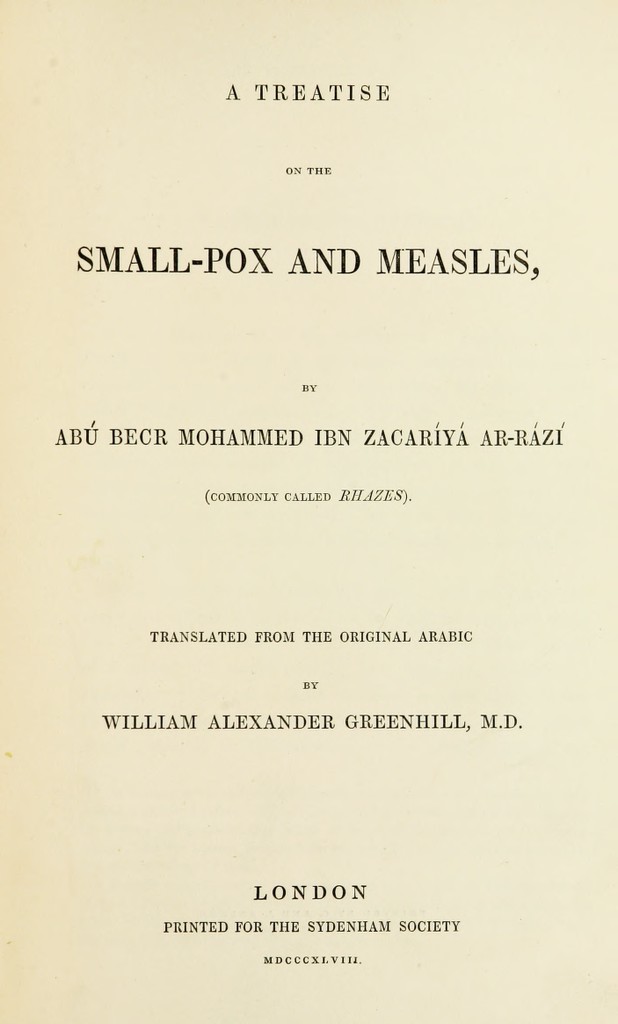
Greenhill's 1848 edition translates the Arabic text with a dated introduction establishing the credit of separation; the WHO overview treats the treatise as the identification landmark.
Sources: Rhazes on smallpox and measles — Greenhill1848 · Smallpox — World Health Organization · Encyclopaedia of Islam, 2nd edition (Leiden: Brill, 1954–2008), 13 volumes
Before it
- Clinical observation of smallpox and measles in Arabic and Greek medicine — known entities but not separated.
Built on it
- The differential-diagnosis tradition in medicine — the idea of separating similar diseases by distinctive signs.
How it works
Summary
Al-Razi's short book "On Smallpox and Measles" is the first known medical text to tell two dreaded diseases apart. Before it, smallpox and measles were one confusing pox; after it, physicians could name which patient faced which danger — the earliest written exercise in what medicine now calls differential diagnosis. Translated into Latin and printed in the fifteenth century, it became the first medical book ever printed 1.
What it is
A clinical treatise: definitions of smallpox and measles, their differing signs — the fever's character, the eruption's look and course — their causes as al-Razi's theory framed them, and regimen for each. Its invention is the separation itself 1.
The world before it
Both diseases were ancient and both were seen — but as one "pox" family. No known earlier text separated them as independent diseases with their own courses; treatment was generic.
The story
The maker(s)
Abu Bakr Muhammad ibn Zakariya al-Razi (c. 854–925), physician of Rayy and Baghdad; his faith is recorded on the person record under the museum's declared Sunni frame with the academic debate noted there.
How it works
The method is comparison by sign: lay the two courses side by side — onset, fever quality, eruption timing, distribution, sequelae — until the clusters of signs resolve into two diseases. Once separated, each gets its own prognosis and regimen 1.
The spread
Latin as "De variolis et morbillis," it travelled into the European curriculum, was among the earliest medical incunabula, and stayed in print for three centuries.
What it was built on
On accumulated clinical observation of both diseases in Greek and Arabic practice — the diseases were known; the differentiation was new.
What was built on it
The whole habit of differential diagnosis: separating look-alike diseases by discriminating signs, the daily grammar of modern medicine.
Impact on daily life
Correct naming meant correct nursing: smallpox and measles differ in danger, course and care, and telling them apart changed what a family could expect.
How it changed history
It founded the differential method in infectious disease — and as Europe's first printed medical book it carried that method into print culture itself 2.
Who invented it?
Al-Razi, on the record read: no earlier differentiation text is known, and later writers cite his. The claim is textual priority, not discovery of the diseases 1.
Today
Smallpox is eradicated (1980) and measles is vaccine-managed — but every "rule out" in a clinic descends from the method this treatise pioneered.
Surviving examples
The Arabic text in Greenhill's 1848 translation and the manuscript tradition behind it 1.
In culture
A fixture of "firsts in medicine" lists — the book that told two plagues apart.
For young readers
Long ago two diseases looked so alike that people treated them as one. Al-Razi wrote: watch the fever and the rash closely, and you will see they are two different enemies — and must be fought differently. That careful watching is what doctors still do every day.
References
Connections
- Invented by
- Abu Bakr al-Razi
People and things also explored
Al-Razi's clinical comparison of smallpox and measles· Al-Hawi: al-Razi's comprehensive compendium of medicine· Al-Razi's distillation of petroleum into white naft· Al-Razi's reported patient-group comparison· Al-Razi's substance classification and structured handbook· Gerard of Cremona· Rayy· Al-Mubdi'un (programme)
Sources
- Rhazes on smallpox and measles — Greenhill1848
- Smallpox — World Health Organization
- Encyclopaedia of Islam, 2nd edition (Leiden: Brill, 1954–2008), 13 volumes
Cite this page
islam.museum contributors. “Al-Razi's treatise on smallpox and measles”. islam.museum, https://islam.museum/en/invention/razi-smallpox-treatise/. CC BY-SA 4.0. Last updated 2026-11-15.
Improve this page on GitHub · Report an error · Help complete it · JSON