

At a glance
- Era
- The Early Abbasid Caliphate
- Region
- al-Andalus & Europe
Quick facts
- Domain
- Music and instruments
- Kind
- Instrument
- First attested
- c. 800 (approx.) CE
- Era
- Abbasid age
- Where
- Cordoba
- Attribution
- Contested
Who made it
- Ziryab Improver
The claim and its basis
Attributed refinement by adding a fifth string; no established universal priority or inevitable guitar descent.
Maqqari explicitly attributes the addition; Reynolds exposes his editing of older voices, so retellings are not independent confirmations.
Sources: Nafh al-Tib min Ghusn al-Andalus al-Ratib — al-Maqqari · Ziryab — TDV · Al-Maqqari's Ziryab: The Making of a Myth — Reynolds · Ziryab, lyre of civilization — Al Jazeera · Oud1918.350 — Cleveland Museum of Art
Before it
- Four-string oud inherited in the account
How it works
Summary
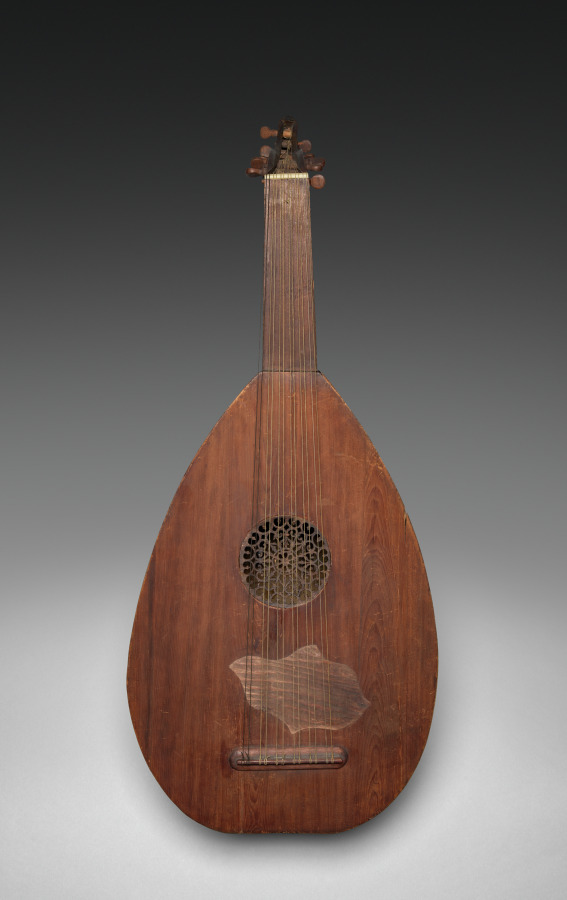
Maqqari attributes an additional oud string to Ziryab in al-Andalus, following an inherited four-string arrangement: a refinement, not invention of the oud itself 1. This is a qualified historical attribution because Dwight Reynolds shows how Maqqari assembled older voices into an idealized portrait of one artist 3. The photograph shows a much later Cleveland instrument, not an oud surviving from his court 4.
What it is
The subject is an extra string within the oud's arrangement, not a separate new instrument. The account calls it red, places it below the mathlath and above the mathna, and associates it with the soul in an instrument-as-body analogy 1. This specifies the attributed contribution: changing the equipment of a familiar instrument, expressed through an old combination of music and humoral ideas, rather than a surviving product with complete dimensions and tuning specifications 1.
The world before it
Maqqari begins with a four-string oud corresponding to four bodily temperaments; the addition therefore presupposes an existing instrument and performing craft 1. His Baghdad training story places Ishaq al-Mawsili's oud beside Ziryab's, with competition over singing and instrument refinement, not discovery of the plucked string from nothing 5. Naming that inheritance preserves other people's work without inventing an unknown first maker to complete a diagram.
The story
The TDV biography connects Ziryab with Baghdad, Kairouan and Cordoba, dating his arrival at Abd al-Rahman II's court to 822. It does not establish that as the year the string was added 6. Maqqari recounts a meeting with Harun al-Rashid, refusal to use the teacher's oud, preference for an instrument made by his own hands, westward departure and generous Andalusi patronage 7.
The attractive narrative needs a distinction between storyteller and witness. Maqqari wrote much later; Reynolds's comparison reveals multiple, sometimes contradictory sources behind the Ibn Hayyan material he used 8. The record consequently gives a broad ninth-century setting, not an invented year, day or court session for the modification 1.
The maker(s)
The attributed improver is Abu al-Hasan Ali ibn Nafi, Ziryab. TDV describes training under Ibrahim al-Mawsili and his son Ishaq, placing him within an educational tradition 6. The Muslim identity basis here is Al Jazeera's explicit presentation of his biography in its Muslim Scholars series: a named biographical classification, not a personal profession of belief. Sunni is separately the museum's declared frame, not a personal school proved by his name or patron 9. Reynolds's suggestion of a convert father is not substituted for that basis 10.
How it works
TDV, reporting Henry George Farmer, adds a tuning account distinct from string count: Ziryab introduced the older Arabic tuning established by Ibn Misjah and revised by Ishaq al-Mawsili after an earlier single-octave system in al-Andalus 6. This is the encyclopedia's account of the historian, not independent reading of Farmer or a modern frequency specification for Ziryab's oud.
Tuning, string count and striking are three questions: count concerns the additional string and its position, tuning concerns relationships between sounds, and the plectrum changes the means of exciting vibration 11 6. Attributing all three to one person does not make them one change. Adding a string does not automatically specify its tuning, and changing a plectrum does not add a string; symbolic color cannot supply missing acoustic values.
Al Jazeera's modern account gives a plectrum detail: seven eagle-wing feathers soaked in oil for months until softened, replacing wood 12. This is a named journalistic account, not new primary text verified in al-Maqqari or a craft instruction offered to visitors; keeping it separate distinguishes modern elaboration from the earlier general claim 12 11.
The account relates string order, colour and thickness: a yellow zir, red mathna, white mathlath and black bamm, with the additional red string between the middle ones 1. The colours are not a modern key from which frequency can be calculated. They participate in an analogy of humours and soul, not medical evidence or an acoustic law 1.
A separate improvement replaces a wooden plectrum with an eagle quill, praised for lightness and gentleness on the strings. Changing the plucking tool is not the same act as adding a string 11. The passage does not supply a fully specified fifth-string pitch or measurements from which to reconstruct the instrument faithfully 1.
The spread
TDV names Seville, Toledo, Valencia and Granada among places with schools modeled on Cordoba and reports Farmer's account of the school's continuation until the Andalusian caliphate ended 6. These locate educational history, not dated arrival of a fifth string in each workshop. A school offers a learning context without authenticating a particular instrument or identical string counts for every pupil 6.
The biography attributes organized singing instruction in Cordoba and schools on its model in other Andalusi cities. It describes stages moving from rhythm and words to melody and then performance subtleties 6. These are accounts of teaching, not an inventory of five-string ouds or a map recording each instrument's arrival 6. The spread of a reputation and teaching model cannot automatically become a documented material route for every string.
What it was built on
The clear inheritance is the account's four-string oud and the singing craft learned from earlier teachers, not an empty field created by one person 13. The instrument/body comparison is itself part of the historical explanation: useful for understanding that thinking, not for describing human physiology today 1. The teaching diagram shows this limited relationship rather than attaching it to an undocumented invention.
What was built on it
Cleveland discusses the oud's lute-family connections and wider influence, but a family description does not establish the route from Ziryab's particular string to a particular guitar 4. Reynolds observes modern performers claiming descent from Ziryab's music; that is meaningful cultural memory, not a handover record for every melody or wooden component across the centuries 14. Similar names therefore do not create a confirmed technical dependency.
Impact on daily life
TDV's Cordoba school history puts education alongside craft and performance, so Ziryab's contribution is not reduced to one material alteration 6. The school concerns learning, al-Maqqari's string concerns an instrument; they connect through performance without institutional history substituting for a surviving oud 6 11.
Maqqari locates singing and the oud in court gatherings and instruction, and names sons and daughters who practiced the craft: a social and professional setting rather than simply a slogan about solitary invention 15. Reynolds restores family music-making and differing children's abilities to a scene obscured by the singular-genius portrait 16. These accounts cannot quantify use of the additional string beyond the circles described.
How it changed history
Ziryab became central to the story of Andalusi music. Reynolds describes a remembered figure combining musical genius, elegance and courtly accomplishment, enlarged by texts separated in time 17. This matters historically even where priority cannot be proved: it shows how a culture chooses one personality to embody artistic transmission and changing taste 10. It does not mean every detail is fabricated; it means the portrait needs its sources and voices kept visible.
Who invented it?
TDV phrases priority more categorically. Its authors' attribution remains visible without treating a later encyclopedia as an independent ancient artifact confirming the claim 6.
Today
Cleveland describes the oud as still prominent, recognizable by its pear-shaped body, fretless fingerboard and angled pegbox 4. Continuity of the name does not make every present-day oud preserve Ziryab's reported arrangement. Nor can the visible string count in a modern photograph settle a ninth-century question 4 1.
Surviving examples
Cleveland's accompanying oud illustrates a later instrument, not Ziryab's: its overall dimensions are 81.3 by 33.7centimetres, and the catalogue describes a pegbox angled 45 to 90 degrees to the neck 18. These belong to the catalogued object, not an assumed ninth-century instrument; a later pictured string cannot date its first addition or establish colors in the older narrative 4.
The catalogue mentions al-Farabi's Great Book of Music and its explanation of the Arabic modal system 4. This connects the instrument with theoretical musical writing, not proof that al-Farabi saw Ziryab's oud or transmitted his fifth string. Instrument family, theoretical description and evidence for one improvement are distinct matters 4.
The photographed Cleveland oud1918.350 is West Asian, late1800s–early1900s, made of wood, gut and metal. Its image is CC0 19. Its wooden body, decorated soundhole, strings and pegs are clearly visible: a much later comparison, not Ziryab's instrument or a documented reconstruction 20. The evidence for the attribution here is textual, not ownership of a surviving original.
In culture
TDV places stories about dress, hair, food and hygiene beside music. This records the breadth of Ziryab's cultural image, not patents granted for every custom mentioned 6. Reynolds reads that breadth against nostalgia for a lost Andalusi golden age and the making of memory: studying a cultural symbol differs from proving the first maker of every detail 21.
For young readers
Imagine someone telling you that a small part was added to an old instrument. Ask what existed before it, who tells the story and whether the same object survives. Ziryab's account has earlier strings and an extra one attributed to him, while the photographed oud is much later 1 4. Compare description and photograph without treating them as one witness: a museum visit becomes practice in asking questions, not a competition to memorize inventors.
References
- Maqqari, Nafh al-Tib, Ihsan Abbas edition3:122–129, especially 126; actual Shamela text, not an independent original Ibn Hayyan reading. 22
- Fazli Arslan and Fatih Erkocoglu, TDV44(2013),464–465. 6
- Dwight Reynolds,2008,155–168; selected portions used 155–156 and 158–166. 23
- Al Jazeera,14 June2022, biographical introduction and Muslim Scholars series classification; film not claimed as watched. 24
- Cleveland Museum of Art,1918.350, actual catalogue/API and inspected photograph. 19
Connections
People and things also explored
Sources
- Nafh al-Tib min Ghusn al-Andalus al-Ratib — al-Maqqari , v.3 p.126
- Al-Maqqari's Ziryab: The Making of a Myth — Reynolds , pp.155–158,166
- Al-Maqqari's Ziryab: The Making of a Myth — Reynolds , pp.158–166
- Oud1918.350 — Cleveland Museum of Art , catalogue
- Nafh al-Tib min Ghusn al-Andalus al-Ratib — al-Maqqari , v.3 pp.122–123
- Ziryab — TDV , pp.464–465
- Nafh al-Tib min Ghusn al-Andalus al-Ratib — al-Maqqari , v.3 pp.122–125
- Al-Maqqari's Ziryab: The Making of a Myth — Reynolds , pp.155–158
- Ziryab, lyre of civilization — Al Jazeera , introductory paragraphs
- Al-Maqqari's Ziryab: The Making of a Myth — Reynolds , p.166
- Nafh al-Tib min Ghusn al-Andalus al-Ratib — al-Maqqari , v.3 pp.126–127
- Ziryab, lyre of civilization — Al Jazeera , plectrum discussion
- Nafh al-Tib min Ghusn al-Andalus al-Ratib — al-Maqqari , v.3 pp.122–123,126
- Al-Maqqari's Ziryab: The Making of a Myth — Reynolds , p.155
- Nafh al-Tib min Ghusn al-Andalus al-Ratib — al-Maqqari , v.3 pp.125,128–129
- Al-Maqqari's Ziryab: The Making of a Myth — Reynolds , p.161
- Al-Maqqari's Ziryab: The Making of a Myth — Reynolds , pp.155–156,166
- Oud1918.350 — Cleveland Museum of Art , dimensions and catalogue
- Oud1918.350 — Cleveland Museum of Art , catalogue and API
- Oud1918.350 — Cleveland Museum of Art , inspected photograph
- Al-Maqqari's Ziryab: The Making of a Myth — Reynolds , pp.165–166
- Nafh al-Tib min Ghusn al-Andalus al-Ratib — al-Maqqari , v.3 pp.122–129
- Al-Maqqari's Ziryab: The Making of a Myth — Reynolds , pp.155–156,158–166
- Ziryab, lyre of civilization — Al Jazeera , introduction
Cite this page
islam.museum contributors. “Ziryab's reported fifth oud string”. islam.museum, https://islam.museum/en/invention/ziryab-fifth-string/. CC BY-SA 4.0. Last updated 2026-11-13.
Improve this page on GitHub · Report an error · Help complete it · JSON