

Dotting for case and vowel (naqt al-i'rab): Abu al-Aswad's dots

Words Objects

نقط الإعراب: نقط أبي الأسود الدؤلي

Dotting for case and vowel marks the vowels by dots: a dot above the letter for fatha, below for kasra, between its parts for damma and two dots for sukun; its invention is attributed to Abu al-Aswad al-Du'ali at the request of Ziyad, governor of Basra, after he heard a reader make a grammatical error; al-Dani records that vowelling was by dots in the first age 1 2.

Depth

At a glance

Images

A diagram of Arabic letter forms and marks; see the caption for what it shows.
Wikimedia Commons file "Arabic script evolution.svg" by G Yassine Mrabet, CC BY-SA 4.0, https://commons.wikimedia.org/wiki/File:Arabic_script_evolution.svg · Licence: CC-BY-SA · Media record
A manuscript page in Hijazi script: lines of handwritten Arabic script on a single leaf; see the caption for what the file page says about its marks.
Wikimedia Commons file "Qur'an folio in Hijazi script (BnF, Arabe 334, f. 32r).jpg" by Unknown, public-domain mark, https://commons.wikimedia.org/wiki/File:Qur%27an_folio_in_Hijazi_script_(BnF,_Arabe_334,_f._32r).jpg · Licence: PD · Media record
A manuscript page in Hijazi script: lines of handwritten Arabic script on a single leaf; see the caption for what the file page says about its marks.
Wikimedia Commons file "An Early Hijazi Qur'an Folio, Arabia, Second Half 7th-Early 8th Century.jpg" by Unknown, public-domain mark, https://commons.wikimedia.org/wiki/File:An_Early_Hijazi_Qur%27an_Folio,_Arabia,_Second_Half_7th-Early_8th_Century.jpg · Licence: PD · Media record
A manuscript page in Hijazi script: lines of handwritten Arabic script on a single leaf; see the caption for what the file page says about its marks.
Wikimedia Commons file "An Important and Early Hijazi Qur'an Folio, Arabia, Second Half 7th Century (1).jpg" by Unknown, public-domain mark, https://commons.wikimedia.org/wiki/File:An_Important_and_Early_Hijazi_Qur%27an_Folio,_Arabia,_Second_Half_7th_Century_(1).jpg · Licence: PD · Media record
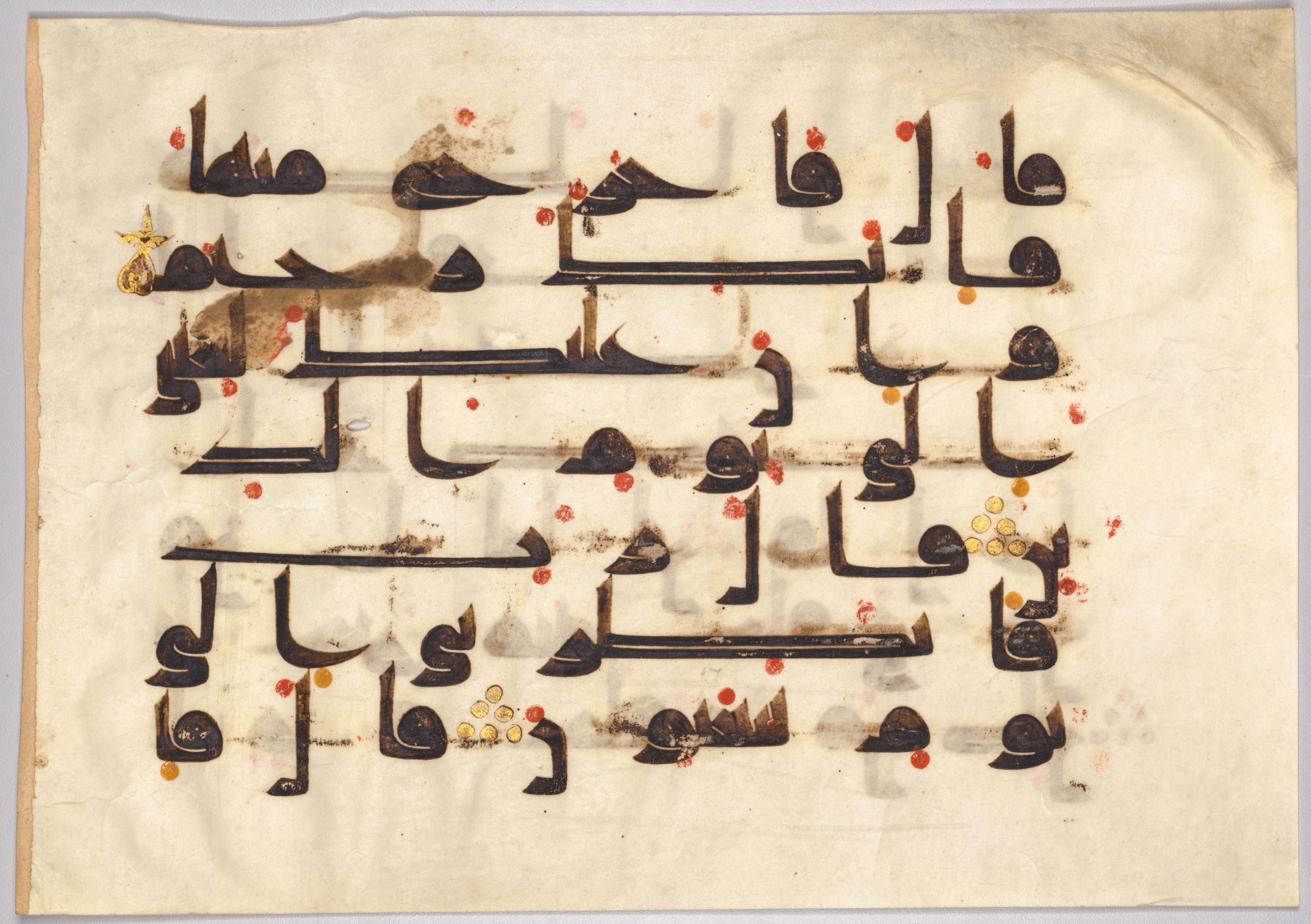
A manuscript page in Kufic script: lines of handwritten Arabic script on a single leaf; see the caption for what the file page says about its marks.
Wikimedia Commons file "Clevelandart 1933.493.b.jpg" by Unknown, CC0, https://commons.wikimedia.org/wiki/File:Clevelandart_1933.493.b.jpg · Licence: CC0 · Media record
A manuscript page in Maghribi script: lines of handwritten Arabic script on a single leaf; see the caption for what the file page says about its marks.
Wikimedia Commons file "Coran in Kasbah Museum of Tangier 2023.jpg" by Melenn14, CC0, https://commons.wikimedia.org/wiki/File:Coran_in_Kasbah_Museum_of_Tangier_2023.jpg · Licence: CC0 · Media record
A manuscript page in New-style (eastern Kufic) script: lines of handwritten Arabic script on a single leaf; see the caption for what the file page says about its marks.
Wikimedia Commons file "Kufi script (New Style I) - Qur'anic verses - 3.jpg" by Unknown, public-domain mark, https://commons.wikimedia.org/wiki/File:Kufi_script_(New_Style_I)_-_Qur%27anic_verses_-_3.jpg · Licence: PD · Media record
A manuscript page in New-style (eastern Kufic) script: lines of handwritten Arabic script on a single leaf; see the caption for what the file page says about its marks.
Wikimedia Commons file "Kufi script (New Style III) - Qur'anic verses.jpg" by Unknown, public-domain mark, https://commons.wikimedia.org/wiki/File:Kufi_script_(New_Style_III)_-_Qur%27anic_verses.jpg · Licence: PD · Media record

Scripture and its sciencesArts of the book

Summary

The codices the Companions wrote by Uthman's order were bare of dots and vowel marks, so reliance was on memory and not on the script alone; Ibn al-Jazari says they were stripped 'so that they could carry what is soundly transmitted and established in recitation from the Prophet ﷺ'. 3 When tongues changed with non-Arabs entering Islam, foreignness began to affect the language of the Qur'an, and the need arose for marks that show the vowels; this is the first 'dotting', dotting for vowels. 1

Abu al-Aswad's story

Khalid al-Sabt relates, with 'it is said', that Abu al-Aswad al-Du'ali heard a reader recite al-Tawba 9:3 with a genitive ending on the final word, the one meaning 'his messenger', which reverses the sense; the glaring error alarmed him and he said: God's face is too exalted to disown His messenger. He went to Ziyad, governor of Basra, and said: I have granted what you asked. Ziyad had asked him to make marks by which people would know God's Book, and he had been slow to answer until this alarmed him. 1 See Abu al-Aswad's pointing of the codex.

What he laid down

He made the sign of fatha a dot above the letter, of kasra a dot below it, of damma a dot between the letter's parts and of sukun two dots. 1 Al-Suyuti says vowelling in the first age was by dots: the fatha a dot at the head of the letter, the damma at its end and the kasra under its head, which is the way al-Dani went. 2 Al-Sabt relates that people followed his path and then added and invented: they made a sign like a bow for the doubled letter and a hook above, below or inside for the connecting alif, according to the vowel before it. 4

Who was first?

Al-Suyuti says people differ about dotting and vowelling the codex: it is said the first was Abu al-Aswad al-Du'ali by order of Abd al-Malik ibn Marwan, or al-Hasan al-Basri and Yahya ibn Ya'mar, or Nasr ibn Asim al-Laythi. 5 Al-Sabt distinguishes: the nearest account is that Abu al-Aswad's dotting was dotting for vowels, that is vowelling, with dotting of letters coming after; he says this is a matter of probable judgement and nothing in hand makes any of these views certain, and notes that many of the reports of the dotting of codices go back to Ziyad ibn Abihi's governorship of Basra (44-53 AH), and some to the time of Ubaydallah ibn Ziyad (d. 67 AH). 6 4 See also Who first pointed and vowelled the codex?

What replaced it

When dotting of letters came in under Abd al-Malik ibn Marwan, the caliph saw that keeping the vowel signs as dots would collide with the dots of letters, and replaced them with the vowel signs known today. 4 See dotting of letters and al-Khalil's vowel signs.

Connections

Explore the connections

Based on
Abu al-Aswad's pointing of the codex at Ziyad's request in Basra
Part of
Qur'anic orthography (rasm)
Basis for
Al-Khalil's vowel signs: marks taken from the letters

People and things also explored

Qur'anic orthography (rasm)· Al-Khalil's vowel signs: marks taken from the letters· The rules of the Uthmanic rasm: omission, addition, hamza, substitution, joining and separating· The science of dabt: marking the codex with vowels and signs· Dotting of letters (naqt al-i'jam) under Abd al-Malik and al-Hajjaj· Keeping the codex bare: the early dislike of dots and tens, and their later acceptance· Abu al-Aswad's pointing of the codex at Ziyad's request in Basra· Ibn Kathir's al-Bidaya wa-l-Nihaya, scan volume 3, p. 366 — the readers; the collection of the Qur'an and the codices

Sources

  1. Khalid b. Uthman al-Sabt, Tahdhib Manahil al-Irfan fi Ulum al-Qur'an , p. 330
  2. Al-Suyuti, al-Itqan fi Ulum al-Qur'an , p. 2249
  3. Ibn al-Jazari, al-Nashr fi al-Qira'at al-Ashr, vol. 1 (corrected and printed by Muhammad Ahmad Dahman, Matba'at al-Tawfiq, Damascus 1345 AH) , p. 17
  4. Khalid b. Uthman al-Sabt, Tahdhib Manahil al-Irfan fi Ulum al-Qur'an , p. 331
  5. Al-Suyuti, al-Itqan fi Ulum al-Qur'an , p. 2245
  6. Khalid b. Uthman al-Sabt, Tahdhib Manahil al-Irfan fi Ulum al-Qur'an , p. 329
Cite this page

islam.museum contributors. “Dotting for case and vowel (naqt al-i'rab): Abu al-Aswad's dots”. islam.museum, https://islam.museum/en/concept/naqt-al-irab/. CC BY-SA 4.0. Last updated 2026-11-15.

Improve this page on GitHub · Report an error · Help complete it · JSON

Wing

Words

Qur'an, hadith, poetry, and the languages and scripts of Muslim peoples.
Related

Qur'anic orthography (rasm)

In Sheikh Omar Abdelkafy's lessons the Sheikh reflects on differences in how some words of the Qur'an are written, such as the dropped ya in «al-muhtadi» in Surat al-Isra and in «atumiddunani» in Surat al-Naml, and finds meaning in these differences. He says the Qur'an is miraculous in its writing and even in its movement.