

At a glance
- Region
- Levant & Iraq
Images
Quick facts
- Domain
- Mathematics and computation
- Kind
- Method
- First attested
- c. 900 (approx.) CE
- Era
- Abbasid age
- Where
- Baghdad
- Attribution
- Improvement
Who made it
The claim and its basis
Simplification and extension of inherited spherical methods, not first trigonometry or tangent.
Translated preface names inheritance, new methods and proofs; sine proof preserved beside the editor's priority dispute.
Sources: Abu al-Wafa's Almagest — Carra de Vaux1892 · Abu al-Wafa — Britannica · Abu al-Wafa al-Buzjani — Aydin, TDV · Abu al-Wafa — Youschkevitch, scientific biography · Abu al-Wafa — MacTutor · Al-Khujandi — MacTutor and spherical sine priority · Commons — right spherical triangle · Encyclopaedia of Islam, 2nd edition (Leiden: Brill, 1954–2008), 13 volumes
Before it
- Menelaus and the six-quantity apparatus of spherical trigonometry
How it works
Summary
An astronomer calculating on a sphere cannot simply use a straight-sided triangle drawn on paper: the boundaries are great-circle arcs, and the problem connects their lengths with the angles at which they meet. The contribution presented here is Abu al-Wafa al-Buzjani's simplification of these relationships, including a proof of the general sine relation and methods for right spherical triangles—not the invention of all trigonometry 2. The French publication of1892 places the proof beside an explicit priority dispute; both remain in our story 3.
What it is
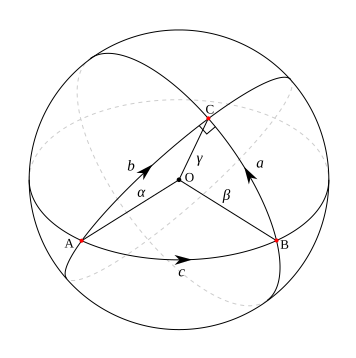
The spherical triangle considered here has three great-circle arcs for sides; a great circle lies in a plane through the sphere's center. A side is measured by its arc's central angle, not a straight chord through the sphere; a vertex angle is between the directions of the two arcs meeting there. This distinction is essential to reading the translated proof, and explains why we cannot take the plane sine law and retain its ordinary side lengths unchanged on a sphere 3.
The method is not a brass instrument or a new observatory, but a set of relationships, proofs and calculations that helps recover an unknown from suitable data. Youschkevitch describes simpler methods replacing the six-quantity apparatus; the encyclopedia records sine and tangent rules for right triangles 2 4. We do not inflate the count by treating every relationship as a separate invention: this record represents one bounded methodological contribution.
The world before it
The sky was not beyond calculation before Abu al-Wafa. In the translated preface, the author names inherited work and Greek predecessors, then explains his intention to simplify procedures and add proofs and examples 5. The scientific biography explains the cumbersome use of Menelaus's six-quantity configuration in spherical problems. That background makes the simplification intelligible; it is not an opponent to erase in pursuit of an absolute beginning 2.
Nor should improved solution methods be confused with introducing every trigonometric function. The Encyclopaedia of Islam rejects attributing the introduction of tangent, cotangent, secant and cosecant to Abu al-Wafa because Habash al-Hasib had used them earlier 4. Aydin likewise mentions Habash's earlier tables, although reference works differ in wording about definitions and particular first uses 6. A precedent does not cancel a later improvement, but it changes the label we should give that improvement.
The story
Born in Buzjan, Abu al-Wafa moved to Iraq and lived in Baghdad; Aydin records the move in348/959, teachers from his family, and contacts with contemporary scholars 6. Britannica describes observing work and cooperation with al-Biruni, placing calculation among questions about sky, position and time rather than in an isolated biography 7. These reports do not identify the desk where he wrote his proof or the day he completed it.
The translated preface distinguishes geometrical proof from calculation, emphasizes numerical problems, and discusses corrected tables: a broader scientific and teaching program than the slogan “discovered a law” 5. The record's tenth-century date is a broad activity frame, not an invented year of composition. Death reports differ between997 and998; we turn neither into an exact proof date or a fabricated Hijri conversion 7 6.
The maker(s)
Britannica explicitly calls the individual a Muslim mathematician and astronomer. That is the identity evidence—not inference from his name or a patron's denomination 7. Sunni is declared here as the museum's frame, not testimony to a personal legal school that the biography does not establish. The mathematical contribution is identified by the preface and proof, not merely by fame or association with a city 1.
Sunni—declared frame: we present a documented Muslim scholar and his attributed work while separating the general frame from individual school testimony 7. Academic account: Carra discusses priority between Abu al-Wafa and Abu Nasr ibn Iraq; MacTutor adds al-Tusi's attribution of a proof to al-Khujandi while leaving priority uncertain 8 9. A patron's denomination is not transferred to the scholar, and the museum issues no verdict deciding priority without the necessary evidence.
How it works
In our modern teaching notation, vertices are A,B,C and opposite sides a,b,c, each side an angular arc rather than a chord length. The spherical sine law is then sin(a)/sin(A)=sin(b)/sin(B)=sin(c)/sin(C). This corresponds to the translated text's proportionality between sines of angles and sines of opposite sides—not the plane ratio of a side itself to an angle's sine 3. Modern letters are not asserted to be the author's manuscript labels, or our vertex order the translator's figure.
For C=90°, the relations in this convention include sin(a)=sin(c)sin(A), tan(a)=tan(A)sin(b), and cos(c)=cos(a)cos(b). This is a normalized formulation of the simpler right-triangle apparatus described in the encyclopedia 4. The first retrieves an unknown when suitable data are available; the second connects tangent and sine; the third relates the three arcs. They are connected relationships, not three unrelated inventions, and do not imply that any three arbitrary numbers always determine exactly one valid triangle.
Try a modern example created for this explanation, not historical numbers from Abu al-Wafa's book: a=30°, b=45°, C=90°. The cosine relation gives c≈52.238756°; the tangent relations give A≈39.231520° and B≈63.434949°. Substitution makes all three sine ratios approximately0.790569415, providing a numerical check. This verifies our example in the stated notation, not an independent reconstruction of every step of the translated proof 3.
Notice that our example's angles total more than180 degrees: we do not force a spherical triangle to obey the plane triangle's rule. For surface distance on a sphere of radiusR, multiply the arc angle in radians byR; a sine value alone is not kilometers. Inverting sine also requires attention to angle choice and context, so the formula is not a promise of a unique solution for arbitrary input. These are modern geometrical explanations of the relationships read, not a claim that the author used calculator language 3.
The translated proof does not merely announce a ready-made ratio: it begins with great-circle arcs bounding a triangle, introduces arcs associated with poles, then perpendicular projections to establish the proportionality 3. This distinguishes checking a particular number from proving a general relationship. Our numerical example can reveal the mistake of using a side angle instead of its sine, but cannot replace the geometrical construction. Agreement among three numbers in one example does not by itself prove a law for every triangle.
The spread
One traceable witness is Carra's publication of translated selections in a scholarly journal in1892, followed by discussion in modern encyclopedias and scientific biographies 10 11. This establishes the text's presence in modern history of science, not the route of every manuscript or use of the same copy in every school. We therefore do not draw arrows from Baghdad to every trading city merely because spherical calculation is useful for travel.
The priority discussion itself shows transmission of reports: MacTutor recounts al-Tusi's attribution to al-Khujandi and claims associated with Abu al-Wafa and Abu Nasr 9. We read the historians' account here, not every original claim text. A direct translated passage remains distinct from a report of another author's judgment.
What it was built on
The contribution draws on traditions of circles, arcs and tables, and on earlier Menelaus-based apparatus, as the scientific biography and translated preface explain 2 5. These are connections among problems and proof techniques, not evidence that every ancient name was Abu al-Wafa's personal teacher. Keep the table evidence bounded too: the translator says the tables were missing from his manuscript. We cannot claim to have inspected the author's complete tables or read their accuracy from an absent leaf 12.
What was built on it
The scientific biography treats these methods as an important stage in spherical trigonometry, distinct from exclusive priority for all its results 2. We can teach the law today, but two similar equations do not by themselves establish technical transmission to a particular navigation device. This record therefore supplies no named unsupported descendant, and does not make the modern phone the direct result of one proof. Where the necessary witness is missing, the connecting arrow remains undrawn.
Impact on daily life
The passage summarized by Carra names applications including Qibla azimuth and numerical examples: a documented window onto the usefulness of astronomical relationships, not a count of beneficiaries or an estimate of computation speeds everywhere 13. We describe the mathematical question, not issue a religious ruling. The preface's separation of proof and calculation matters here: establishing a relation is not yet performing an example with tables and data, even when both are needed 5.
How it changed history
The point is not that astronomy changed overnight on a known date, but that a calculating apparatus could be simplified and extended. Youschkevitch places Abu al-Wafa among early proofs of the general relation and describes the tangent method 2. This is more precise than a contest over “the first person to know sine.” It reveals accumulation: inherited problems, simpler formulation, a demonstrable proof, and later historical debate over priority for a shared result.
Who invented it?
Sunni—claim boundary: the contribution established here is improvement of Abu al-Wafa's solution apparatus, not ownership of all trigonometry. His documented Muslim identity is separate from priority for each theorem 7. Academic account: Carra explicitly names the dispute with Abu Nasr on423; MacTutor adds al-Khujandi and al-Tusi without turning the available evidence into a final verdict 8 9. The museum does not decide what the research read has not settled.
We also exclude the lunar-variation discovery claim. Britannica and the encyclopedia reject it; it cannot decorate the biography of a different mathematical improvement 7 4. Separating claims prevents a famous erroneous story from becoming evidence for a sound one.
Today
The modern diagram shows a sphere, a triangle right-angled atC, and centerO; its sides are arcs, and dashed lines help visualize hidden portions 14. Greek letters near the center label central angles: do not confuse them with vertex angles in our equations. The image helps explain a side's arc, but is not a copy of Abu al-Wafa's figure or a scale drawing of our numerical example. Its modern teaching purpose is explicit.
Surviving examples
Our direct textual witness is a published selected translation with proof, figure and commentary. The image of printed423 was visually checked in the public scan, and the proof's continuation on424 read in the transcription 3. We claim neither an independent Arabic collation, inspection of an autograph, nor reading the entire article. Scientific biographies expand the context of surviving and lost works; the survival of another book does not make every calculation here a direct reading of that book 15.
In culture
Biographies bring together Abu al-Wafa's practical arithmetic, geometry and astronomy, including problems for scribes and artisans 16. Those books do not merge into one, and their disputed dates cannot supply a convenient single composition year for this spherical law. Our licensed diagram is a modern public-domain teaching work credited to its documented Commons creators, not a historical portrait or reconstruction of his observatory 17.
For young readers
Draw a triangle on paper, then imagine one on a ball: the lines become arcs, and not every paper rule transfers unchanged. Abu al-Wafa helped simplify calculation on a sphere, within a history of earlier methods and other proof claims 2 9. If you ask who was first, look for a text and what it can establish, not just a name on a poster. Enjoying the problem and understanding the evidence matter more than declaring an unsupported winner.
References
- Carra de Vaux, L'Almageste d'Abu'l-Wefa,1892: selections413–414 and421–425, especially proof423–424; not a claim to have read the complete article 18.
- Youschkevitch, scientific biography, trigonometry/works; university-hosted reflowed text, not original-edition pagination 19.
- Britannica; Aydin348–349; MacTutor Abu al-Wafa and al-Khujandi biographies 7 6 20 9.
- Encyclopaedia of Islam, volume1,178; Commons modern diagram/licence 4 21.
Connections
- Improved by
- Abu al-Wafa' al-Buzjani, Muhammad ibn Muhammad
People and things also explored
Abu al-Wafa's debt-aware complement multiplication· Abu al-Wafa's fixed-opening construction repertoire· Abu Nasr Mansur ibn Ali ibn Iraq· Iran· Abu al-Wafa' al-Buzjani, Muhammad ibn Muhammad
Sources
- Abu al-Wafa's Almagest — Carra de Vaux1892 , pp.413–414,423–424
- Abu al-Wafa — Youschkevitch, scientific biography , trigonometry
- Abu al-Wafa's Almagest — Carra de Vaux1892 , pp.423–424
- Encyclopaedia of Islam, 2nd edition (Leiden: Brill, 1954–2008), 13 volumes , vol.1 p.178
- Abu al-Wafa's Almagest — Carra de Vaux1892 , pp.413–414
- Abu al-Wafa al-Buzjani — Aydin, TDV , pp.348–349
- Abu al-Wafa — Britannica , biography
- Abu al-Wafa's Almagest — Carra de Vaux1892 , p.423
- Al-Khujandi — MacTutor and spherical sine priority , sine theorem
- Abu al-Wafa's Almagest — Carra de Vaux1892 , pp.408–471
- Abu al-Wafa — Youschkevitch, scientific biography , bibliography
- Abu al-Wafa's Almagest — Carra de Vaux1892 , p.414
- Abu al-Wafa's Almagest — Carra de Vaux1892 , p.425
- Commons — right spherical triangle , description and image
- Abu al-Wafa — Youschkevitch, scientific biography , works and bibliography
- Abu al-Wafa — MacTutor , works
- Commons — right spherical triangle , description and licensing
- Abu al-Wafa's Almagest — Carra de Vaux1892 , pp.413–414,421–425
- Abu al-Wafa — Youschkevitch, scientific biography , trigonometry and works
- Abu al-Wafa — MacTutor , biography
- Commons — right spherical triangle , licensing
Cite this page
islam.museum contributors. “Abu al-Wafa's spherical-triangle solution methods”. islam.museum, https://islam.museum/en/invention/abu-wafa-spherical-triangle-methods/. CC BY-SA 4.0. Last updated 2026-11-06.
Improve this page on GitHub · Report an error · Help complete it · JSON