

At a glance
- Era
- The Buyid, Fatimid and Seljuk Era
- Region
- Egypt & Nile
Quick facts
- Domain
- Optics and physics
- Kind
- Discovery
- First attested
- 1031 CE · 422 AH† (derived)
- Era
- Middle period
- Where
- Cairo
- Described in
- Ḍawʾ al-qamar (On the Light of the Moon)
- Attribution
- Improvement
Who made it
- Ibn al-Haytham (Alhazen) Improver
The claim and its basis
In On the Light of the Moon, Ibn al-Haytham improved on the ancient theory of lunar light: he rejected the mirror model reflecting a single ray and proposed that every point on the lunar surface broadcasts light rays in all directions, with some physical effect of the sun's rays on the Moon rendering its color and light visible; the record is bounded to this treatise's argument, not a claim to complete modern understanding of lunar light.
The entry describes On the Light of the Moon as taking up again the problem of perceiving lunar and solar eclipses on the assumption that Moon and Sun are solid physical bodies; it refutes the ancient theory that the Moon reflects sunlight like a mirror, holds the Moon to be a self-illuminating body because every point on its surface broadcasts rays in all directions while a mirror reflects a ray in one direction, and concludes that some physical effect of the sun's rays on the Moon renders its color — and thereby its light — visible, opening the way to reconcile Aristotle and Ptolemy. ISMI catalogs it as an optics composition written before 7 August 1031 with three surviving witnesses.
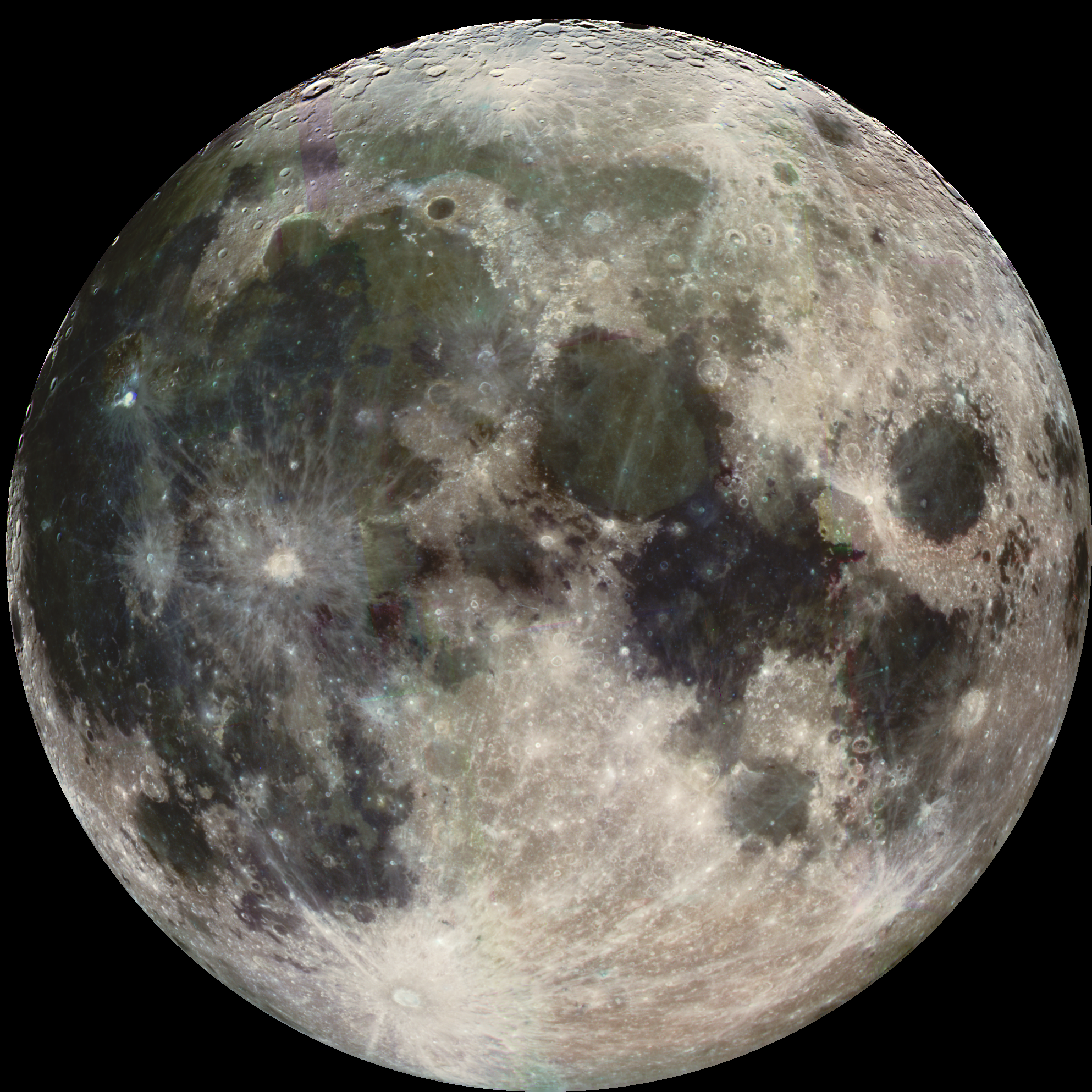
Sources: Ḍawʾ al-qamar — ISMI Islamic Scientific Manuscripts Initiative · Ibn al-Haytham — Encyclopedia of World Biography (updated 2018) · Full Moon image from the Galileo spacecraft — Wikimedia Commons (NASA)
Before it
- Ibn al-Haytham's integrated incoming-light theory of vision
- The ancient theory that the Moon reflects sunlight like a mirror
How it works
Summary
On the Light of the Moon is an Arabic treatise by Ibn al-Haytham al-Basri al-Misri, composed before 7 August 1031 and surviving in three manuscript witnesses at Aleppo, London and St Petersburg 1. In it Ibn al-Haytham rejects the ancient theory that the Moon reflects sunlight like a mirror: every point on the lunar surface broadcasts light rays in all directions, while a mirror reflects a single-source ray in one direction, and he concludes that some physical effect of the sun's rays on the Moon renders its color — and thereby its light — visible 2. The museum records this treatise as an improvement in understanding lunar light inside the optics tradition, not as a complete discovery of its mysteries.
What it is
On the Light of the Moon is not an instrument or a machine but a scientific treatise — a work in the subject of optics — in which Ibn al-Haytham poses a physical-astronomical problem: why does the Moon shine, and what happens to sunlight when it strikes the lunar surface? 2. ISMI catalogs it in the Islamic Scientific Manuscripts Initiative under the title Ḍawʾ al-qamar with the aliases "Maqālaẗ li-Ibn al-Ḥasan fī al-ḍawʾ al-qamar" and "Maqālah fī al-ḍawʾ al-qamar", an early first-order prose composition by Ibn al-Haytham al-Basri al-Misri, subject optics 1. The cataloging source describes neither letterforms nor page count; its material is the work's name, attribution, date and witnesses 1.
The world before it
Before Ibn al-Haytham, the common understanding of lunar light among philosophers and astronomers approximated the mirror: a surface reflecting the sunlight falling on it back to the eye 2. In his own On the Structure of the World — as the entry notes — he had already inserted a discussion of perceiving lunar and solar eclipses on the assumption that Moon and Sun are solid physical bodies, so the question of lunar light had entered a debate about the nature of celestial bodies, not merely a visual phenomenon 2. For Aristotle and Ptolemy the element of the heavenly bodies was one that does not change in kind — fixed in nature — which made any "change" in their light something needing justification 2. In this setting Ibn al-Haytham wrote his treatise: not to ask "does the Moon shine?" but "how does it shine, and what makes its light?" 2. ISMI's bibliography for the work also lists a study by Sabra, Grant and Murdoch on "Psychology versus Mathematics: Ptolemy and Alhazen on the Moon Illusion", indicating the treatise belonged to a wider debate about the Moon in his tradition — one extending from the physical question to the visual perception of it 1.
The story
Ibn al-Haytham — Abu Ali al-Hasan ibn al-Hasan ibn al-Haytham — was born at Basra around 966 CE and won fame in his youth for his knowledge of physics until the Fatimid al-Hakim summoned him to Egypt to attempt regulating the course of the Nile 2. When he failed the task and was disgraced, he settled in Cairo as a copyist of mathematical manuscripts and remained at that craft for the rest of his life; the entry records that a copy of the Banu Musa version of Apollonius's Conics in his hand survives in Istanbul, copied in 1024 2. In his own words he was a Muslim: the Manazir opens in his name with the basmala, and he wrote treatises answering critics of prophethood and against the Mu'tazila 2. On the Light of the Moon belongs to his late Cairo works, composed before 7 August 1031 — in the last decade of his life or near it 1. It survives in three manuscript witnesses: Aleppo at the Basil House, number 720; London in the British Library, IO Islamic 1270; and St Petersburg in the National Library, ANS 600 1.
The maker(s)
The documented maker is Ibn al-Haytham himself, author of Ḍawʾ al-qamar in the ISMI catalog 1. He is a Muslim in his own words — the Manazir opens with the basmala and he wrote against critics of prophethood and the Mu'tazila — and no source names his legal school, so he is kept within the museum's Sunni frame 2. His role here is "improver" rather than absolute "inventor": he improved on the ancient mirror-reflection model with a new physical argument, while inventing neither lunar light nor the whole science of optics 2.
How it works
Ibn al-Haytham's argument rests on his theory of radiation — built in the Manazir — that light proceeds from the visible object to the eye, not from the eye to the object 2. In On the Light of the Moon he applies this to the Moon: every point on the lunar surface — a body lit by sunlight — broadcasts light rays in all directions, as a lit lamp sends its rays everywhere 2. A point on a mirror's surface, by contrast, reflects a single ray from a single source — here the sun — in only one direction 2. What reflects one ray in one direction cannot be like what broadcasts rays in every direction; the Moon is therefore not a mirror but a self-illuminating body 2. Ibn al-Haytham then adds that the eye receives two primary impressions in vision — light and color — so he concludes that some physical effect of the sun's rays on the Moon renders its color, and thereby its light, visible 2. And this, in the entry's words, opens the way to reconciling Aristotle and Ptolemy: the element of the heavenly bodies remains unchangeable in kind, as Aristotle insisted, yet it is subject to some quantitative change that displays their light when struck by sunlight 2.
The spread
On the Light of the Moon did not spread in the sources read as an independent treatise with a school or defenders 1. Its three surviving witnesses — Aleppo, London and St Petersburg — testify to the copies reaching dispersed Islamic libraries across the centuries, not to the argument's spread as a later scientific school 1. The entry mentions neither a Latin translation nor a direct effect on European optics debates 2. The documented spread is the transmission of copies, not the spread of the theory as a doctrine.
What it was built on
The treatise rests on two foundations: Ibn al-Haytham's own theory of radiation in the Manazir — light issuing from the visible object — itself an improvement on the emission model of the mathematical opticians 2 2. And the astronomical-physical discussion in On the Structure of the World about the nature of celestial bodies and the perception of eclipses on the assumption of solid bodies 2. Its target, in the entry's words, is the ancient theory of reflecting sunlight like mirrors 2.
What was built on it
Nothing documented in the sources read was built directly on this argument of On the Light of the Moon 1 2. The entry calls Ibn al-Haytham "the greatest Moslem student of physical theory", with caution about exaggerating him as "the founder of modern physics" — but that assessment covers his whole system, not a direct line from this treatise 2. Its documented purpose is to stand as a witness to Ibn al-Haytham joining optics with physical astronomy on a single question.
Impact on daily life
On the Light of the Moon was neither a daily tool nor a practical invention; its effect was scientific-intellectual: it turned a question treated as a visual phenomenon into a physical problem requiring a model of the lunar surface's nature and its response to light 2. In his age, such questions — are the heavenly bodies physical things with a changeable nature? — stood at the center of the Aristotle-Ptolemy debate that occupied philosophers and mathematicians alike 2. Ibn al-Haytham made the Moon — the farthest lit body from Earth and the least testable — a proving ground for his theory: if he could explain its light without assuming a giant mirror, his reach was wider 2.
How it changed history
Within what is documented, the record changed the course of understanding lunar light inside Ibn al-Haytham's tradition: from "a mirror that reflects" to "a body that broadcasts in every direction" with a physical effect of sunlight 2. This shift matters because it moved the question from pure geometry — angles of reflection — to physics: what is light, and what is the nature of the body that receives it? 2. And the treatise's survival in three witnesses makes it a witness that Ibn al-Haytham did not stop at the theory of vision but applied it to distant bodies, raising optics from the science of the eye to the general science of light 1 2. Within the context of all Ibn al-Haytham's treatises, this essay looks like a connecting link: the Manazir explains how rays reach the eye, On the Structure of the World explains the nature of bodies, and On the Light of the Moon applies both together to the nearest lit body and the least practically testable 2.
Who invented it?
The question — "why does the Moon shine?" — is far older than Ibn al-Haytham, and the old model — the reflecting mirror — preceded him 2. What Ibn al-Haytham improved in On the Light of the Moon is the model itself: he rejected simple mirror reflection and proposed the "body broadcasting in all directions" model with a physical effect of sunlight on the lunar surface 2. So the museum's record is neither "the invention of lunar light" nor "the discovery of the modern reason it shines" — but a documented improvement on an ancient physical model, inside Ibn al-Haytham's own optics tradition 2 1.
Today
There is no physical object for this treatise; it survives in three manuscript witnesses 1. Today lunar light is explained as sunlight reflected from its bright dusty regolith — an answer different from Ibn al-Haytham's "self-illuminating body" model 2. The displayed image — the Galileo spacecraft's full-Moon photograph of 1992 — is visual context for the lunar surface he discussed, not an old observation and no evidence for his theory 3. The question itself — how does the Moon shine? — remains, but today's answer is measured by space instruments, not by treatises.
Surviving examples
The three documented witnesses: the Aleppo copy at the Basil House, number 720; the London copy in the British Library, IO Islamic 1270; and the St Petersburg copy in the National Library, ANS 600 1. Neither ISMI nor the entry mentions a modern critical edition of the text in the sources read; the full testimony — the argument itself — requires reading the manuscript 1 2. The displayed image is modern visual context only 3.
In culture
On the Light of the Moon is a rare example that Ibn al-Haytham did not stop at the Manazir — his most famous book — but continued applying his theory of vision to distant problems in physical astronomy 2. In the tradition of Ibn al-Haytham's treatises, these essays — like the one on lunar light — were a bridge between theoretical optics and physical astronomy, a bridge few of his contemporaries crossed 2. The record remains a witness that "light" for him was no mere subject of the eye but a subject of nature: what it is, where it comes from, and what makes it visible 2.
For young readers
A thousand years ago, people believed the Moon was like a giant mirror reflecting sunlight. But a scholar named Ibn al-Haytham — one of history's greatest students of light — wrote a small treatise called On the Light of the Moon saying: no, the Moon is not a mirror, because every point on its surface sends out light in every direction, like a lamp lit from all sides. He was among the first to treat moonlight as a real scientific question, not just something we see in the sky.
And so On the Light of the Moon remains a witness that Ibn al-Haytham did not content himself with knowing how we see — he asked how the Moon itself shines, and dared to say "not a mirror" where everyone said "mirror". That is the beginning of science: asking the question no one before you asked.
References
Connections
- Improved by
- Ibn al-Haytham (Alhazen)
- Built on
- Ibn al-Haytham's integrated incoming-light theory of vision
- Described by
- Ḍawʾ al-qamar (On the Light of the Moon)
People and things also explored
Kitab al-Manazir (The Book of Optics)· Ibn al-Haytham's integrated incoming-light theory of vision· Ibn al-Haytham (Alhazen)· Ibn al-Haytham summoned to Cairo· Kitāb al-Manāẓir composed· Ibn al-Haytham's dark room (the camera obscura experiments)· Ibn al-Haytham's factorial remainder construction· Ibn al-Haytham's circular-mirror reflection method
Sources
- Ḍawʾ al-qamar — ISMI Islamic Scientific Manuscripts Initiative
- Ibn al-Haytham — Encyclopedia of World Biography (updated 2018)
- Full Moon image from the Galileo spacecraft — Wikimedia Commons (NASA)
Cite this page
islam.museum contributors. “Ibn al-Haytham's treatise On the Light of the Moon”. islam.museum, https://islam.museum/en/invention/ibn-al-haytham-moonlight/. CC BY-SA 4.0. Last updated 2026-11-15.
Improve this page on GitHub · Report an error · Help complete it · JSON