

At a glance
- Era
- The Early Abbasid Caliphate
- Region
- Levant & Iraq
Quick facts
- Domain
- Architecture and building techniques
- Kind
- System
- First attested
- 773 CE · 156 AH† (derived)
- Era
- Abbasid age
- Where
- Baghdad
- Attribution
- Improvement
Who made it
- Abu Ja'far al-Mansur Commissioner
The claim and its basis
Reallocation of existing markets between inner arcades and commercial areas outside the walls.
Duri dates a move to Karkh to773CE; Le Strange describes shops leaving the arcades and those spaces becoming guard barracks.
Sources: Bagdat — Abd al-Aziz al-Duri, TDV · Baghdad During the Abbasid Caliphate — Le Strange1900 · Tarikh al-Khulafa — al-Suyuti (Dar al-Minhaj edition) · Mansur round-city map catalogue — Commons
Before it
How it works
Summary
Baghdad's first inner markets occupied four gate roads and arcades, while Duri also records market places outside the walls 1 3. Duri attributes to al-Mansur an order in 773 CE moving markets from the city toward Karkh for security 1. Le Strange describes the shops leaving the arcades and those spaces becoming barracks for city police and horse-guard 3. In a later chapter he retells a security warning attributed to al-Tabari and describes markets moving to suburbs beyond the gates 4. These reports document a reallocation of commercial space, not the invention of markets, a measured security outcome, or proof that every seller moved together 1 3.
What it is
The change concerned the location and use of existing urban spaces: inner market roads gave way to commercial venues outside the walled centre 1 3. Le Strange describes four gate roads lined by arcades, with shops first occupying those routes 3. Duri says four other market places already stood outside the walls, so the transfer did not create Baghdad's first outside markets 1. Duri names Karkh as the destination, while Le Strange also refers to suburbs outside several gates and singles out Karkh's market street 1 4. The accounts do not give a street-by-street register that would let us plot every relocated stall 1 2.
Duri's wider description places merchants and craftspeople in Karkh south of the Sarath, while soldiers generally lived beyond the walls to the north and west 1. This is his account of Baghdad's spatial pattern, not evidence that every household was assigned a plot under one surviving zoning code 1. It helps explain why moving markets toward Karkh mattered to the city's organization without proving that the transfer created every later occupational quarter 1.
The world before it
Markets and trade already belonged to Baghdad's urban life before this reported order; the sources describe both inner arcades and outside market places 1 3. The arcades formed part of the pre-existing gate roads of the round-city plan, rather than a new structure built for the relocation 3. Duri distinguishes the city's construction in 762, governmental occupation in 763, and completion in 766 from the later market transfer dated 773 5. Le Strange says the markets were removed before many years had passed, but does not give a year in the chapter describing the arcades 3. The available accounts therefore place the move in an evolving city, not at its founding 5 3.
The story
Duri's chronology places the market order after the stages of Baghdad's establishment and dates the transfer to 773 CE 5. His account gives security as the stated reason for moving markets from the city to Karkh 1. Le Strange recounts the episode in a later chapter as a story about a Greek envoy who warns al-Mansur about foreign merchants inside the city 4. Le Strange says that this anecdote is transmitted through al-Tabari and repeated by later authorities; the original medieval account was not checked for this record 4. The exact administrative steps, timetable, and participation of individual traders are not supplied in these passages 1 2.
The maker(s)
The order is attributed to al-Mansur, who is recorded here as political commissioner rather than sole designer or builder of the market district 1. Duri discusses the city's architects and construction workforce, but the consulted market passage does not name a separate planner for the relocation 5. Le Strange describes the move and the later use of the arcades, without identifying every official, merchant, or craftsperson involved in carrying it out 2. A personal basis for al-Mansur's Muslim identity is recorded elsewhere: al-Suyuti transmits his account of learning and a conversation with Malik 6. The museum names its Sunni frame explicitly; it is not inferred from his title, the market order, or political authority 6.
How it works
Before the move, four principal roads between the gates carried arcades and market shops inside the walls 3. Duri's account adds that other markets existed outside the walls before the relocation 1. The reported order shifted the inner markets toward Karkh, while Le Strange also describes new commercial suburbs beyond several gates 1 4. Le Strange says the arcades cleared of shops were used as lasting quarters for city police and horse-guard 3. This is a change in spatial allocation and building use; the sources do not describe a technical procedure for moving each stall or reconstruct its exact route 1 3.
Le Strange gives dimensions for the gate-road arcades: he describes squares about ten yards across and a road between them roughly seven and a half yards wide and one hundred yards long 3. He reports fifty-three archways and suggests that twenty-six stood on each side with one at the end; he also says teak double doors could close the road entrance 3. These are measurements and reconstructions reported in a later historical account, not a contemporary survey of the markets 3. For Karkh's main market street he gives forty ells, which he renders as twenty yards 4. Neither figure supplies the location of each shop or proves how the move was carried out 2.
The spread
The evidence consulted concerns Baghdad and its changing districts; it does not document this particular relocation being copied in another city 1 2. Le Strange describes Karkh as a commercial centre of western Baghdad that continued to expand after its establishment 4. Duri describes further merchant quarters and distinct bazaars as Baghdad grew, but does not present them as a dated export of the original order 1. Similar arrangements elsewhere would not by themselves prove direct transmission from Baghdad 1 2. No route, named recipient city, or chain of planners is provided in the two accounts used here 1 4.
What it was built on
The reallocation used an existing city plan, gate roads, and arcades rather than introducing a new kind of marketplace 3. Duri's description of four outside market places shows that commercial activity was not confined to the inner streets before the move 1. Le Strange says Karkh was not included in the original plan of the round city and describes it as a later suburb associated with the commercial change 4. The sources do not identify a new market technology, trading instrument, or legal code as part of this episode 1 2. Its documented basis is spatial administration applied to streets and markets already in use 3.
What was built on it
After the relocation, Duri describes separate bazaars for different trades and crafts in Karkh, including markets for produce sellers, grocers, money changers, and booksellers 1. He also records merchant quarters linked with arrivals from several named cities as Baghdad expanded 1. These details belong to his broader account of growth; they are not all dated to the order of 773 CE 1. Le Strange describes Karkh's principal market street and its later growth, but does not establish that every later commercial feature was a direct consequence of this single decision 4. The record therefore links the relocation with subsequent urban descriptions without turning sequence into a complete causal story 1 2.
Impact on daily life
The sources describe a commercial landscape in which traders and craftspeople could use designated market areas, while some city arcades took on a guard function after shops were removed 1 3. Duri lists several kinds of trade and reports that merchant groups had quarters and leaders as the city grew 1. This provides evidence about how commercial space was described, not a census of all occupations or residents in Karkh 1. The accounts do not measure travel time, prices, access, safety, or the distribution of benefits among residents 1 4. No claim is made that the policy improved daily life equally for every person 1 2.
How it changed history
Le Strange's account presents Karkh as a district that became a major commercial centre of western Baghdad and continued to grow over time 4. Duri describes Baghdad's wider expansion, including growing settlement on the eastern bank and the development of distinct merchant areas 1. Those developments show a changing city, but the cited passages do not isolate the market order as their sole cause 1 4. Le Strange also reports a later fire in Karkh and its rebuilding, illustrating that the district's history extended beyond its initial market arrangement 4. The historical significance recorded here is the documented reallocation and reuse of urban space, not a measured economic or security result 1 2.
Who invented it?
The move is attributed to al-Mansur as an order, while the sources do not identify him as the sole author of the market layout or its implementation 1 3. Duri gives the year 773 CE, whereas Le Strange's description of the arcade change says only that it occurred within a few years 1 3. Le Strange's account of an envoy's warning is a transmitted explanation, not a direct record of the ruler's private reasoning or of a threat that actually occurred 4. Al-Mansur's personal Muslim identity basis is taken from the separately cited report of his learning and conversation with Malik, not inferred from his name or office 6. The attribution remains bounded to a reported commission 1.
Today
The episode can be read as a historical example of changing the location and use of commercial spaces, with a stated security rationale that the sources do not test 1 2. It is not presented as a ready-made planning model for present-day cities 1 3. The accounts provide no contemporary operational rules, measurements of outcomes, or evidence that later market systems directly descended from this order 1 4. Any comparison with modern zoning would need its own evidence and would have to account for different institutions and conditions 1 3. This page limits itself to what the historical descriptions report and what they leave unresolved 1 2.
Surviving examples
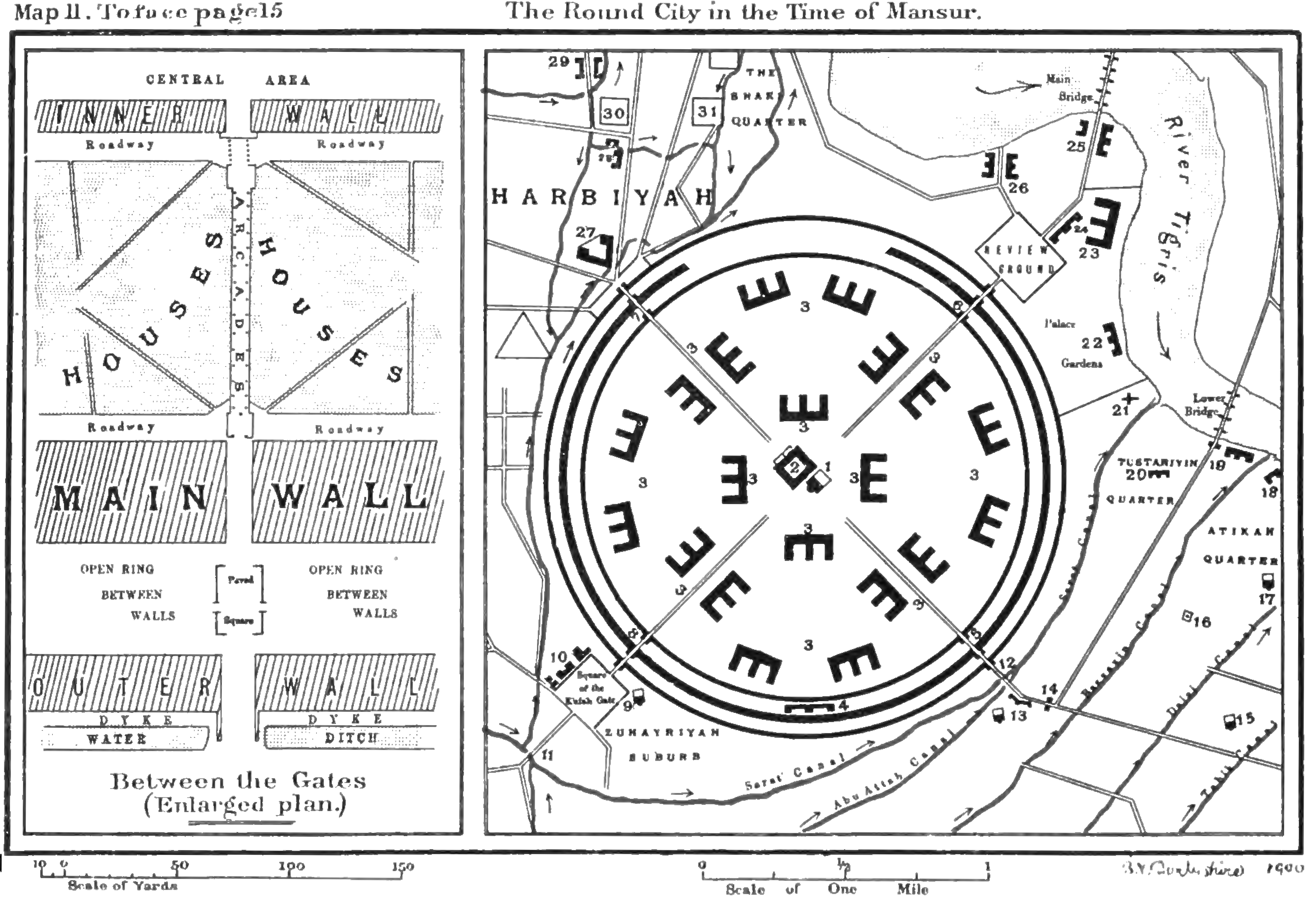
The sources consulted describe the market arrangement through historical narratives; they do not identify a surviving shop, street plan, or administrative order as a direct material witness to the transfer 1 2. The image accompanying this record is Le Strange's published reconstruction of the round city, reused as broad context rather than as a map of market sites 7 8. Its lines do not locate the four market arcades or delineate the transferred stalls 8 3. The diagram is a generic chain graphic showing the predecessor relation and reported commissioner; it is not a reconstruction of Baghdad's street geometry 1 3.
In culture
The most vivid explanation in Le Strange is a story about a Greek envoy warning that foreign merchants inside the walls could create a security risk 4. Le Strange attributes this narrative to al-Tabari and notes that later writers repeated it, but the original account was not independently checked for this record 4. Duri gives the security rationale more briefly and does not repeat the envoy episode in the consulted market passage 1. The story records how a later historical account explains the decision; it does not establish that foreign traders acted as spies or threatened the gates 4. No broader claim about popular memory or cultural reception is made 4 1.
For young readers
Baghdad had busy markets on four roads inside its walls, and it also had market places outside the walls 1 3. Duri says al-Mansur ordered markets moved toward Karkh in 773 CE, giving safety as the reason 1. Le Strange says the empty arcades were later used by guards 3. The books do not tell us that every seller moved at once or that the danger was proved 1 2. The change was about where people could trade and what the old market spaces were used for, not about inventing shops or buying and selling 1 3.
References
The market chronology and later trade divisions follow the first Baghdad article by al-Duri in the TDV İslâm Ansiklopedisi 1. The descriptions of the inner arcades, their reuse, and Karkh's market district follow Guy Le Strange's 1900 book, with the envoy account treated as a transmitted story 2. The source for al-Mansur's individual Muslim-identity basis is al-Suyuti's Tarikh al-Khulafa, page 427 6. The reused public-domain map's file and attribution are defined in the Commons source record 8.
Connections
- Built on
- Baghdad's round-city nucleus plan
People and things also explored
Sources
- Bagdat — Abd al-Aziz al-Duri, TDV , Markets
- Baghdad During the Abbasid Caliphate — Le Strange1900 , p.25–26,p.65–66
- Baghdad During the Abbasid Caliphate — Le Strange1900 , p.25–26
- Baghdad During the Abbasid Caliphate — Le Strange1900 , p.65–66
- Bagdat — Abd al-Aziz al-Duri, TDV , Foundation and plan, Markets
- Tarikh al-Khulafa — al-Suyuti (Dar al-Minhaj edition) , p.427
- Baghdad During the Abbasid Caliphate — Le Strange1900 , MapII
- Mansur round-city map catalogue — Commons
Cite this page
islam.museum contributors. “Relocation of Baghdad's markets to Karkh”. islam.museum, https://islam.museum/en/invention/karkh-market-relocation-zoning/. CC BY-SA 4.0. Last updated 2026-11-13.
Improve this page on GitHub · Report an error · Help complete it · JSON