

At a glance
- Era
- The Early Abbasid Caliphate
- Region
- Persia & Central Asia · Arabia
Quick facts
- Domain
- Astronomy and its instruments
- Kind
- Concept
- First attested
- c. 850 CE · c. 235 AH† (derived)
- Era
- Abbasid age
- Where
- Baghdad
- Attribution
- Transmission
Who made it
- al-Farghani Describer
The claim and its basis
The Arabs did not invent the mansion system; they received it from the Indian system at an early date, matched each mansion to an Arabic anwā' star or asterism, and al-Farghani fixed the unified Arabic form in his treatise.
Kunitzsch shows the Arabic mansion list descends from the Indian system through the anwā' matching, and that al-Farghani in the third century AH lists it as an established tradition, not a personal invention. Al-Farghani details the twenty-eight names, each mansion's stars and its risings and settings.
Sources: Paul Kunitzsch, 'Lunar Mansions in Islam' · al-Farghani, Elementa astronomica (Golius, Amsterdam 1669) · Metadata for the Zubdat al-Tawarikh celestial map showing the zodiac and lunar mansions
Before it
- The Indian mansion system — the older division of the heavens into twenty-eight stations
- The anwā' star-lore — the star names and asterisms known to the pre-Islamic Arab tribes
Built on it
- The lore of asterisms and judgments attached to the mansions
- Time and direction reckoning in the Islamic tradition
How it works
Summary
The lunar mansions are an astronomical system that divided the heavens into twenty-eight stations through which the Moon passes in about a day each; received from the Indian system and matched to the Arabic anwā' asterisms, the list was recorded by al-Farghani in the twentieth chapter of his book 1 2. The system remained the basis of calendar reckoning, prayer times and direction-finding in the Islamic tradition 3.
What it is
A 'manzil' in Islamic astronomy is an arc of the zodiac that the Moon traverses in about one day during its monthly circuit 1. The mansions number twenty-eight, each with a stellar name — al-Sharatayn first, al-Hut last — and distinguished stars by which the observer knows it 2. The list is not the twelve-sign zodiac but a finer division: each sign contains one mansion or more, so the heavens gained a finer grid of time references 1. Twenty-eight is not arbitrary: it approximates the Moon's monthly cycle, so each mansion corresponds to about a day of the month, making the division practical for the eye and for reckoning alike 1. Each mansion has a beginning and an end fixed by the stars the Moon crosses, so the division is precise, not estimated 4.
The world before it
Before the Arabic system, the Arab tribes knew the sky by the star names and groupings called the anwā': al-Sharatayn, al-Thurayyā, al-Jabhah, al-Han'ah, al-Dabarān and others 1. This knowledge was practical: it marked the seasons of rain, heat and cold, and the times for watering and harvest 1. In India the mansion system was older and more precise, dividing the heavens into twenty-eight stations with their own names 1. Thus the world before the Arabic system held two separate frameworks: a folk Arab knowledge of the stars, and an Indian scientific system of stations. The anwā' lore was oral at first — preserved by transmitters from parents and grandparents, then written into independent books; the Indian system was the first to organise it into a table, and the Arabic the first to bind it to the anwā' 1. The sky before Islam already had its own network of names.
The story
Muslim astronomers received the Indian mansion system at an early date, though the exact date of reception is not recorded 1. Crucially, the Arabs did not take the list as it was: each Indian mansion was matched to a star or asterism of the Arabic anwā', so every mansion acquired an authentic Arabic name and a folk reference 1. Al-Farghani recorded the list of twenty-eight mansions with their names, stars and risings and settings in the twentieth chapter of his 'Elements of Astronomy' 4. In his chapters on the sphere's motions he investigated the times of mansion risings and settings, binding the system to astronomical time 3. The list had been preserved in memory before it was written, and memorisation was itself an art: students repeated it in astronomy circles as they repeated verses 4.
The maker(s)
There is no single 'inventor' of the mansions in the source read. The system was received from India and matched to the Arabic anwā', a collective work spanning generations of astronomers and transmitters 1. Al-Farghani's role was transmitter and documenter: he carried the list into a systematic treatise that became a school reference, not its inventor 2. His role should be read against what he did for astronomical knowledge generally: he joined old Arab knowledge with precise Indian computation. This does not mean the absence of genius: the matching between the Indian system and the Arabic anwā' was a complex intelligent work, and al-Farghani was the one who moved it from memory into the book 1 2.
How it works
The system works on a simple principle: the Moon circles the zodiac in a monthly circuit, crossing about one mansion of the twenty-eight each day 1. Each mansion has a beginning and an end on the sphere, which al-Farghani fixes by the stars the Moon passes 4. The system serves three ends: in time-reckoning — the rising of a given mansion marked an hour of night or day; in direction — knowing the mansion roughly indicated the direction of wind or qibla; and in knowledge — each mansion carried an astronomical judgment and sayings about weather 3 1. In practice the Muslim watched the Moon each night and knew from which mansion it rose or set, so the night became 'the night of al-Sharatayn' or 'the night of al-Thurayyā' in popular memory 1. The system also served in reckoning the seasons of rain: the rising of a mansion meant a season was near, and the setting of another meant another was approaching 1.
The spread
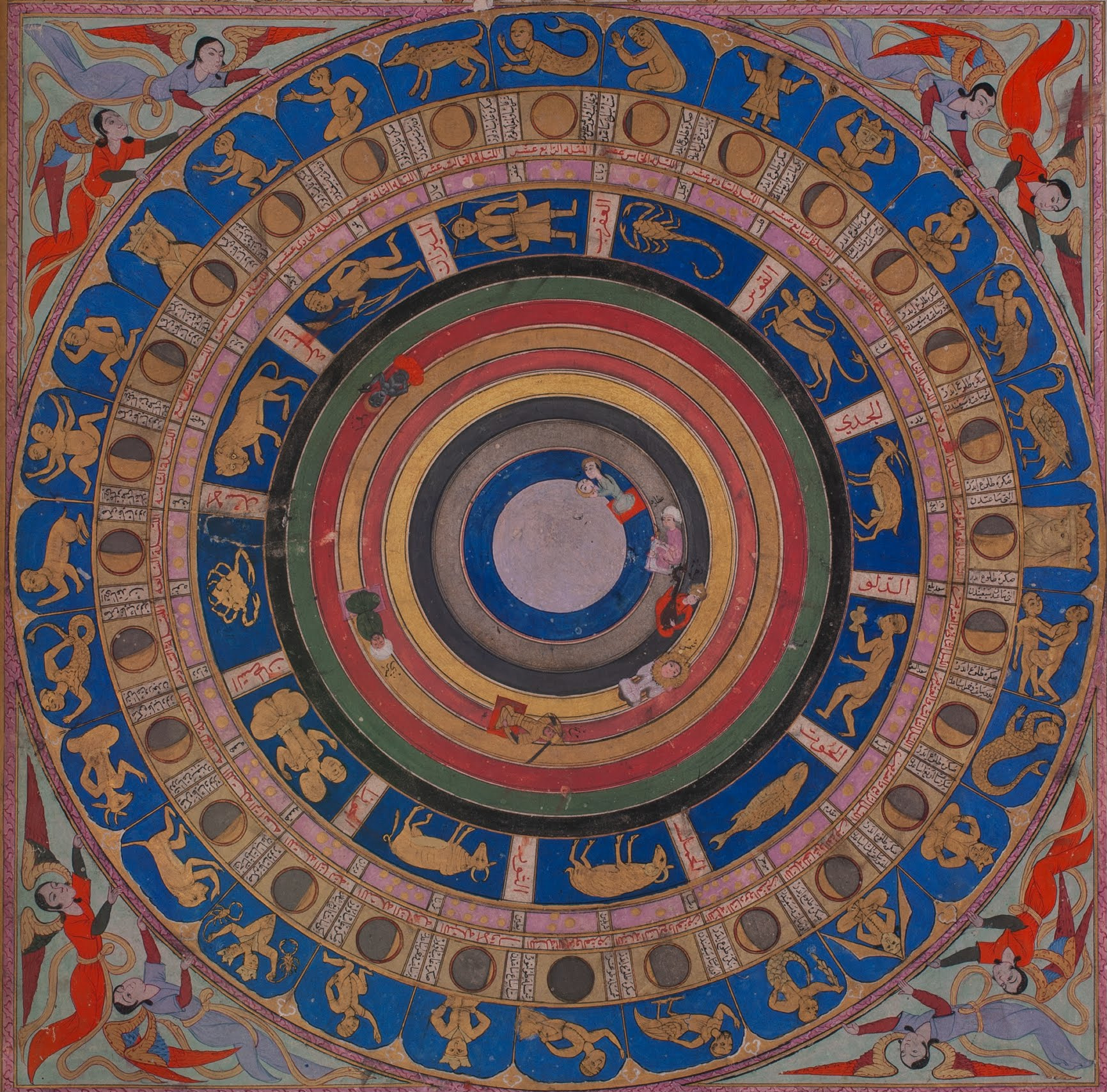
The system spread with the Arabic astronomical books: al-Farghani recounted the mansion list in the third century AH, and it became a reference in all later hay'a compendia 2. Books on anwā' and celestial phenomena recorded the judgment of each mansion, binding astronomy to daily life 1. With the spread of the Arabic language the mansion names reached Persia, Iraq, Syria and Egypt, becoming part of the shared astronomical vocabulary 1. In al-Andalus and the Maghreb the names survived in anwā' and astronomy books, and in the East in the hay'a compendia 1. On Ottoman and Mughal celestial charts the mansion names appear beside the zodiac signs 5.
What it was built on
The mansion system was built on two pillars: the Indian mansion system received earlier, and the Arabic anwā' asterisms to which each mansion was matched 1. It also rested on pre-Islamic Arab knowledge of the sky, which knew al-Sharatayn, al-Thurayyā and al-Dabarān and their seasons 1. This composition of Indian science and Arab knowledge is itself what marks Islamic civilisation: it does not transmit science as it is but reformulates it in its own language and culture 1. The mansions are distributed over the twelve zodiac signs, each sign containing one mansion or more.
What was built on it
On the mansions rose a whole heritage: books of anwā' giving each mansion a judgment on weather, health and temperament, and books of physiognomy reading the person from their natal mansion 1. In practical astronomy the mansion names remained in the astronomical tables and prayer times, for the Muslim in the desert knew the time from the Sun's altitude or the Moon's mansion 3. In fiqh practice the mansions served in computing the seasons of hajj, zakat and vows, binding worship to the sky 3. In old medicine the mansions were used in the temporal diagnosis of illnesses, each carrying a power and a season of the year. On Ottoman and Mughal celestial charts the mansion names appear beside the zodiac signs 5.
Impact on daily life
The system gave the Arabic calendar a unified astronomical frame: instead of a month being a mere count of days, each day had a stellar name and a lunar mansion 1. It bound popular star-knowledge to scientific computation: al-Sharatayn, known to the bedouin, became the first mansion in the astronomical table 2. In the house the farmer knew the time of sowing from the Moon's mansion: when al-Sharatayn rose he knew the new month had begun, and when al-Thurayyā set he knew the heat had grown 1. At night the farmer watched the Moon to know the time of watering and harvest, so the mansion became the 'calendar of the night' needing no paper. In the mosque the muezzin knew the time from the Sun's altitude or the Moon's mansion 3.
How it changed history
The system changed the shape of Arabic astronomical knowledge: it turned the stars from scattered folk knowledge into a unified scientific table taught in the schools 2 1. The mansion names remain in the astronomical tradition to this day, displayed on old celestial charts as the twenty-eight lunar mansions 5. Today historians of astronomy study how the system passed from India to Arabic and how al-Farghani shaped it. It is studied today in universities of Islamic history as a history of knowledge exchanged between cultures 1.
Who invented it?
One does not invent what one receives. The system came from India at an unrecorded date, the Arabs matched it to the Arabic anwā', and al-Farghani recorded it in the third century AH 1 2. The honest answer: the system 'existed' in Arab memory before it was written, and al-Farghani's role was to fix it in the scientific text. The question 'who invented the mansions?' is a modern question that does not match the nature of ancient science: knowledge was cumulative and collective, and names are recorded for documentation, not invention 1. Honesty requires saying: the Arabs did not invent the system but 'delivered it to the book'; al-Farghani was the faithful transmitter, not the inventor.
Today
The mansion names remain known in the Arabic astronomical tradition, displayed on old celestial charts as the twenty-eight lunar mansions 5. In museums and libraries old books of anwā' are preserved that explain each mansion 1. They are read today by researchers in the history of astronomy and Arab culture, not in living religious practice. In modern schools the mansion system is not taught, but it remains in books of the history and old astronomy of Islam, and in the names of streets and buildings that bear star names 1. In Arab museums copies of anwā' books and celestial maps bearing the mansion names are displayed 5.
Surviving examples
Al-Farghani in the 'Elements of Astronomy' names the twenty-eight mansions with their stars and risings and settings 4. In the Ottoman museum the celestial map 'Zubdat al-Tawarikh', dedicated to Sultan Murad III in 1583, shows the zodiac signs and lunar mansions on the same heavenly chart 5. In scattered anwā' books the judgments of each mansion on weather and health are preserved 1. Many copies of the 'Elements of Astronomy' survive in Arab libraries, and astronomical museums display maps of mansions and signs together 2 5. Kunitzsch's survey records the survival of old anwā' books explaining each mansion's judgments in the manuscript tradition 1.
In culture
The mansion names entered the folk imagination: al-Sharatayn is mentioned with births and harvests, al-Thurayyā with spring, and al-Dabarān with the storm 1. In Arabic poetry the star names serve as metaphors for time and place, so the lunar mansions became vocabulary in the Arab divan. In Sufi literature the mansions are mentioned in the jurisprudence of heaven and cosmos. In contemporary literature the star names are used in poetry and stories as symbols of Arab and Islamic memory 1. In modern education the star names are used in geography and astronomy textbooks for secondary schools.
For young readers
A thousand years ago, Muslim astronomers divided the sky into twenty-eight mansions the Moon passes through on its monthly journey, like stations on a road. Each has an Arabic name, like al-Sharatayn and al-Hut. Al-Farghani learned this list in his book, and it became a key for counting days and finding directions 2 1.
References
Connections
- Described by
- al-Farghani
People and things also explored
The seven climates· al-Farghani's eccentric-orb account· al-Farghani's table of epicycle radii· al-Farghani's criteria for planetary rising out of the sun's rays· al-Farghani's five-circular-motion composition of the Moon· al-Farghani's account of parallax in planetary positions· The sphericity of the heavens· The obliquity of the ecliptic
Sources
- Paul Kunitzsch, 'Lunar Mansions in Islam' , pp. 1242–1243
- al-Farghani, Elementa astronomica (Golius, Amsterdam 1669) , p. 53
- al-Farghani, Elementa astronomica (Golius, Amsterdam 1669) , pp. 36, 38
- al-Farghani, Elementa astronomica (Golius, Amsterdam 1669) , pp. 51–53
- Metadata for the Zubdat al-Tawarikh celestial map showing the zodiac and lunar mansions
- al-Farghani, Elementa astronomica (Golius, Amsterdam 1669) , pp. 36–53
Cite this page
islam.museum contributors. “The twenty-eight lunar mansions”. islam.museum, https://islam.museum/en/invention/manazil-al-qamar/. CC BY-SA 4.0. Last updated 2026-11-15.
Improve this page on GitHub · Report an error · Help complete it · JSON