

At a glance
- Era
- The Early Abbasid Caliphate
- Region
- Levant & Iraq
Images
Quick facts
- Domain
- Astronomy and its instruments
- Kind
- Method
- First attested
- ../0861
- Era
- Abbasid age
- Where
- Samarra
- Described in
- Elements of Astronomy (Jawami' 'ilm al-nujum)
- Attribution
- Transmission
Who made it
- al-Farghani Transmitter
The claim and its basis
Organised transmission of the circle-based lunar model from earlier astronomical traditions into an influential Arabic book, not a claim of new motions.
al-Farghani presents a five-circular-motion lunar composition inside a summary of Ptolemy's Almagest; Iranica describes the book as a summary of the Almagest.
Sources: al-Farghani, Elementa astronomica (Golius, Amsterdam 1669) · al-Farghani — Mahmut Kaya and Sami Selhub, TDV Islam Ansiklopedisi · Farghani, Ahmad b. Muhammad b. Kathir — Encyclopaedia Iranica · Commons — Lunar phase diagram
Before it
- Circle-based lunar models in Ptolemy's astronomy and earlier traditions
Built on it
- Arabic and Latin astronomical books that drew on the Jawami'
How it works
Summary
How did Muslim astronomers describe the Moon's path before telescopes? The answer given in al-Farghani's book "Compendium of the Science of the Stars and the Principles of Celestial Motions" (Jawami' 'ilm al-nujum) is a path built from five nested circular motions: the body itself circles on a small orb called the epicycle, the centre of that small orb circles on a larger eccentric deferent, the centre of the eccentric deferent itself circles on a small circle concentric with the zodiac, an inclined circle then carries the two lunar nodes, and finally the whole celestial sphere turns by the amount of the fixed stars' daily motion. This is the model al-Farghani set out in his chapters on the planets' motions in their orbs, inside his summary of the science of the spheres — an organised transmission of an older astronomical model, not a claim to new motions. 123
The record documents a transmitted computational method rather than an original invention: al-Farghani's book is a summary of Ptolemy's Almagest as described by the TDV and Iranica encyclopaedias, and its values and figures belong to the earlier tradition. Its museum value is that it marks a clear point of transmission: the organised Arabic text that carried this model to Muslim readers and then, through its Latin translations, into medieval European astronomy. 45
What it is
It is a geometrical method for computing the Moon's apparent position across time, built entirely on regular circles. In the Latin text al-Farghani explicitly enumerates five circular motions: first, the motion of the Moon's body on its epicycle, running from east to west when the epicycle's upper part is occupied and the reverse when the lower part is. Second, the motion of the epicycle's centre around the eccentric deferent, running from west to east. Third, the motion of the eccentric's centre on a small circle whose centre is the centre of the zodiac itself. Fourth, the motion of the inclined circle that carries the head and tail of the Dragon, that is the two nodes. And fifth, the motion of the whole sphere, equal in amount to the motion of the fixed stars in the day. 12
These motions are not independent of one another but interlocked: the turning of the epicycle's centre on the eccentric is what produces the Moon's large swings in distance and closeness to the Earth, while the inclined circle carries the Moon north and south of the zodiac, explaining the tilt of its apparent path. The small epicycle explains the Moon's uneven pace, since it moves faster when near and slower when far, as al-Farghani states explicitly. 3
The world before it
Astronomy in the ancient world had already reached a mature stage of circular modelling before al-Farghani. In the tradition of Ptolemy's astronomy and the earlier work of Hipparchus and his predecessors, the planets' anomalies were handled not by abandoning circles but by adding small circles and an eccentric orb until the calculations matched the rough observations. The Moon in particular suffered a known problem: its varying distance was larger than simple models could explain, so nested-circle schemes arose to reduce that discrepancy. 1
What marks al-Farghani's entry is that he presented this inherited model in organised scholarly Arabic, in a clear sequence within thirty chapters, and it became a reference for Muslim readers — and remained the channel through which the model reached Latin Europe in the Middle Ages. The model itself was not born with him, but his organised Arabic summary was a genuine intellectual event in the history of astronomical transmission. 45
The story
Muhammad ibn Kathir al-Farghani — sometimes given in the classical sources as Ahmad ibn Muhammad ibn Kathir, the name-chains differing in the reports — wrote his book on celestial motions in the milieu of the Abbasid caliphate. The TDV encyclopaedia records him among the leading mathematicians and astronomers of his age, serving under the caliphs al-Ma'mun, al-Mu'tasim, al-Wathiq and al-Mutawakkil; al-Mutawakkil is said to have entrusted him with building the new nilometer at Fustat, completed around 247 AH / 861 CE. Iranica describes him as flourishing at Samarra when it served as the Abbasid capital. 67
In this setting he composed his book in thirty chapters; Ibn al-Nadim called it "The Chapters: a Selection from the Almagest" in his Fihrist, while the Latin publisher in Golius's 1669 edition titled it "On the Celestial Motions and the Compendium of the Science of the Stars". The chapters concerned with the motions of the heavenly bodies are distributed through the book: chapters on the description of the orbs and their motions, a chapter on the planets' revolutions in their orbs, chapters on the lunar mansions and phases, alongside chapters on ascensions, risings and eclipses. 8910
The maker(s)
The name attached to this record is al-Farghani himself, in the role of "transmitter" rather than "inventor": he does not claim in the text to have invented the motions but arranged the inherited model and expressed it in Arabic. Our museum duty here is to record his attribution as it stands: a documented computational method received from earlier astronomical traditions, carried by an influential Arabic book to its Muslim readers and then to European astronomy. This satisfies the museum's strict condition: the Muslim identity is documented by a cited basis, and the documented Muslim contribution is organised transmission, not original creation. 116
There are no other partners in the record: the book is a single-author work attributed to al-Farghani in the sources we read, and the Latin translation in Golius's edition is the work of Jacob Golius, the Dutch orientalist who collated the Arabic text and annotated it — a translator and editor, not a partner in the astronomical content. 124
How it works
The central idea is that the Moon's apparent motion is not one motion but a set of interlocking circular motions, each with its own centre, speed and direction. The Moon's body circles on the small epicycle, and this epicycle itself circles on the rim of the eccentric deferent, and this eccentric in turn wobbles around the zodiac's centre on a small circle; the inclined network carries the Moon alternately north and south of the zodiac line, and finally the whole sphere's daily rotation drags everything along. 23
Each motion has an effect that can be matched to observation: the epicycle's motion explains the Moon's varying speed, the eccentric's motion explains its changing nearness and farness, the small circle's motion explains the Moon's path deviating from the zodiac line now north, now south, the inclined circle's motion carries the two nodes along the zodiac over roughly eighteen years in the comparable astronomical tradition, and the whole-sphere motion represents the daily rotation shared by all the bodies. 23
The spread
The book did not remain in Arabic alone. TDV records two medieval Latin translations: one attributed to Johannes Hispalensis in 1134 and another to Gerard of Cremona in 1175, then a Hebrew translation by Judah Anatoli in the mid-thirteenth century, then Golius's Arabic-Latin edition in Amsterdam in 1669 and Sezgin's facsimile in 1986. Through these translations the book became "indispensable" for European astronomical study from the twelfth century to the end of the fifteenth. 13
The encyclopaedia also notes that scholars such as Robert Grosseteste in his Summa philosophiae cite Ptolemy through this very book, and that the references to astronomy in the works of thirteenth- and fourteenth-century Italian astronomers such as Ristoro d'Arezzo, and Dante's thinking in the Convivio, rest on the same source. 14
What it was built on
The whole record rests on al-Farghani's summary, which is itself a condensation of the book called the Almagest attributed to Ptolemy of Alexandria. al-Farghani's book does not present a new lunar model of his own but organises what circulated in the Arabic-Greek astronomical tradition before his time. The internal evidence in the text points the same way: phrases such as "as we have shown" and "we have mentioned" indicate reliance on earlier foundations, and the book's value lies in its ordering, not its invention. 41
At a deeper level the model stands on the circle itself: the nested-circle scheme assumes that celestial motions are regular circles, an assumption inherited by all ancient astronomy and untouched by al-Farghani. 1
What was built on it
Built on this record is a long history of the model's absorption: later Arabic astronomical books that relied on the Jawami' or on what branched from it, the medieval Latin astronomical books that depended on the Hispalensis and Cremona translations, and then the European astronomical debates that tested the model against observation. The lunar chapters in particular served as reference for calendar computation and eclipse timing in traditions that estimated positions by circular reckoning. 141
This does not mean every later book took its five motions in the same wording; the influence operated at the level of the general system, not line by line. 14
Impact on daily life
These motions were not dry theory alone; they were the computational structure on which people's knowledge of time was built: the seasons of the year, the times of prayer and the seasons of worship, predictions of eclipses, and the watching of the Moon through the months of the Islamic calendar. In this model the Moon is not merely a beautiful body in the sky but a complex celestial clock, and every error in the composition of its motions reflected on the calculation of dates. 13
In the daily life of farmer, jurist and judge alike, knowing the Moon's position on its path meant knowing the seasons of sowing and the periodic phenomena; the book that carried this model was in essence an instrument for organising public time before precise clocks existed. 10
How it changed history
This record changed history not by inventing but by its position in the chain of transmission: al-Farghani's book was the textual bridge across which the Ptolemaic lunar model passed into Arabic and then into Latin. Before its translations the model stayed within the circle of specialists in Arabic and Greek; afterwards it became part of the European astronomical curriculum for centuries. The encyclopaedic evidence is that the book is described as "indispensable" and as the most influential Muslim work on the scientists of medieval Europe in the context of astronomy. 14
This assessment does not mean the model itself was physically correct; it remained Earth-centred with circular motions until the mechanics of Copernicus, Kepler and Newton. The record's value is that it documents how this model lived in Muslim and European scientific consciousness for a long time. 14
Who invented it?
The honest answer in this record: al-Farghani did not invent the Moon's five motions, and no one in the Islamic world did; they are a circular structure inherited from earlier Greek-Indian astronomical traditions, which al-Farghani carried into Arabic in a more orderly system. What he actually did was "ordered arrangement and transmission": he selected the five motions from earlier astronomical materials, arranged them in a logical sequence, and explained each one's role. 25
Nor do we know today, with certainty, the name of the first inventor of the circular lunar motions; ancient astronomy accumulated on itself, and circular motion was the language of all astronomy before anyone claimed it. That is why the record is classed "transmission", not "creation". 4
Today
Today no astronomer uses this model to compute real positions; modern lunar calculation rests on precise celestial mechanics, laser ranging and artificial satellites. But the model has not died completely: it is still taught in the history of astronomy as the first comprehensive "engineered" lunar model in the Ptolemaic-Islamic tradition, and displayed in science museums and histories of astronomy as a picture of a particular astronomical way of thinking at a particular time. 14
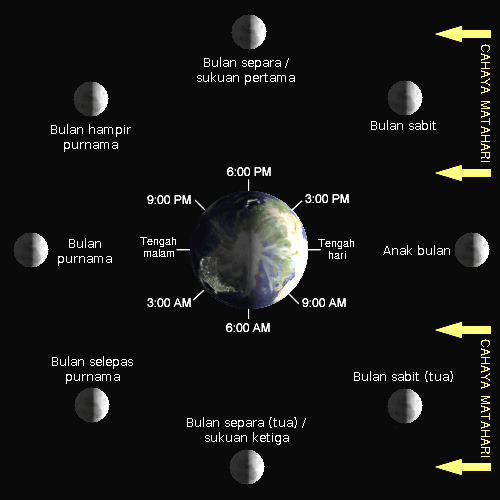
The image accompanying this record — a modern lunar-phase diagram — shows the same phenomenon (the Moon circling Earth, its phases changing) rather than the historical model; its purpose is to connect the visitor between what they see in the sky and what was computed in the old books. 15
Surviving examples
The direct surviving witness is the printed text itself: Golius's 1669 edition, which preserved the Arabic text and the Latin translation together, and whose relevant chapters were read for this record. Among indirect witnesses are the Latin translations that made the book a reference in European astronomy until the fifteenth century, and Sezgin's facsimile edition of 1986. There is no artefact in the museum of the kind "al-Farghani's instrument", because the work was a book, not an instrument; but the printed book is the surviving intellectual machine. 1213
In culture
The model entered Muslim scientific consciousness through the Jawami' as "al-Farghani's book", which became synonymous with teaching astronomy; even those who never read the Almagest read its summary. In European culture the book remained a witness that medieval astronomy was not purely Greek but had passed through an organised Arabic translation. 14
In contemporary heritage al-Farghani is named in lists of great Islamic astronomers alongside al-Battani, al-Khwarizmi and al-Farisi, though he lacks the popular fame some of them gained because his role was "transmitter" rather than "originator". 166
For young readers
Imagine you hold a small ball (the Moon) and place it on the rim of a big wheel, then you turn the wheel slowly, then you tilt the whole wheel around another centre, then you incline it a little — that is how old astronomers "drew" the Moon moving! It was not a real picture of the Moon's motion but an old way of calculating: circles upon circles upon circles until the answer came out close to what we see. 2
Al-Farghani did not invent these circles, but he wrote them clearly in an Arabic book that became very famous, until it was translated into Latin and stayed a reference in Europe for five hundred years. 13
References
- al-Farghani, Jawami' 'ilm al-nujum, Golius edition 1669, PDF pages 182, 185–186 for the lunar composition, and pages 5, 10 and 133+ for title and index.
- Mahmut Kaya and Sami Selhub, "FERGANI", TDV, biography, work and transmission of the book.
- Encyclopaedia Iranica, FARGHANI, "Muslim astronomer" classification and chapter plan of the book.
- Lunar phase diagram, Jiaminglimjm, CC BY-SA 3.0, modern contextual image.
- al-Mas'udi, Muruj al-dhahab, al-Farghani among those who studied the science of the spheres, p. 519.
Connections
- Transmitted by
- al-Farghani
- Described by
- Elements of Astronomy (Jawami' 'ilm al-nujum)
People and things also explored
The seven climates· al-Farghani's eccentric-orb account· al-Farghani's table of epicycle radii· al-Farghani's criteria for planetary rising out of the sun's rays· al-Farghani's account of parallax in planetary positions· The sphericity of the heavens· The twenty-eight lunar mansions· The obliquity of the ecliptic
Sources
- al-Farghani, Elementa astronomica (Golius, Amsterdam 1669) , p. 182
- al-Farghani, Elementa astronomica (Golius, Amsterdam 1669) , p. 185
- al-Farghani, Elementa astronomica (Golius, Amsterdam 1669) , p. 186
- al-Farghani — Mahmut Kaya and Sami Selhub, TDV Islam Ansiklopedisi , work
- Farghani, Ahmad b. Muhammad b. Kathir — Encyclopaedia Iranica , chapter plan
- al-Farghani — Mahmut Kaya and Sami Selhub, TDV Islam Ansiklopedisi , biography
- Farghani, Ahmad b. Muhammad b. Kathir — Encyclopaedia Iranica , biography
- al-Farghani, Elementa astronomica (Golius, Amsterdam 1669) , p. 5
- al-Farghani, Elementa astronomica (Golius, Amsterdam 1669) , p. 10
- al-Farghani, Elementa astronomica (Golius, Amsterdam 1669) , index
- Farghani, Ahmad b. Muhammad b. Kathir — Encyclopaedia Iranica , classification
- al-Farghani, Elementa astronomica (Golius, Amsterdam 1669) , preface
- al-Farghani — Mahmut Kaya and Sami Selhub, TDV Islam Ansiklopedisi , transmission
- al-Farghani — Mahmut Kaya and Sami Selhub, TDV Islam Ansiklopedisi , reception
- Commons — Lunar phase diagram , description
- Muruj al-Dhahab — al-Masʼudi , p. 519
Cite this page
islam.museum contributors. “al-Farghani's five-circular-motion composition of the Moon”. islam.museum, https://islam.museum/en/invention/farghani-lunar-five-motions/. CC BY-SA 4.0. Last updated 2026-11-15.
Improve this page on GitHub · Report an error · Help complete it · JSON