

At a glance
- Era
- The Umayyad Period · The Early Abbasid Caliphate · The Buyid, Fatimid and Seljuk Era · The Crusades, Ayyubids and Mamluks
- Region
- Levant & Iraq · Persia & Central Asia · al-Andalus & Europe
Music and its permissibilityTranslation and transmissionLiterature
Quick facts
- Domain
- Music and instruments
- Kind
- Instrument
- First attested
- c. 900 CE · c. 287 AH
- Era
- Abbasid age
- Where
- Cordoba
- Attribution
- Transmission
Who made it
- Ziryab Transmitter
The claim and its basis
Documented: the instrument and its name carried to Europe; no invention of the oud itself — the Sasanians knew the barbat before Islam, and the Muslim role was refining the instrument (wooden belly, frets, plectrum) and carrying it west.
EI2: the Arabic name entered the European languages (alaude, liuto, luth, lute, Laute), and the Sasanian barbat precedes the Arab oud; Farmer: the derivation of lute, rebec and guitar from al-ʿūd, rabāb and qītāra is lexicographically established, and minstrels spread the new fretted instruments.
Sources: Encyclopaedia of Islam, 2nd edition (Leiden: Brill, 1954–2008), 13 volumes · Farmer, Historical Facts for the Arabian Musical Influence (1930) · Farmer, Studies in Oriental Musical Instruments (1931)
Before it
- The Sasanian barbat
- The mizhar, kiran and muwattar
Built on it
- The European lute and the Andalusi luth
- The guitar, pandore and rebec of Europe
How it works
Summary
The lute that filled European courts from the thirteenth to the seventeenth century is the Arabic oud under a borrowed name — and the name itself confesses it: al-ʿūd, Arabic article and all, became Spanish alaude, Italian liuto, French luth, German Laute and English lute. Farmer calls the derivation 'an established fact' {cite:farmer-historical-facts-arabian-musical-influence-1930; encyclopaedia-of-islam-2}.
What it is
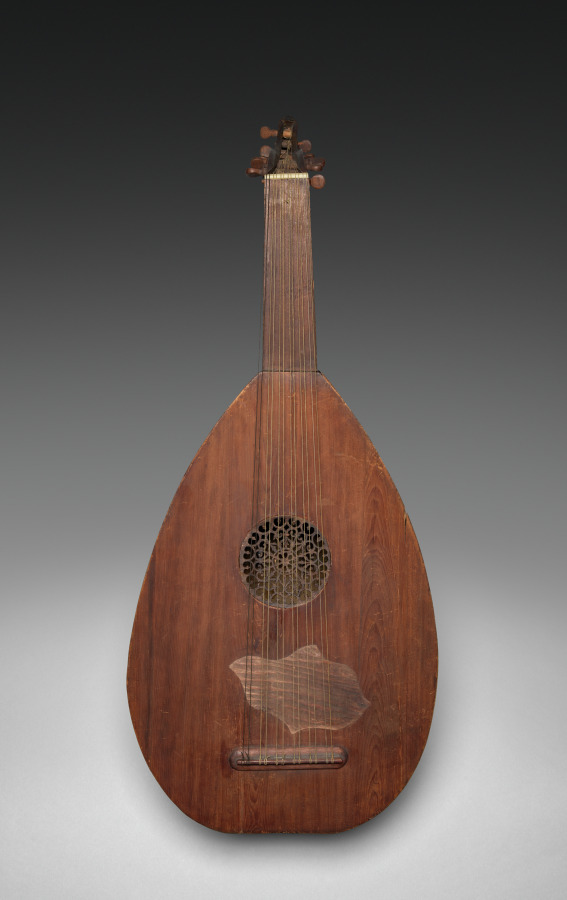
The oud is a short-necked, pear-shaped lute played with a plectrum — the most important instrument of Islamic peoples, in EI2's phrase, from the Atlantic to Persia. Its transmission to Europe was a double event: an instrument and a word travelling together 2.
The world before it
Europe of the early Middle Ages had the cithara and the harp — open strings, no frets, tuned by ear alone. The deeper lute family was already old in the East: undoubted lutes appear in Indian sculpture of the second century BCE, and Sasanian Persia played the barbat, the skin-or-wood-bellied ancestor EI2 distinguishes from the Arab oud proper 2.
The story
The refined wooden-bellied oud emerged in early Islamic Iraq — a two-stringed lute is already named in seventh-century sources, and the classic four-and-five-stringed instrument was perfected in the Abbasid capitals. The decisive westward step came through al-Andalus: Ziryab, the celebrated musician who left Baghdad for Cordoba in 822, carried the Baghdad school, its tunings and its technique into the Islamic west {cite:encyclopaedia-of-islam-2; farmer-historical-facts-arabian-musical-influence-1930}. From there, and later through Crusade-era contact, the instrument and its name moved north with the wandering minstrels Farmer credits as the real disseminators of medieval music 3.
The maker(s)
No maker — a transmission has carriers, not inventors. Ziryab is the documented figurehead of the Andalusi channel; behind him stand the Abbasid lutenists — Ishaq al-Mawsili and his school — who made the oud the master instrument of Baghdad, and behind them the anonymous players who turned the Persian barbat into the Arab oud 2.
How it works
A vaulted wooden body separate from its neck, a pegbox bent back, gut or silk strings stopped against a fingerboard — with frets (dasatin) fixing the notes, where the European cithara had none. The player strikes with a quill plectrum; the tuning (the accordatura) was a science of its own, recorded by al-Kindi, Ishaq al-Mawsili and al-Farabi {cite:encyclopaedia-of-islam-2; farmer-oriental-musical-instruments-1931}.
The spread
Through Muslim Spain and the minstrel circuits into France, Italy, Germany and England; through Sicily and the Crusading contact-zone as a second door. By the thirteenth century the lute is painted in the Cantigas de Santa Maria; by the fifteenth it is the court instrument of Europe; by the sixteenth it fills printed lute-books — Farmer notes the printed tutor for the luth (1557) identical in method to the guiterne's 3.
What it was built on
The Sasanian barbat — its name folk-etymologised as 'duck-breast' — and the older Arab skin-bellied lutes the poets called mizhar, kiran and muwattar. The wooden belly, the separate neck and the fret-map were the Islamic refinement {cite:encyclopaedia-of-islam-2; farmer-oriental-musical-instruments-1931}.
What was built on it
The whole European lute family: the Renaissance lute with its added bass courses, the theorbo and archlute, the mandolin; and by cousinly descent the guitar (Farmer keeps the guitar's route an open question) and the rebec from the rabab 3.
Impact on daily life
In the Muslim world the oud was the sound of courts, salons and taverns — and of music theory, since its frets made intervals visible and tunings teachable. In Europe the lute did the same work: it became the household instrument, the accompanist of song, the tool every educated amateur was expected to hold 3.
How it changed history
It is one of the clearest cases where a whole word-and-object package crossed a civilisational border. Europe did not merely adopt an instrument; it adopted the fretted, mode-tuned way of making music that came with it — and kept the Arabic name as a permanent receipt 3.
Who invented it?
Not one people. India shows early lutes; Sasanian Persia perfected the barbat; the Arabs refined the wooden oud and theorised its tunings; Europe received the finished instrument through al-Andalus and the Crusade-era East. Farmer's verdict is precise: we owe the Arabs 'the instruments themselves' for lute, rebec and (perhaps) guitar — and the words beyond question 3.
Today
The oud never left home: it remains the central instrument of Arab, Turkish, Persian and Armenian music. The lute returned in Europe's early-music revival, and its modern descendants — guitar and mandolin — are the world's commonest instruments 2.
Surviving examples
Historical ouds survive in museum collections — the record's image is a late West Asian oud photographed by the Cleveland Museum of Art — and lutes fill European instrument museums; medieval depictions in the Cantigas manuscripts show the instrument mid-journey, played by Muslim and Christian musicians side by side 2.
In culture
The oud is the instrument of the legendary singers of the Kitab al-Aghani and of the modern masters — the 'sultan of instruments'. In Europe it became the lutenist of Shakespeare and the painted companion of Vermeer: two cultures sharing one instrument and one name 2.
For young readers
Say the word slowly: al-oud. Now say it the way Spanish heard it — alaude — and the way English ended up saying it: lute. The instrument in the old paintings of European kings is the same instrument still played in Cairo and Baghdad today. A word and a lute travelled together from Cordoba, and neither ever went back.
References
- Encyclopaedia of Islam, 2nd ed., vol. X, 'UD part II (in music), printed pp. 769-771 2.
- H. G. Farmer, Historical Facts for the Arabian Musical Influence (1930), chapter 'Arabian Influence on Musical Instruments', pp. 135-138 3.
- H. G. Farmer, Studies in Oriental Musical Instruments (1931), lute-family studies 4.
Connections
- Transmitted by
- Ziryab
People and things also explored
Ziryab's reported fifth oud string· Cordoba· Ulayya bint al-Mahdi· Ziryab· Kitab al-Hayawan (The Book of Animals)· Anugerah Industri Muzik· BBC Radio 3 Awards for World Music· Billboard World Albums
Sources
- Encyclopaedia of Islam, 2nd edition (Leiden: Brill, 1954–2008), 13 volumes , vol. X pp. 769-771 'UD (II); farmer-historical-facts-arabian-musical-influence-1930 p. 137
- Encyclopaedia of Islam, 2nd edition (Leiden: Brill, 1954–2008), 13 volumes
- Farmer, Historical Facts for the Arabian Musical Influence (1930)
- Farmer, Studies in Oriental Musical Instruments (1931)
Cite this page
islam.museum contributors. “The transmission of the Arabic oud to Europe as the lute”. islam.museum, https://islam.museum/en/invention/oud-transmission-to-lute/. CC BY-SA 4.0. Last updated 2026-11-15.
Improve this page on GitHub · Report an error · Help complete it · JSON